
History
Translating the epic
The Kutar brothers sacrificed time and money, and with great effort succeeded in translating Firdausi's Shahnamah into Gujarati
"If Firdausi did not make any money on his Shahnamah why should I?” thought Faramarz Kutar who with his brother Mahiar toiled for 10 years to translate the epic into Gujarati.
In those early days, Faramarz had made up his mind to sell each volume at two rupees per copy or 20 rupees for the 10-volume set. But no one had anticipated the outbreak of World War I, which led to an increase in the prices of all commodities including paper and printing ink. The printers agreed to print the volumes if their price was increased to seven rupees per volume but Kutar refused since he had already made up his mind that his work should reach all in the community at two rupees per volume, reminisced his granddaughter Dinaz Kutar Rogers in an article published in the FEZANA Journal ("Such is the stock I am made of,” Fall 1997).
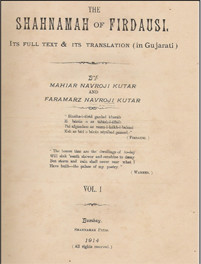
As though by divine intervention he came to know of an old defunct printing press, which he purchased and named the Shahnameh press. Starting off on a jubilant note, volume one was printed there in 1914. True to his word Kutar sold the first work for two rupees per volume and suffered a loss of over Rs 5,000. This was a large sum of money in 1914 but thanks to the herculean efforts of the Kutar family the precious Shahnamah was available to the Zoroastrian community in its Gujarati version. By the time the 10th volume was printed four years later, the pricing situation had changed drastically and Kutar was compelled to raise the price.
The decision to translate the Shahnamah into Gujarati was taken by Faramarz or "Motabawaji” as he was affectionately called by his family, when Zarathushtis urged him, "Dasturji, with your command over both Farsi and Gujarati, you will be performing a great service to the community by translating the Shahnamah from Farsi to Gujarati. If this is not done this great epic will be lost to our Zoroastrian community.” Motabawaji, without any further delay set about executing the monumental task of translating the epic. After performing their daily duties, Faramarz and Mahiar would devote hours to studying, reading and making notes by hand. They scrupulously learnt all they could about the great epic as narrated by Firdausi.
At the same time, Faramarz studied various translations in other parts of the world. He noticed that in northern India and Kashmir, the translation was popular in the Urdu language. In Iran and its surrounding regions, as recounted by Sir Henry Laird in his travelog, little children would weep at the narration of the tales from this extraordinary epic. Faramarz and Mahiar approached K. R. Cama of the Cama Oriental Institute for borrowing the 10-volume French translation of the epic by the German Orientalist Julius Mohl. Unfortunately Cama turned down their request since the volumes were a part of his private collection. Disappointed but determined not to give up, they continued their work with extra zeal.
As if in answer to their prayers, soon after the refusal from Cama, Faramarz sighted an advertisement offering the said Mohl translations for sale. He immediately purchased the volumes. While the brothers looked up reference books and other available information, all the family members helped in some way or the other.
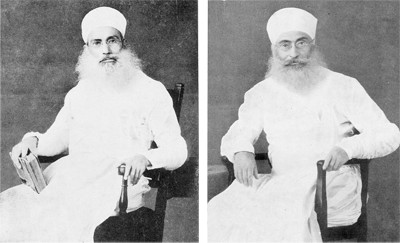
The illustrious brothers Mahiar (left) and Faramarz Kutar Photo: Parsi Lustre on Indian Soil
On completion of the translation the brothers had to cross another hurdle. They did not have the means or the knowhow to publish this vast work. On hearing of their hard work, perseverance and single-minded devotion Meherji Behramji Dotiwala, a Parsi scholar and a devout Zoroastrian came to their help, without whose aid this epic would not have reached the community. It must be mentioned that other stalwarts came forward to help. Among them was Jivanji Modi, a leading scholar of his time, who wrote a vibrant six-page forward, which is worth reading.
When working on the translation Faramarz would remind himself of the travails of the original author of these exalted tales, a humble poet called Firdausi of pre Islamic Iran. He is considered to be one of the greatest Persian poets to have ever lived. He wrote this epic of Iran in true classical Persian, using minimal Arabic words. Firdausi was born in Tus in the Iranian province of Khorassan and he took about 30 years to complete the 60,000 couplets in 1010 AD. This labor of love had adversely affected his health, at the same time leaving him in an impoverished state.
The ruler Sultan Mahmud of Ghaznavid had promised Firdausi a treasure in gold coins and 7,000 dinars on completion of his epic poem. But a treacherous minister thwarted his expectation, assuming that the poor poet did not understand the value of his work. He substituted a chest full of silver coins instead of the promised gold. Disappointed and grieved at this deceit, the embittered poet died in 1020 AD. Meanwhile the king was troubled by his conscience and he hastened to send the promised payment of gold to Firdausi.
But alas as the caravan of 12 camels carrying the gold was nearing the poet’s home, Firdausi’s funeral procession was heading the other way from the Gate of Razan to the cemetery. Though he faced personal hardships and sacrifices when alive, his work Shahnamah immortalized him and bestowed him with great fame and honor.
◆ ◆ ◆
From the archive