
Books
Great kings
The Religion of the Great Kings by the Right Rev Dr L. C. Casartelli. Reprinted in 2005 by The K. R. Cama Oriental Institute, 136, Bombay Samachar Marg, Bombay 400001. Pp: 24. Price: Rs 50.
Books are our most precious heritage — yes, much more than heritage buildings — as they preserve for the benefit of the future generations, our ancient history, culture, knowledge and civilization. Posterity has to be grateful to institutions and individuals who help preserve out-of-print rare books and manuscripts. All kudos to them. Great credit to the The K. R. Cama Oriental Institute (KRCOI) for the vision in continuing its progressive policy of reprinting selectively such rare books.
Printing books, magazines, etc have become prohibitively costly. The Institute — and the vast reading public — owe a deep debt of gratitude to the Zartoshty Brothers (Faridoon and Mehraban) Fund for their magnanimous donation for reprinting such rich heritage.
The London based Catholic Truth Society had a splendid record of organizing lectures on The History of Religions. "The Religion of the Great Kings” was one such lecture delivered at the University of Manchester by the Right Rev Dr L. C. Casartelli, Bishop of Salford. The lecturer refers to the great kings of the Achaemenid dynasty and adds, "Most of these kings have left inscriptions, cut in the solid rocks, narrating the various exploits of their reigns, and incidentally containing no small amount of information concerning their religious beliefs.” The Bishop then refers to the Avestan literature and adds, "it is impossible to identify absolutely the Mazdeism of the Avesta with the Mazdeism of the inscriptions... The Avesta knows nothing of these great Persian monarchs Cyrus, Darius, Arta-Xerxes and the other names so familiar in history of the Achaemenid dynasty. The Bishop then emphasizes that though in the Avestic system and in the sacred books, Zarathushtra is mentioned frequently, "yet in the whole range of the royal inscriptions, there is not the slightest allusion, in any shape or form, to the existence of the Prophet.”
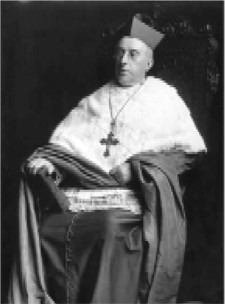
Casartelli: love for Avestic studies
He emphasizes that whilst the exact dates of the royal inscriptions are accurately known, that of the Avesta are not. He further clarifies that "it was the great Darius who first introduced the monotheistic form of religion into Persia proper as a state religion, displacing the preexisting paganism or nature worship.” Referring to Herodotus, the lecturer emphasizes, "Moreover, the Greek writer expressly states that falsehood was in the eyes of the Persians the greatest of sins, and likewise mentions their horror of defiling rivers.” He further clarifies that "these great monarchs were in the habit of inscribing records of their reigns and especially of their wars and conquests in great inscriptions deeply chiselled on the face of mighty rocks, which had been planed and smoothed for the purpose.” It was the Englishman Rawlinson who copied these inscriptions accurately at the risk of his life in 1835. The German scholar Grotenfeud first discovered the key to their interpretation.
The learned Bishop then emphasizes that the great kings were fond of repeating in their rock inscriptions the specific mention of "Auramazda.” In fact, this name is met with at least 114 times, and frequently twice or thrice in the same sentence.
The English version of some of the rock inscriptions given in this interesting booklet will interest Parsiana readers. I reproduce below some of them:
Auramazda is the great God.
By the will of Auramazda, I am king.
By the will of Auramazda, these nations have become my slaves and my tributaries.
Auramazda has invested me with sovereign powers.
Auramazda delivered (the enemy) into my hands.
Everything that I have done, I have done, without exception by the will of Auramazda.
I would end the quote by referring to the prayer of Darius: May Auramazda protect this land from the hostile inroads from bad harvests and from lying.
This booklet (24 pages) is interesting and also absorbing. A Bishop is busy with his multifarious duties. That he should continue his love for Avestic studies and delve into ancient Iranian history speaks volumes for his scholarly approach to the study of the history of religions.
Capt Hormazdiar J. M. Desai
◆ ◆ ◆
From the archive