
Institutions
“At the right time...”
The new World Zoroastrian Organisation Sanatorium at Sanjan provides a new holiday venue for the community
The ornate gate swings open, revealing a well-kept one-storeyed bungalow at the end of the drive. Like a hospitable maharaja the WZO (World Zoroastrian Organisation) Sanatorium stands in the center of the 4.5 acre property, welcoming Zarathushtis to stay awhile to ponder on their life in India, in full view of the Stambh next door which commemorates their legendary landing at Sanjan.
The two-way drive, with a children’s playground on one side and a sheltered car park on the other, circumscribes a garden, still amaking, of color-edged lawns and flowering shrubs. The portico-shaded front steps lead to a lounge simply furnished in vintage wooden furniture around an octagonal marble topped tile-encrusted table — a prototype that served the needs of innumerable Parsi households for generations.
To one side of the lounge opens the dining area with the kitchen further away; on the other are the manager’s office area with passenger accommodation beyond. On the floor above are two three-bedded rooms on either side of the large room above the lounge. Each of these side rooms is equipped with a spacious, freshly-tiled bath and toilet with running water. Each bathroom is actually one half of the originally enormous common bath between two rooms in each wing. There being no provision for similar facility for the central room, it is therefore only given out when large groups can avail of bath and toilet facilities through the interconnected room on either side, explains Bachi Tamboly who has nursed this WZO project with single-minded concentration. Rear terraces on either end of the first floor corridor are provided with gas geysers for bucket baths and well-laid lines for guests to dry their towels and clothes in the open sunshine without cluttering their rooms and baths.
The only things new among the furnishings are the mattresses, the linen, the curtains and plastic chairs as all the furniture has been donated by well-wishers, say WZO Trust managing trustee Dinshaw Tamboly and his wife Bachi. One Calcutta-based WZO sympathiser told them to avail of whatever they wished from his old bungalow in Saronda, so Bachi says she happily transported almost everything it contained to furnish the Sanatorium in a style befitting the period structure with a little help from the carpenter and finishing touches by the polishwalla. There is a cable connection in each room and three TV sets are available for hire at Rs 25 per day by the community’s holidaymakers. Bombay’s Taj Mahal Hotel has donated the crockery, cutlery and kitchen utensils.
Lodging at the WZO’s Sanjan Sanatorium works out at Rs 50 per person per day. Linen (i.e. bedsheets, pillow cases and bed covers plus bath towels) costs an extra Rs 30 per head per week. The use of the car park costs Rs 20 per day per car. To ensure responsible behavior from its guests, the WZO charges Rs 750 as deposit per room, refundable in whole or part to cover breakages, etc, says Bachi. The cost of breakage is clearly delineated behind the receipt.
Manager Dadi Dordi and his wife Kuma look after the boarding aspects of the Sanatorium. Rs 125 per person per day covers the cost of three meals including a breakfast of two eggs made to specifications and bread — no butter, jam or cheese; lunch consisting of a single rice dish; and dinner comprising a lentil plus a vegetable dish with mutton or chicken. They also undertake catering jobs for short-term residents at the various Mazda apartments in the neighborhood.
Dordi’s checkered career began with a six-month stint in the police in the latter half of the 1940s which he says he gave up because his parents did not approve of the job. The son of a carding master, Dordi worked for three years with Bombay Dyeing’s waste planning department and then as a clerk ere he quit to set up a business partnership which crumbled. As manager of the WZO Sanatorium he and Kuma may have found their own niche. Of their three children, Shernavaz is a receptionist with consultant physician Kekobad Mody, Dinaz Karbhari is settled with her family in Abu Dhabi and son Khurzand is employed in Dubai.
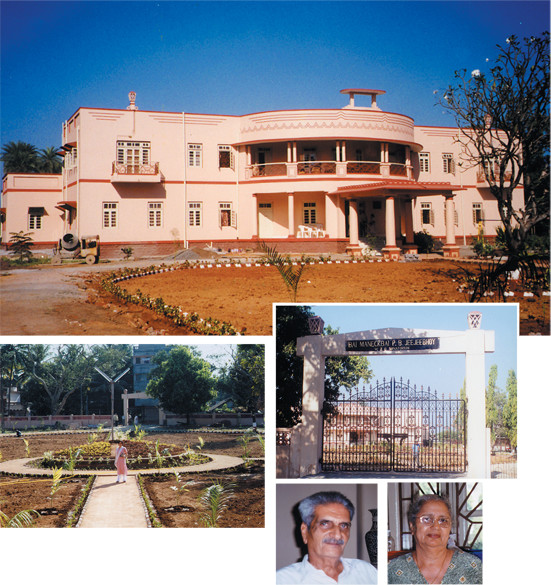
Clockwise from top: the frontage of the Sanatorium (Photo: Simin J. Patel); its ornate wrought iron gate (Photo: Homyar J. Mistry, Homz Prints); Kuma and Dadi Dordi and fresh planting in the garden (Photos: Arnavaz S. Mama)
One of many Parsi properties for sale in the area being snapped up by sister communities, this Hormasji Davierwalla bungalow saw a change of user thanks to the vigilance of solicitor Burjor Antia and scholar Dr Homi Dhalla. When Antia and Dhalla became aware of the overtures of other communities to acquire the dilapidated structure lost in the midst of a jungle of overgrowth, they approached the Bai Maneckbai P. B. Jeejeebhoy Trust (BMJT) in an effort to rouse them into acquiring the property instead.
Not willing to involve itself in the nitty-gritty of running an establishment, BMJT offered the funds to buy the property if the WZO (then in the throes of setting up the BMJT-funded Senior Citizens Centre in Navsari) was willing to set up and run an institution fulfilling the current needs of the community.
The Tambolys agreed to shoulder the burden and the property was acquired in 1997 with a grant of Rs 70 lakhs from the BMJT, of which Rs 66 lakhs went toward the purchase (including stamp duty) with the balance used for repair and maintenance.
When the Senior Citizens Centre in Navsari garnered so many plaudits, the WZO initially toyed with the idea of setting up a counterpart in Sanjan. However, the lack of medical facilities in the locality deterred them, says Dinshaw and for two years the property lay fallow until it was decided to establish a sanatorium with modern conveniences. The project did not evoke the spontaneous response of smaller donors.
"Only the outer shell of the bungalow remains,” says Dinshaw. The flooring had sunk and had to be totally redone. The roots of the overgrown wild trees had undermined the foundation and the property required more than cosmetic repair, they indicated. The Tambolys also noted that they were united in the intention to start on the project only after the necessary funds were available, which took between two to three years of fund-raising.
Much of the professional help they needed came voluntarily and without charge which the Tambolys note with much gratitude and the barest hint of pride. Agriculturist Farrokh Kassad and forest conservator Phiroze Panthaky advised the clearance of the old overgrown trees which were of no worth whatsoever. With the necessary official permission they have been replaced in the rear grounds with 140 mango and coconut saplings whose revenue in time to come will help sustain the institution. The front garden planned by Dr Rohinton Avari was a later addition for which no funds had been allocated. Then, a Parsi lady passing through after the Sanatorium had been inaugurated in September 2001 chose to donate towards it, notes Dinshaw. The structural repairs and renovations were overseen by Navsari architect Jayant Mehta and builder Yezdi Kassad, also of Navsari, supervised the construction free of cost. Similarly photographer Homyar Mistry refused to charge for the preinaugural assignment. When more than 50 truckloads of soil had to be brought in for the garden, it was the Muslim contractor, overseeing the construction of the compound wall, who arranged it, acknowledges Bachi.
The BMJT has contributed a further Rs 7,80,000 for a wall round the premises and two lakh rupees toward a new tubewell and pumps as Sanjan’s local authority does not provide water to any residence in the area. Two large tanks have been acquired to provide the water needed for the garden and two full-time gardeners are at work. Electricity being expensive — and unreliable — the Tambolys are seeking to install a generator, funds permitting. The snag is that there is no petrol/diesel available in Sanjan. You need to go to Talasari or Umbergaon for it.
Not everything has been smooth sailing. The Tambolys have had their share of hassles. But the successful launch of the new venture — November and December 2001 registered nearly full occupancy — has strengthened their individual philosophies: "At the right time the right thing appears,” says Bachi; "We never realized it’ll take off so well,” adds Dinshaw. "Keeping good relations with people is always very very helpful.”
For reservation, readers may contact the WZO Trust office at Shanti, 5th floor, 6, Banaji Street, Fort, Bombay 400001 or the WZO Senior Citizens Centre, Pinjar Street, Malesar, Navsari 396445, preferably 15 days before the projected visit. Check out time is 9 a.m.
◆ ◆ ◆
From the archive