
In Memoriam
Theater's Sunshine Boy
Died: Hosi Hormusji Vasunia, 65, popular dramatist-director-producer of English plays, on August 10, 2005 in Bombay following cardiac arrest.
Died: Hosi Hormusji Vasunia, 65, popular dramatist-director-producer of English plays, on August 10, 2005 in Bombay following cardiac arrest.
"In our ongoing play The Rummy Game his character Fali Pastakia meets with a heart attack after a game of cards. Each time I’d tell him how realistic his performance was he’d say, ‘One day I’m going to get a heart attack for good and that will be my curtain call,’” Vasunia’s co-star in the play Sabira Merchant recalled his prophetic words for the thespian’s sudden end came at his office at the National Centre for the Performing Arts (NCPA) when he was in a meeting with director Vijaya Mehta. With his fondness for fine dining the celebration of the 100th show of The Rummy Game was at The Royal China, added Merchant.
"Hosi got me to adapt D. L. Coburn’s Pulitzer prize-winning Gin Game…to fit its new setting of a Parsi old-age home,” mentioned columnist Bachi Karkaria in The Times of India of August 14, recalling how the renamed The Rummy Game scripted by her traveled with Vasunia and Merchant as a local fund-raiser (the proceeds of The Rummy Game were donated to the Street Children Project) not only to Indian cities but also to Dubai, London, Belgium, Dusseldorf, Paris, Chicago, New York. "He died like a true trouper. He didn’t upstage his fellow actors or the play itself by collapsing mid-performance. He did it more subtly but still as theatrically as he joked about. He slumped on the script lying open on his office desk,” she remarked.
Referring to "the tremendous relationship” that they shared, producer-director Sam Kerawalla acknowledged how they worked as a team: whenever Vasunia chose to be director, Kerawalla was producer and when Vasunia produced, Kerawalla was director. Having observed Vasunia’s performance at one of the Sydenham College stage productions Kerawalla remembers recommending his name to Adi Marzban who was then scouting for fresh faces for his play Ah Norman. This play did really well at the theaters and Vasunia was thereafter invariably included in Marzban’s English productions staged by Co-operative Players, a joint venture by Marzban, Pesi Khandalavala and Homi Lala. During those days Vasunia did a lot of shows when Ruby and Burjor Patel were also active on the Bombay stage. As their daughter Shernaz was quoted in the Afternoon Despatch and Courier of August 12, "I grew up watching Vasunia on stage. I remember he would walk on the stage and the audience would start applauding.” After Khandalavala’s demise when the group disbanded, Vasunia set up his independent production. Love Letters, a hit play starring Shernaz, continued to be produced by Vasunia for the last 13 years.
Over the years the actors who had worked with Vasunia came together at a special condolence meeting convened under the auspices of the NCPA on August 23, 2005 to take a toast to "his joie de vivre, intensity and charisma” as remarked theater doyen Alyque Padamsee. With an unmistakable presence on stage, when he enacted his part "not only did he get in the role, he was the role,” added Padamsee, appreciating him for the gamut of parts he played.
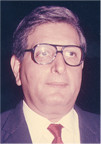
Vasunia: intensity and charisma
A booming voice, a sharp wit, the recognizable ring to his laugh were the other characteristics of the actor, recalled producer Ronnie Screwvala who when working with him on the Dynasty Culture Club had observed Vasunia’s "good and tough and resilient side… Whatever the adversity there was always a smile on his face… He had the ability to constantly motivate people.” He was always willing to experiment whether it was a Bharat Dabholkar revue or a Tamasha style play like Tempt Me Not which was an English translation of Ichhaa maazi poori karaa. A role close to his heart was that of Elvis Presley in his last days in Are you lonesome tonight. Kunal Vijaykar remembered (From the Pavilion End, September 2005) playing the role of an awestruck Charley while Vasunia draped in a sari as Charley’s Aunt would have the audience "rock from aisle to aisle and whoop in laughter.”
"He taught me everything about the theater. Not just comic timing but what being in the theater as a whole represented. He taught me to never settle for less than the best, even if you have to fight for it,” commented Devika Shahani Punjabi who started acting with Vasunia’s production Don’t Dress for Dinner and ultimately made her own directorial debut with his support: "Hosi was always there. He inspired so many of us who worked with him in the late ’90s and early 2000s…His spirit of unflinching determination and solid talent” needs to be carried forward, she advocated.
At the well organized function conceived by Raell Padamsee, besides tributes by certain colleagues there were play readings from his popular productions Ah Norman, Don’t Drink the Water, Tempt Me Not and The Sunshine Boys by the well known names in the theater circuit that included Cyrus Broacha, Vijaykar, Meher and Noshirwan Jehangir, Tanaaz Currim, Sohrab Ardershir… While all his co-stars had tasted his explosive temper they also vouched for his caring and generous disposition. Projected on the screen were slides where Vasunia had played the lead role like in Mary Mary, The Rummy Game, the TV serial Zabaan Sambhalke… An adaptation of the song Candle in the Wind by Vishaal Asrani brought the evening to a close. The song ended, "And your footsteps will always fall here/In every theater yes they will/Your candle burned out long before/Your legend ever will.” Before disbursing the gathering joined in the refreshments, whiskey and ‘theater whiskey’ that was invariably used for his stage productions, as recalled Dolly Thakore.
Instrumental in resurrecting the Screen Annual Awards, his partner in the undertaking, Bhawana Somaaya, editor of Screen, narrated in the Mumbai Newsline of August 14, "Over the years during our preparations for the annual event, there were several challenges but Hosi and I bonded in crisis. On some occasions we disagreed and had frequent outbursts. As creative people, we were both highly tempera-mental…No matter how exhausted he was, he never failed to compliment a beautiful girl and never failed to cheer up a disturbed colleague…When the discussions continued for long hours, Hosi was the first to get restless. Then the boys would coax him to get out and have a cigarette. Ten minutes later Hosi would return feeling refreshed…” The once chain smoker tried to control this habit but although he could not quit he did succeed in curtailing his puffs.
He was always happy to encourage Parsi talent, reminisced his wife Dinoo, referring to his going out of his way to judge a competition at the Dadar Parsi Colony despite his hectic schedule. Actor Perizaad Zorabian remembered Vasunia coming backstage and commenting, "It’s good another Parsi girl has joined theater.” In the movie Percy, depicting the life of a lower middle class Parsi family, Vasunia played the role of Percy’s father. In latter years every Sunday he would visit the Saher Agiary and although he did not wear the sudreh-kusti during the day, at nights he invariably had them on.
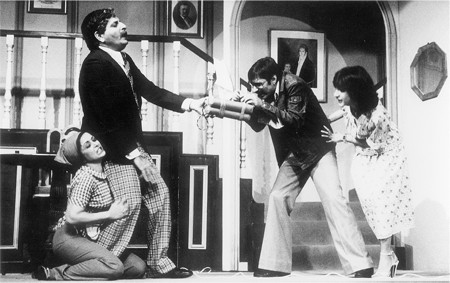
Vasunia (second from left) in a scene from Don’t Drink the Water
Evening time saw Vasunia unwind over a cup of tea with select members of his El Gang at the Cricket Club of India, discussing their passions, their jobs... This was a ritual they had established since their college days. By 7.30 p.m. they would have disbanded, heading for their respective homes. Just as the theater was a passion with Vasunia ever since his talent was noticed by one of the Jesuit priests during his school days at St Xavier’s, he would happily spend hours in the company of his little granddaughter Leiah, ungrudgingly altering his schedules to honor his commitments to her, explains Dinoo.
Born in Kobe, Japan when his father’s family ran a trading business in textiles, spices and sandalwood in the name of E. F. Kavarana and Company, after China became a Communist country, the family relocated to Hongkong for a brief period and thence to India. Following his graduation in commerce Hosi joined Esso and was posted in Indore and Mhow. He subsequently gained experience at the family firm for a few years, then became a partner in a shop Vevas at the Taj Intercontinental selling leather products. Ten years ago he opted out of this partnership and concentra- ted on his work as consultant to The Indian Express Group and the NCPA.
"An exuberant man who lived life to the full,” his son Phiroze cherishes a note he received from his father when there was a setback in Phiroze’s career: "Do not be afraid; things always happen for the best; something good will definitely come out of it,” he enthused his son.
The talented thespian is survived by his wife Dinoo, son Phiroze, and daughters Shernaz Tyebjee and Arnavaz.
Parinaz M. Gandhi
◆ ◆ ◆
From the archive