
Books
Delicious and nutritious
Vitality Cook Book: Fruit and Vegetable Recipes for Healthy Living by Katy Dalal. Published in 2005 by Vakils, Feffer and Simons Private Limited, Hague Building, 9, Sprott Road, Ballard Estate, Bombay 400001. Pp: xix+220. Price: Rs 260.
Vitality Cook Book: Fruit and Vegetable Recipes for Healthy Living by Katy Dalal. Published in 2005 by Vakils, Feffer and Simons Private Limited, Hague Building, 9, Sprott Road, Ballard Estate, Bombay 400001. Pp: xix+220. Price: Rs 260.
"Normally cookery books never give any information on the vegetables that are included in the book,” writes author Katy Dalal in her introduction to Vitality Cook Book: Fruit and Vegetable Recipes for Healthy Living. This being her fifth title on the subject of cookery (the earlier four were Jamva Chaloji, Jamva Chaloji – 2, Delicious Encounters, Pulaos and Biryanis – A Tribute to Indian Cuisine) Dalal observes, "I thought that it was high time that our general public learnt what vegetables and fruits were all about and how they affected us in our daily life and our health. We can save so much heartburn, agony, pain and money by living right and that means eating the right way.”
Most of the 12 chapters – be it the humble banana with its corresponding 32 recipes or the much touted tomato with 47 recipes – include a chart listing the nutritive value of the principal ingredient. Additionally the section will give a detailed description of the plant, the areas where it is found, its salient features, its varieties, its edible components and health improving properties. Thus we may learn that a banana "has strange names such as ‘apple of paradise’ and ‘Adam’s fig.’”
Bitter gourd, a good climber and creeper, may not be a favorite vegetable but it is apparently very popular in Kashmir, Uttar Pradesh and Kerala, writes Dalal who was able to list as many as 16 recipes under this section. Recommended to all diabetics it is a particularly good remedy for sicknesses of the liver and spleen.
The fewest recipes, only six, are in the pineapple section but this is not to underestimate the value of this fruit, the enzyme of which, bromelain is known to melt blood clots, cure heart diseases as also colds, sinus and urinary infections, and being an anti-inflammatory agent helps in tissue repair in sports injuries, states Dalal. In fact the last page of the book carries a list of ailments treated by fruits, particularly the pineapple. More easily available in its canned version than as fresh fruit, the author explains, "A pineapple which is canned in its own juice, and not in sugar syrup, hardly contains more calories than the fresh pineapple.”
The section on coconut too has limited (12) recipes for "the simple reason that the coconut is an integral part of almost all the recipes given in this book,” notes the author who is convinced that "no true curry can be made anywhere in the world without using the coconut.” Efficacious for jaundice and kidney ailments, Dalal writes, "There is no drink on earth which can quench your thirst like this coconut water.”
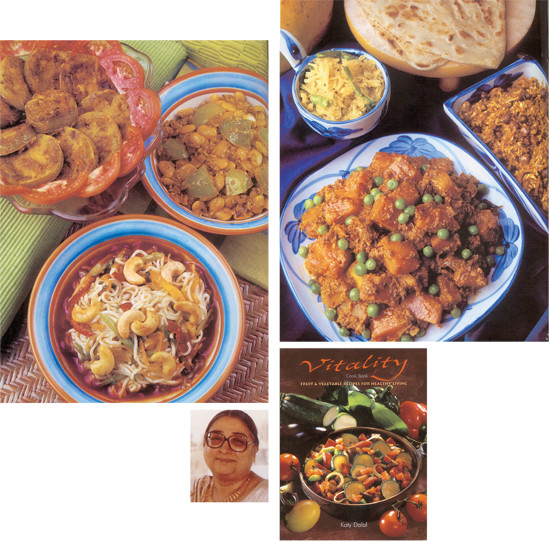
Dalal (bottom) with her parathas and papaya creations (right) and tomato delights (left) (Photos: Jamshed Billimoria)
Mention of the colacasia leaf may not elicit any response from a Parsi. Say ‘patrel’ and you are immediately on the same wavelength for who has not savored this delicacy or the colacasia leaf dal (alu na patra ni dal). Besides the leaf, the stem and the roots of this plant too offer a variety to one’s cuisine, judging by the recipes.
Reading the introduction to the drumstick tree also known as the miracle tree of life one is surprised that its leaves contain four times the calcium in milk, four times Vitamin A in carrots, seven times Vitamin C in oranges and three times the potassium in bananas. Besides the 25 recipes listed in this section there is even a method stated to use its seeds to purify water! While akuri is a well known Parsi breakfast dish, Dalal offers an interesting variety — Parsi style drumstick flower akuri. The next recipe is Parsi style eggs on drumstick flowers.
As therapeutic as the drumstick is the lotus with its roots, leaves, stems, seeds, flowers all contributing to human comfort. One can almost understand why it was selected as the national flower of India. Amongst all Indians, the Kashmiris eat the largest amount of lotus stems or roots, freely available in their habitat.
In the chapter on mango, Dalal refers to the Chalto Amlo or the Walking Mango Tree at Sanjan in Gujarat which is reportedly almost 250 years old and has been growing not vertically but parallel to the ground, yielding red topped fruit. In addition to the Hindu scriptures referring to the mango, even the Parsi customs have included the ritual planting of a mango sapling on the fourth day before a wedding which when touched by five married women signifies an auspicious omen. While the ripe mango if eaten in large quantities serves as a diuretic as well as a laxative, its seed is said to cure diarrhoea and asthma. Infinite are the uses of mangoes in chutneys, pickles, jams and desserts.
So too is the papaya a favorite ingredient for chutneys and pickles as also salads. In fact the papaya is considered a good source of beta carotene which is present in all orange colored vegetables and fruits, helping to ward off cancer. Its juice contains papain which is used in epidurals or spinal injections and helps to control pain.
Ultimately, a substantial consumption of vegetables is bound to create a sizable collection of peels. Instead of throwing away the peels of ridge gourd, potato, white pumpkin and sweet potato, use them to create a delicious snack (the peels cut as julienne strips are fried and sprinkled with broiled sesame seeds, poppy seeds and pepper powder). "To make daily food more exciting, delicious and above all nutritious,” is Dalal’s aim. All of us may not end up as good cooks like her but we will surely be inspired to use the right ingredients.
Parinaz M. Gandhi
◆ ◆ ◆
From the archive