
Books
Religious guidance
Dini Doravni by Jivanji Jamshedji Modi. Published in 2005 by Nadir Ardeshir Modi, Modi Lodge, 13, Vachha Gandhi Road, Gamdevi, Bombay 400007. Pp: 336. Price Rs 90.
Dini Doravni by Jivanji Jamshedji Modi. Published in 2005 by Nadir Ardeshir Modi, Modi Lodge, 13, Vachha Gandhi Road, Gamdevi, Bombay 400007. Pp: 336. Price Rs 90.
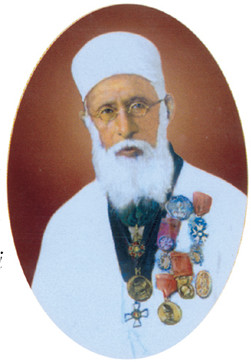
Every few decades a giant of a man comes along whose worth is fully realized by people only after decades of his passing away into the heavenly realms. Dr Sir Jivanji Jamshedji Modi was one such man — and the passage of time after his passing away has made us realize all the more the invaluable contribution this man had made to Zoroastrian scholarship. His contribution to the community at large is yet to be fully explored and understood.
Strangely enough, except for his magnum opus The Religious Ceremonies and Customs of the Parsees his countless other works seem to have been buried under the haze of time. So it was in the fitness of things that in the 150th year of his birth, his grateful family members, especially his grand children Ervad Nadir A. Modi and Shirin and Navroz Kanga have taken it upon themselves to bring to light the unexplored treasures of his works by bringing out some of his more valuable ones either as a reprint or as translations. The above-mentioned book under review is one such book in Gujarati. The book also contains a brief, but beautiful life sketch of Jivanji Modi by Noshirwan Khurshed Daboo. The printing is elegant with large and clear fonts.
Of the more than 150 talks that Jivanji had delivered, about 110 have been published in the seven volumes entitled Jarthoshti dharma sambandhi bhashano ane vaejo (1902 — 1932). They cover a range of topics like Iranian languages and literature, history, religion, ritual, biography, theology and ethics. The book under review contains 14 of these talks delivered by Jivanji during his lifetime. The talks chosen for this book cover a range of interesting and relevant subjects like Ahura Mazda, Prophet Zarathushtra, fire, muktad, heaven, satum, kusti, khoreh and life. The talks on Ardibehesht Ameshaspand, Srosh and Meher Yazads are a rich source of information on the three principal Zoroastrian divine beings. One rarely sees such exhaustive and extensive material in such lucid a style.
As the title of the collection Dini Doravni suggests, the lectures really give religious guidance. And true to the subtitle prakashma pagla, we are truly led into the light of knowledge shed by the insightful talks. Indeed, the well selected talks in this collection give invaluable and rare insights on several religious and literary aspects.
The two talks on muktad covered in this book deal with the contentious question of days of muktad, along with precious and powerful evidences. They also give glimpse into hitherto forgotten traditions and superstitions connected to these solemn days.
The concept of heaven espoused by Jivanji in another of his talks is also quite unique. It states that heaven and hell, rather than being fixed places are situations which each one of us create for ourselves during our lives as also after death. Thus each one of us create our own heaven and hell.
The talk on "Complete Life” elucidates the concept of life and tells us the idea of a ‘religious life’ and an ‘ethical life’ and how living a life of ‘active virtues’ leads us to our duties.
Considering the fact that Jivanji’s language had always been simple and lucid, and was replete not only with quotations from Avesta, Pahlavi, Pazand and Persian texts but also anecdotes from Iranian, Indian, Greek and Roman history, it makes very interesting reading. The liberal quotes and stories from Classical and Romantic poets and authors too greatly enhances the value of Jivanji’s talks. For the linguistically oriented, most of the technical and religious terms are given with derivations and cognates from European languages like French and German, apart from the Indo-Iranian languages of Sanskrit, Avesta, Pahlavi and Persian.
Ervad (Dr) Ramiyar P. Karanjia
◆ ◆ ◆
From the archive