
Zoroastrians Abroad
“A major new window on physics”
Dr Rusi Taleyarkhan ’s experiment on nuclear fusion has the scientist community agog
"I have always admired the giants of the past (Newton, Einstein) who offered paradigm shift benefits to mankind. Being naturally curious, keeping an open mind at all times, helps to avoid the notion that something is not possible,” says Dr Rusi Taleyarkhan who has been in the eye of a storm of scientific skepticism since his paper on desk-top fusion was first published in the journal Science (March 8, 2002). Currently the Arden L. Bement Jr Professor of Nuclear Engineering at Purdue, a university that enrolls 68,000 students and is considered one of America’s best, even as he retains his status as Distinguished Scientist at the Oak Ridge National Laboratory, Taleyarkhan has continued his search for "out-of the-box solutions to difficult problems.”
Leading an international team of scientists, Taleyarkhan acquired additional funding from the US Defense Advanced Research Projects Agency (DARPA), purchased more precise instruments and equipment to collect more accurate data and successfully reproduced and improved upon an original experiment, notes Emil Venere in Purdue News (March 2, 2004). "What we are doing, in effect, is producing nuclear emissions in a simple desktop apparatus. That really is the magnitude of the discovery — the ability to use simple mechanical force for the first time in history to initiate conditions comparable to the interior of stars,” Taleyarkhan had told Venere.
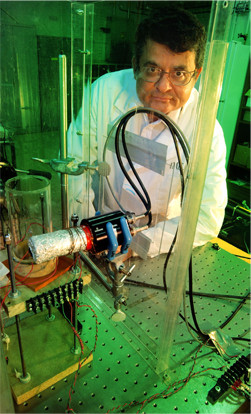
Taleyarkhan’s search is aimed at providing a bountiful, cheap and clean energy source. "Unlike the better known nuclear fission, whose byproducts remain radioactive for thousands of years, his nuclear fusion process leaves radioactively activated byproducts that would go down to background level in about 10 years,” notes Porus Cooper in a profile of the scientist in FEZANA Journal (Summer 2004). "A few cubic kilometers of sea water could be enough fuel to supply the energy needs of the US for several hundred years,” Taleyarkhan told Cooper.
Unlike the Science article in 2002, the presentation in Physical Review E, the journal of the American Physical Society (March 7, 2004), a journal in the domain of the skeptics, was a process "unprecedented in the history of Oak Ridge National Laboratory and excruciatingly demanding,” Taleyarkhan told Cooper. Around 100 scientific reviewers, working anonymously, took numerous cracks at trying to find fault with the methods used and the results presented by the team, writes Cooper. That the eventual decision was to publish, meant that the experiment had gained some very important believers and backers, Taleyarkhan told the journalist.
Subsequent to the Physical Review E publication the US Department of Energy agreed to take a second look at the process after 15 years, as requested by cold fusion scientists, Kenneth Chang reported in The New York Times (March 25, 2004). "I am absolutely delighted... There can be no other conclusion than that a major new window has opened on physics,” said Dr Eugene Mallove, editor of Infinite Energy Magazine, to Chang.
Taleyarkhan ascribes his venture into the field to his PhD thesis advisor Dr Richard Lahey, Jr. "Lahey was working on the field of sonoluminescence (for over 30 years) which involves the use of acoustic energy to cause intense implosions that can turn normal sound energy into flashes of light. Around 1997 he called on me to see what I thought of this field which had reached a stalemate of sorts. It is a fascinating piece of science but people simply could not see how to use it to create conditions similar to the interior of stars. This caught my interest and got me going,” Taleyarkhan responded to Parsiana’s query, "Was there a mentor who inspired you?” He went on to recall the sequence of events leading to the epochal experiments: "Ideas materialized — crazy sounding at first — that I presented to an acquaintance, Dr Larry Dubois, who happened to be the director of the defense sciences office of DARPA — the main research and development arm of the US Department of Defense. Larry saw some merit and offered me an opportunity to check it out. (There was an) ultrahigh risk of failure but also the opposite in potential. I put together a team and started work in 1999.”
Born in Dohad, Gujarat, Rusi, son of the late Dolly and Pesi Taleyarkhan was educated at the Billimoria High School in Panchgani and Boys’ Town in Nasik, and graduated from the Indian Institute of Technology, Madras, before receiving his MBA and PhD degrees from Rensselaer Polytechnic Institute in Troy, New York. Two of his brothers, Jehangir and Eric are master mariners. The youngest, Sheraz, died in a motorcycle accident in 1981.
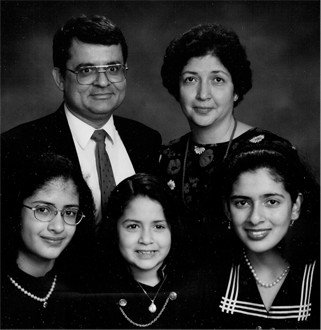
Rusi and Navaz Taleyarkhan with daughters (L to R) Manaz, Meher and Pervin
Married to Navaz, with three daughters — Pervin, 18, who wants to study biomedical engineering and then be a doctor, Manaz, 17, who loves animals and wants to be a veterinarian and the fun-loving Meher, 12 — Taleyarkhan told Cooper that he and his wife spend an hour a day in prayer — an example of the way isolation from the mainstream helps to solidify one’s faith. "I don’t recall doing that in India,” he said. And the children are also taught to say and understand their prayers and imbibe Zoroastrian values. With the one Parsi family at Purdue University — Ness and Jasmin Shroff from Bombay — the Taleyarkhans keep regularly in touch. They also occasionally visit the Parsi families in Chicago: "The Rivetna family there is wonderful,” he notes.
"Being a Zoroastrian to me is a privilege and comes with responsibilities to demonstrate to all around us the virtues taught to us by our Prophet Zarathushtra. Our religion is unique in its ability to encourage self-introspection for enabling good — thoughts, words, deeds; this is a very powerful force if taken seriously in that it can permeate one’s thought process in all walks of life,” writes Taleyarkhan. Proud as he is of Parsi history and the community’s impact on society in the past, he notes, "The community today seems not as challenged but we can all rise to the fore. In North America and elsewhere I do see a resurgence of pride, cohesiveness, self-questioning for improvement...I believe it is ever so important to support our religious and communal institutions — something we’ve not done as we should. The donations and charity that made our community what it is could do well to have us emulate the stalwarts of the past — the Wadias, the Tatas...In recent memory one individual who has impressed me is Jimmy (Jamshed N.) Guzder and his family. He has helped countless needy Parsis. Ratan Tata is another current leader who is impressive in what he seems to have achieved in business life. Khojeste Mistree in his own fiery way is an example of positive thinking — radical to some, but so what?” Taleyarkhan shares his thoughts.
Apart from the dreams and nightmares of fusion, Taleyarkhan enjoys jogging, reading scientific journals, gardening and playing with his two dogs. He is also a father who spends time happily working with his girls at their homework. To aspiring young scientists he says, "Keep questioning the status quo and persevere with the hunch that is unique to each one of us.” And he has an agenda for himself: "At some point in life I will likely dedicate my own energies and resources for betterment of the community in India and worldwide.”
◆ ◆ ◆
From the archive