
Services
Military moustache maintenance
Brig Naozar Patel talks of the travails of sustaining the longest moustache in the Indian Army
"For a year in 1976 I sported that droopy moustache, till my superiors at the College of Military Engineering (CME), Poona objected to its shape telling me it was not military enough. Charged by their remark, coupled with a desire to show them what I could do, I turned my moustache upwards,” recalls Brig Naozar Patel who is famous for sporting the longest moustache in the Indian Army. He would prefer not to measure it lest "najar laagi jaaie (attract the evil eye).” But on October 1, 2005 he is heading for Berlin to participate for the first time in a World Moustache and Beard Competition in which there are 16 categories.
The brigadier has continued with the same upturned style that he had adopted in 1976. When in the lower ranks, he was the only officer in the Indian Army who used to receive a moustache maintenance allowance of Rs 150 per month. This small amount was to pay for accessories like oil and brushes and was more of a token recognition of his feat.
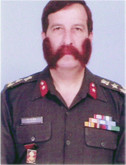
Patel with his famous moustache
Patel devotes three and a half hours daily to his moustache. He uses a thata, which is a piece of cloth to set his moustache when he has had his bath and has to visit windy and rainy places. "At outdoor parties my men will be more concerned about the wind direction than the menu so that my moustache doesn’t get affected. For the last 29 years I have not slept on any side but on my back so that my moustache doesn’t get knotted or ruffled by the pillow! I apply pure coconut oil five times a week to prevent dandruff and don’t use any gel,” he informs us. The reactions to his moustache have been both positive and negative but mostly the onlookers have been curious. Patel has taken it all in his stride since he knows that his moustache is unique. Further it is not in his temperament to lose his temper.
"Gradually over a period of time men have become so involved with the movies and their chocolate faced, clean shaven heroes that they no longer have moustaches. When I commanded my regiment, 80 percent of my troops were inspired to sport moustaches. The inclination is there but somehow the motivation is now lacking,” he regrets.
Currently posted as commander faculty of combat engineering, CME, Patel was commissioned in 1972 to the Corp of Engineers, the Madras Sappers. "In fact the moustache is a reflection of the great tradition of the Madras Sappers, since their officers would sport moustaches,” he says.
Over the last three decades Patel has served all over the country and has enjoyed and is enjoying all his postings. He recounts his most challenging tenure in Operation Pawan in Sri Lanka during the conflict with the LTTE, which began in 1987. "At that time I was inducted there. Initially we had underestimated the capability and capacity of the LTTE to enter into a conflict with the Indian Army. After the initial setbacks which we suffered we were able to assert our dominance and as staff officer at the main headquarters it was a very challenging task to assist in planning and coordinating the Indian Army operations. So my eight months in the Indian Peace Keeping Force were a great learning experience for me.
"The other challenging tenures were the three postings in the high altitude areas of Ladakh and Sikkim during 1975-76, 1988-90 and 2002-2004 respectively. In these areas provision of combat engineering support is of paramount importance because here we are faced with two potent adversaries — the first being the traditional adversaries, the Pakistanis and the Chinese, and the second being the weather. More often than not it is the latter which is more difficult to endure.
"Combat engineering support involves construction of aerial cable wires, construction of roads, tracks, temporary habitat both for equipment and personnel, bunkers and other field fortifications, construction of kerosene pipelines specially in the Siachin Glacier region and snow clearance along the roads and passes,” he explains. Patel’s postings to peace stations have also been rewarding because here he could concentrate on training his subordinates and looking after their welfare which is a major function of command at all levels of the Army.
On a personal note the Brigadier is married to Zeeya. "Ours was a love marriage. She was from Poona. We met at a New Year’s Eve program in 1976 and got married in November 1981. Though Zeeya was from a civil background she adjusted well and is an active part of our Army family. My elder son Nawazesh is in the Army while my younger son, Mehernosh is in the ninth standard of Army School, Khadki.” Ask him how his wife and children react to his moustache and prompt comes the answer, "Since they have never seen me without my moustache the question of any sort of comparison doesn’t arise.”
"We are a three generation Army family,” informs Patel proudly. "My father Burjor was in the Army, my brother is in the Army, my two uncles were in the Air Force, a distant relative is in the Navy and my son is also a part of the Army. He is honest enough to say that joining the Army is a good vocation for youngsters provided they are motivated and money and materialistic things are not their aim in life.
"The Parsi community has contributed to all the three wings of the Armed Forces. We have had a Parsi Chief of Naval, Air and Army Staff and a number of senior officers as well. In fact I remember at one point of time, 1990 to be precise, there were 48 Parsi Army officers out of a strength of 38,000. Parsis have earned goodwill in the Armed Forces. But it pains me to see and talk to our young boys who want to piggyback on this good name. The said youngsters simply want to have everything on a platter but in this fiercely competitive world one needs to make a name for oneself,” he says on a more serious note.
On a parting note his message for Parsi youth is "Join the Army. It is the best profession and the noblest of them all. Here you will get maximum respect, job satisfaction and quality of life because you are dealing with people from all castes, creed and regions from all over the country. This gives a clear perspective of who an Indian is and I request Parsiana to be the medium for motivating our Parsi youngsters to join the armed forces.”
◆ ◆ ◆
From the archive