
Zoroastrians Abroad
Learning at the UN
Kayzad Namdarian, Afreed Mistry, Farhad Mistry and Homi Gandhi attended the United Nations Women’s Rights Conference, organized by the UN’s Commission for the Status of Women (CSW), to make a presentation organized by the Federation of Zoroastrian Associations of North America (FEZANA). Titled "Zoroastrian contribution to the Millenium Development Goals (MDG): Past, Present and Future,” the presentation was part of the third tier of events at the two-week conference and made on March 8, 2005 in one of the smaller, intimate rooms of the UN in New York City, notes an e-mail from Namdarian. FEZANA has been participating in the CSW conferences — this one was the 49th in the series — since the past two years, he writes.
Though the CSW conferences have been held regularly since the first one in Mexico in 1975, it was in Beijing 10 years ago that the ground breaking ‘Platform for action’ was created, setting the goal of gender equality for governments and non-governmental organizations around the world, states Namdarian. Gender equality and reduced discrimination against women is part of the UN’s MDG, to be achieved by 2015. The other goals include lowering of poverty and increasing of education. "Poverty and disease are now being feminized, that is more women are suffering than men and gender equality is now being linked to the other goals,” states Namdarian.
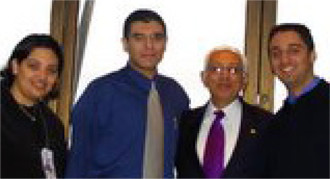
Afreed Mistry, Farhad Mistry, Gandhi and Namdarian at the UN-CSW meet
The conference witnessed three tiers of events: ministers, first ladies and even a princess spoke of their countries’ national programs in the large General Assembly Hall. The second tier events were held in medium sized conference rooms where UN agencies or large NGOs made their presentations. The third tier sessions, held in small intimate rooms with less capacity, featured smaller NGOs like FEZANA.
Tight security pervaded the entire building. "My personal highlight was when I saw Kofi Annan speak during the opening session,” writes Namdarian. "The United States presented a controversial statement in regard to demoting the women’s human right of abortion. The Middle Eastern states seemed to be far more political with less emphasis on what their respective countries have done to improve gender equality. My home country, Australia, presented an item that did not seem appropriate — a maternal payment scheme which pays new mothers $ 3,000. It was interesting to see how a government can turn such an irrelevant, controversial thing, which has been promoted locally to create a baby boom in Australia, into something that is supposed to increase gender equality in the world arena…”
Citing an example of how the sudden requirement of a pass for the delegations to reenter the crowded conference room led to the presentation of statements and statements of support on the floor of the house, Namdarian comments, "All because they were afraid they couldn’t get into the next session!” The spectacle gave Namdarian "the impression that the people who are leading the countries of the world are probably not the most ideally perfect people to do so. Nevertheless they are all humanity has to offer,” he adds philosophically.
◆ ◆ ◆
From the archive