
Life-Style
Budgeting for a bash
Parsiana talks to the trade to find out how much a wedding or a navjote reception could cost
The number of guests who come to a wedding/navjote to give their blessings, or rather to enjoy a hearty repast, in a baug has declined, opine the trade. The traditional ses flaunts fewer jewelry items for the bride and groom. And while there are some Zoroastrians who are making conscious efforts to cut costs there are others more than willing to splurge on festivities on the rationale that "such occasions come but once in a lifetime.”
Even if one were to try and reduce the guest list to 100, and opt for the most economical products and services on such occasions, a wedding in the community would probably not cost less than Rs 1,00,000 today. An approximate analysis undertaken by Parsiana revealed that the major items of expenditure would involve: Rs 40,000 on jewelry (a set comprising a necklace, earrings, bangle/bracelet and ring), Rs 28,500 on the caterer and drinks, Rs 12,000 on the trousseau, Rs 5,000 for video shooting and photographs, Rs 3,000 on the baug/hall and lights (at Cama Baug small otla), Rs 3,000 for flowers, Rs 2,000 for music and Rs 1,350 for the invitations. The cash gifts and presentation of shawls to the priests would easily total Rs 5,000 and there is no knowing how much is to be reserved for the exchange of cash gifts within the family.
Amongst all the heads on which money seems to disappear on such occasions, the single largest item is jewelry. But more than an expenditure, it is considered an investment for the family, expecting its value to appreciate for the future generations (though if the design and stones are not selected well, the expected appreciation may not materialize). Presenting a wedding set to the bride is considered basic even among the less affluent, explains Khurshid Vakil of Framji Rustamji Choksey. With the prices of gold rocketing, sets are available for nothing less than Rs 40,000. "Whilst a couple of years ago families came with a budget of Rs 60,000 today (to purchase the same kind of pieces they need to) come with a budget of Rs 90,000,” reveals Khushroo Press of B. Jamshedji Jivanji who has presently noticed a five fold increase in Parsis wanting to sell their jewelry. With the escalation in gold prices some families are divesting their gold and using the money to buy luxuries and gadgets they have long denied themselves.
With their insistence on 22 carat quality gold Parsis patronize certain select shops. Press claims that 100 percent of their clients are Parsis; Vakil notes that 97 percent are Parsis. She has noticed that Parsis prefer certain set designs "with the leaf/flower/naal (horse shoe), chheras (thick chains) being the all-time favorites.” The real guineas too are available mainly at Parsi shops, states Press, adding, "Parsi tastes are very conservative... The Pedder Road residents may find Hughes Road shops more convenient and those staying in the suburbs may like to go to Bandra but labor wise Zaveri Bazar (where the two Parsi shops are located) is 30-40 percent cheaper. A few Parsis may venture out but after burning their fingers with (jewelers) who sell 19 or 20 carat gold as 22 carat they realize their mistake and come back to us.”
The jewelry worn by the bride and relatives may or may not earn comments from the guests but the food on offer is of prime concern to everybody. A few hosts are known to schedule their functions depending on the availability of the caterer of their choice. The cost of the simplest three-dish patra (chicken, fish and mutton pulao dal) would start at Rs 210 (Rs 175 without fish) and may rise to Rs 350 and more per patra depending on the frills and items on the menu! Few even bother to enquire about the cost of a vegetarian patra. As conveys Tanaz Godiwalla, the caterer most in demand, "paatraa ni machhi is a favorite among non-Parsis because of which hosts like to include this dish in their menu.” "Pulao dal is another dish which is almost always in demand,” mentions Ketayun Khambata of Khambata Caterers. Complimentary starters have become a routine at Parsi functions too, cutting into the profit margins of the smaller caterers who are struggling to offer competitive services. "I started the practice of offering complimentary starters and complimentary custard on some of our package deals,” claims Tehmtan Dumasia of K Caterers. Ending the meal with a fortune cookie is a trend that is catching on just as assigning a catering job to non-Parsis like Mini Punjab.
While some associate a Parsi meal with a traditional sit-down affair served on patras there are other caterers like Katy Dalal who only offer tastefully served buffets to enable the guests to eat at their own covenience and leisure without the jostling that usually follows when one paat (sitting) is finished. "Everybody is on the tandoori bandwagon,” observes Dalal who takes pride in making and grinding her own masala and buying the choicest ingredients. "Except for a few discerning people who care and are willing to spend on quality, everybody seems to be feeling the crunch and wants to settle for a sastu (cheap) patru,” declares Dalal who prefers not to cater to the typical "pavri (pulao dal et al) taste” offering instead such novelties as kesari dahi murghi, fish fillet in different sauces, fish florentine, chicken Hawaian salad. Although her main source of income is not wedding meals Dalal gets upset when competitors spread rumors saying she has stopped accepting wedding contracts or that she is particular about the numbers she caters to.
The waste of food on the patras is often rationalized by patrons stating that it would help to feed some poor person. But, in fact, the caterers have contracts with certain people who regularly go to the baug venues to purchase the leftover patras. They are sold at Rs 20-30 per row (where on an average 20 diners are seated) depending on the number of dishes offered in the original patra, relates one caterer. These leftover patras are then resold near roadside liquor dens.
The love for good food accompanies the need for alcoholic and aerated drinks at Parsi functions. But whilst originally the host went and procured the brands and labels that fell within his/her range they now have to obtain the mandatory permit at a cost of Rs 5,050 before drinks can be served. "As per the excise law we are not permitted home deliveries,” states Perzon Zend of Peekay Wines, known for supplying quality products at competitive rates. "Not only do we advise our clients on how much to spend on which brands, we also help them get permits and take back the excess alcohol after the function,” adds Zend. Director’s Special Whiskey is always in demand. While Royal Stag and McDowell are in the lower range, Signature and Blender’s Pride fall in the middle lot and the expensive scotches are offered at but one or two weddings in a year, conveys Zend. In fact the incentives in the form of glasses and bags offered by companies to traders are passed down to the clients too. This is their way of ensuring customer loyalty.
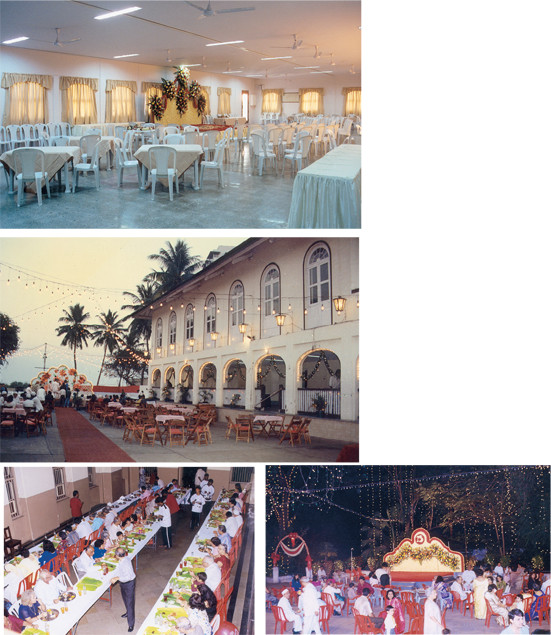
Top: Renovated Banaji Atash Behram Hall (Photo: Mazda Audio Video Lab) Alongside: Colaba Agiary Below (left): Sethna Agiary dining hall and Saher Agiary grounds (right) (Photos: Homyar Mistry, Homz Prints)
The change in trousseau is discernible at the baugs. "Aapra bachchao sari pèherta nathi (our children are not keen to wear saris),” is the statement often heard at Parsi owned sari shops which once did brisk business during the wedding season. Where previously five-seven saris were bought by one family, now it has come down to one or two and some customers are so fussy that they may not buy any. Those with money prefer to go in for designer saris which cost upwards of Rs 50,000. The ones who are budget conscious would opt for sequence work or embroidery. Zardosi and tili kors are equally popular. And the perennially popular are the traditional garas and kor saris. For those with a budget of Rs 15,000-20,000 "I always advise them to buy the traditional ones which would serve as heirlooms,” says Naju Daver. While two years ago beige and grey were the popular colors it’s not so any more. Even though traditional saris look best in red, burgandy or purple, some clients want newer colors, observes Daver. If she finds that a particular color does not suit a client, she will express her opinion, says Daver who would like to ensure that a customer derives 100 percent satisfaction from draping her creations.
Extending her range of products from pugrees to saris to navjote dresses, Gulshan Kolah has been catering to an exclusive clientele over the years. She notices that customers now are more cost conscious.
Yet another cost that has become mandatory at celebration time is photography and video shooting. Whilst video shooting means a cost of Rs 4,000 to 7,000 depending on whose service one selects, photographers charge Rs 10-25 per print, depending on the size specified. Clients sometimes specify "don’t go beyond a certain limit.” A navjote may require the shooting of two or three rolls; at wedding time it can be three or five rolls. "In fact we encourage the presence of a family photographer who can shoot the usual run-of-the-mill pictures reserving the professional services for selective shots,” states Homyar Mistry of Homz Prints. He adds, "The clients’ expectations should improve but they do not. They are satisfied with what they get... The layman just compares the per print price of Rs 2 advertised on hoardings with our rates but he does not realize that the quality is missing there.”
Whilst caterers include their cartage charges depending on the venue, photographers do not keep varied rates. As states Nazneen Vajifdar of Spectravision Labs, "The first person who books me, gets me. My rates are fixed whether it is Cama Baug or the Turf Club.” She has noticed that clients are budgeting but it is not at the expense of quality. Functions are not as formal as they used to be, she observes. "You will find fewer people dressed in saris and suits and more in western clothes and designer outfits.”
"People now tend to spend more wisely,” remarks Sarosh Daruwalla of Mazda Audio Video Lab adding that "consideration for the moghu patru” is the prime factor in extending and accepting invitations. After 20 years in the business he notes that those whose weddings he had shot invite him at the time of their children’s navjotes too. "We are almost like family photographers.” Until the time of the wedding vows he chooses to shoot at his discretion and during the reception he acts on the client’s instructions. To ensure that money rotates within the community he would like to generate employment among the community youngsters. Young college boys should be willing to earn by working as wiremen or holding lights at the time of shoots. Even caterers can use Parsis for serving food. "If youngsters can serve at McDonalds, why not at Parsi baugs too?” he muses. Allow different youngsters to offer recorded music at functions instead of certain baugs encouraging monopoly in certain areas, he recommends.
Live Parsi bands are but a handful today. More often than not recorded music entertains the guests because it comes as part of a package deal along with the photography or with the floral arrangements. But as one discerning organizer points out, the client cannot then expect high grade services in all the sectors because what the person is effectively doing is sub-contracting his business. Parsi bands come for Rs 5,000-6,000, almost the same price as recorded music, but the sound effects of a professional stereo system being better, some clients favor that since it is less jarring to the ears. Also there is the mistaken notion that all the 10 members of the band have to be treated to a free dinner. That is no longer the case. A non-Parsi band will charge three times the amount taken by a Parsi band, plus the members may sit down for a free meal without being invited, but those costs the hosts will bear, pointed out Daruwalla. Often those who offer recorded music have no knowledge of music themselves and are just interested in making fast money, regrets Mehernosh Tantra of Hijackers who is happy that people have now started coming back to bands.
While some customers give business to non-Parsis expecting better quality services, there are others who expect them to be cheaper. Among the Parsis who offer floral services, two complained about a non-Parsi florist who approaches Parsi customers claiming he is a sub-contractor for some Parsi florist. He then gives them a quote for the decorations which he assures will be a couple of thousands lower than that given by the Parsi florist who anyway will assign him the work. Customers who ask Parsi florists for their estimates, realize that this florist in fact demands more than the competitors do.
Floral decorations for the bare essentials comes to nothing less than Rs 3,000 these days. It can go up to a couple of lakhs for clients with exotic tastes. Many Parsis are cutting down on floral arrangements on the rationale that it is a waste of money for the four hours they will be seen, states Sarosh Dumasia of Khushnuma Florist who has been in the business for 21 years. The demand for cutouts of Zarathushtra and a farohar as stage backdrops which were in vogue have now reduced by 30-40 percent, points out Dumasia. "This is because people are turning more religious and do not like the idea of scraping out flowers or throwing them away saying ‘kachraa maa jaai to dil dookhai (sentiments are hurt if they are thrown away).’” Armaity Bamanbehram of Adil Florist explained that the stage backdrop is their main concern. Clients are offered a choice of 100 varieties from which they make their final selection. Along with the flowers there is a lot of cloth and net in use too now, says Tehmtan Dumasia of Shernaaz Florist. It’s not just the stage and the aisles, even the tables and the rearside of chairs are important to those who have the resources to impress the guests.
Invitation cards are usually an indicator of the lavish expenditures that follow. "While many think that we should not waste money on chithis there are others who view this as an important expenditure, being the first impression they will create,” points out Meher Chinoy of Union Press. An average, no frills card can cost Rs 3.50 a piece, not counting the Rs 4 postal stamp on the envelope, and the Rs 6 for the reply card. Some cards can cost as much as Rs 14 or 15 and there are the expensive ones which come upwards of Rs 35. While red ink is cheaper than gold or silver, fancy fonts come at a higher price. This season, in vogue are the three-fold invites printed on foreign machine-made paper or tissue paper or hand-made paper, reveals Chinoy who has nearly 200 designs on offer each season. For wedding invites the Christian designs (like the one showing a couple in a horse carriage) are gaining in popularity. For navjotes, the one with the traditional ses motif is most in demand, especially by those settled abroad. Liaising with their overseas clients on the e-mail, Union Press now also offers them the facility of proofing and scanning their invites on the computer.
Would there be takers for certain products like pugrees, if offered as a rental service, wonders Tehmtan Dumasia who is toying with the idea depending on the ‘pugree bank’ he is able to build. Instead of spending Rs 3,000 on a pugree which may be worn on just one or two occasions why not hire it for Rs 300? he questions. And if the rental scheme for pugrees is successful, why not other products as well?
"We don’t take any advance. We trust Parsis,” is the sentiment echoed by all those who proffer different services on joyous occasions. As the shrewd business person realizes, it is not just profit margins which make them accept assignments; some are considered an exercise in image building. Ultimately everyone is concerned that the months of preparation result in a memorable celebration.
Baug rates
Gone are the days when people threw dice or picked lots to determine their chance of booking a baug on an auspicious day. Families may now book the baug, caterer, florist, videographer more than a year in advance to ensure that they get the services they require at a price they are willing to pay. The prices quoted should be verified with the baugs before booking. The rates may vary from those stated here.
The popular Jeejeebhoy Dadabhoy Agiary at Colaba can be booked for Rs 30,000, not counting the lights which are arranged by Framroze Hormusji Pavri and Sons for Rs 15,000.
Another favorite venue is the Dadar Parsi Colony Gymkhana grounds which members can book for Rs 15,000 and non-members for Rs 80,000.
Allbless Baug costs Rs 12,000 per day with the lights provided by The Eastern Electric Light and Power Company Private Limited costing Rs 6,500 to Rs 17,000 (for jashans the lights cost Rs 3,300 and for a single otla the cost is Rs 2,600).
The Banaji Atash Behram Hall can be booked from 4 p.m. to 12 midnight for Rs 12,000 with A/c or Rs 6,000 without A/c. This includes the cost of tables, chairs, electricity and compound lighting.
Saher Agiary can be had on a minimum donation of Rs 10,000 with a variable extra payment for lights.
Elphinstone Cricket Club charges Rs 8,000 for a booking (done through a member) plus Rs 1,000 for lights and Rs 500-700 for music. If an outside caterer is to be brought they levy an additional Rs 3,000 plus Rs 1,000 as a refundable deposit after the place is cleaned up.
The Ripon Club in south Bombay also has to be booked through a member. The Club charges a per head rate of Rs 15 for a guest. Rs 350 has to be paid extra as lift charges. Catering can be done through the Club’s caterer Rattan Elavia. Music has to be provided by the host himself.
Sohrab Palamkote Hall at Dadar can be booked for Rs 7,650 which includes the cost of lights, music and chairs.
The Athornan Boarding Madressa Hall at Dadar charges Rs 6,900 for a full day (8.30 a.m. to 8.30 p.m.) booking (that includes the use of electricity, chairs and passage for cooking) of which Rs 1,000 is a refundable deposit. For a half day (2.30-8.30 p.m.) they charge Rs 4,700 of which Rs 1,000 is refundable.
Malcolm Baug permits the use of its compound from December to February on payment of Rs 6,000 plus Rs 480 being eight percent Government Service Tax. Off season rates from March to November are Rs 4,000 plus Rs 320. Lights for the full compound cost Rs 14,500 and for the half compound, Rs 7,500. An optional water fountain with lights costs Rs 800. For recorded music from 6 to 10 p.m. the charges are Rs 4,500. If a live band is to be brought the cost is borne by the host. The use of the Hall during monsoons is permitted on payment of Rs 1,000 inclusive of lights.
The Cama Baug (big otla) charges Rs 3,000 for the premises (of which Rs 1,000 is refundable), and Rs 5,000 for the lights. The manager arranges for recorded music at an additional cost of Rs 2,000.
The Dadysett Atash Behram at Fanaswadi charges Rs 1,000 for the use of the otla and compound. Lights on extra payment are arranged by Eastern Electric.
The Sethna Agiary Hall can be booked for around Rs 800 with extra payment for lights and music.
For use of the Cama Baug (small otla) ground floor premises the rates are Rs 500.
Chairs and tables too at different venues have to be arranged at extra cost and the rate per piece of furniture would vary as per the venue.
The Banaji Atash Behram Hall
For first birthdays, engagement ceremonies, anniversary functions, meetings... the cool confines of the renovated Seth Cowasji Behramji Banaji Atash Behram Hall opposite Charni Road railway station would be ideal, recommends Sarosh Daruwalla, the prime mover behind the refurbished project. With a comfortable seating capacity of 200 for a buffet meal and 300 for an auditorium style lecture/seminar, the barely 70-80 bookings in its first year of operations has disappointed Daruwalla.
The fact that several Parsis host certain exclusive functions in two-three star hotels convinced Daruwalla that there is a demand for such a facility. And instead of the money going to business groups outside the community why not encourage entrepreneurship within the community? was his rationale. There would be no monopoly of any services, be it catering, music, floral decorations or photography, he was determined. The initial costs of sprucing up the premises were shared jointly by him and Tanaz Godiwalla.
The Hall can be booked for Rs 12,000 if utilizing the airconditioning facility or for Rs 6,000 if the airconditioning is not required. These rates permit the use of the Hall from 4 p.m. to 12 midnight and include the cost of electricity and compound lights, 25 tables and 225 chairs. To change the ambience of the Hall, recently all the lights were changed from white to yellow. "The effect was fantastic,” says Daruwalla who is now the sole promoter of the project after Godiwalla chose to withdraw her investment.
Considering that cooking is not permitted on the premises and a caterer has necessarily to start with partially cooked food, this deters many. Music too is permitted only until 9.30 p.m. if airconditioning is not used. If the airconditioning is utilized, the 10 p.m. deadline applies. Hall bookings are permitted only to Parsis in the expectation that the sanctity of the Atash Behram will be maintained. When one party chose to burst a stream of cacophonous firecrackers in the compound, the family was strongly reprimanded lest the incident set a precedent.
◆ ◆ ◆
From the archive