
Zoroastrians Abroad
“Getting together is important”
Congresses focus on the far-flung Zoroastrian communities, says ZAGNY president Homi Gandhi
"I believe in action. I don’t like to procrastinate,” says chartered accountant and New York Stock Exchange (NYSE) principal examiner (broker) Homi Gandhi. Into his second three-year term as president of the Zoroastrian Association of Greater New York (ZAGNY), Gandhi had been busy setting up an NRO account for the New Jersey based Asian Indian Chamber of Commerce’s tsunami project while he was in Bombay in February this year. The money is meant for payment to the contractors commissioned to build 50 houses funded by the Chamber.
ZAGNY membership comprises about 50 percent of the estimated 2,000-2,500 Zoroastrians in the metropolitan New York area (states of New York, New Jersey and Connecticut), says Gandhi, describing the Association’s aims to further the religion and culture, cooperate with other Zoroastrian associations, help other Zoroastrians in North America, work with interfaith groups and their local communities. "It is a typical professional urban society with far-flung activities,” comprising families with two children on average, with three or four in some cases, and a group of unmarrieds, notes Gandhi. Their annual general meetings are held at Jamshedi Navroz every year and the whole managing committee is elected for a term of three years. The ZAGNY membership is open to anyone whose one parent is a Zoroastrian. Non-Zoroastrians can be associate members, as notes the ZAGNY website. Membership fee for the family is $ 100, for the individual $ 50. "You pay to be a part of the community group. The benefit of getting together is important,” says Gandhi.
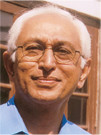
Gandhi
Relying on its many volunteers as is the case with associations everywhere in the diaspora, ZAGNY numbers 60-80 families in its core group of workers. "My failure is that I’ve not been able to double that number,” says Gandhi. Even so, the level of activity is high. "People are complaining because every weekend there’s something at the Darbe Mehr.” The new center at Pomona is a little harder to reach than the original one at New Rochelle which was nearer the city, with more public transport available. And on weekends public transport is invariably less frequent. But, "when people are committed, they come.” He admits that "time is a factor.” But what is the solution? Do you break down associations into smaller groups? He wonders aloud, referring to pot luck groups and the four center points (corner points of the area) where four days of the Gatha prayers are held, with only one Gatha day being celebrated at the Darbe Mehr since the past three years.
Gandhi speaks of the voluntary service to the old and sick in the local community which is provided by many Zoroastrians and how ZAGNY’s Critical Assistance Fund grew out of the need to help young cancer patient Nazneen Kolah who sought treatment at the Sloan Kettering Institute. Though her parents sold their possessions, they could not meet the requirement of $ 250,000 in her account before issuance of a visa. The UK and Hong Kong communities contributed about $ 25-30,000. A donation appeal was sent out by Gandhi to the North American community and the rest of the money was collected by the various associations in North America. ZAGNY members were there with personal help to the Kolah family. Most of the community in the area is financially well settled, says Gandhi. "Every year there is a growth in donations. What we need are physical volunteers.”
With about 10 percent of the ZAGNY membership comprising intermarried families, two years ago the Zoroastrian Intermarried Group (ZIG) was formed under the auspices of ZAGNY. Conceived and established by Tehmi Ghadially, their meetings generally comprise 30-35 people with one or two new couples joining the group at each meet, says Gandhi. In the past, the perception of intermarrieds had been one of hostility, he recalls, but now "people recognize the bonds, open up, talk.”
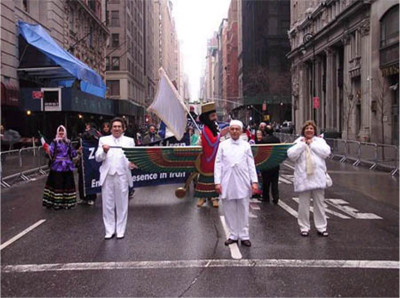
Above: At the Persian Day Parade in New York City
Each new managing committee updates and compiles the association’s directory which is published to coincide with the Parsi New Year celebration in August. They are currently evaluating the cost of putting it on their website www.zagny.org. A revised third edition of Good Life, a manual based on Zoroastrian principles published by ZAGNY, has been recently published. As the book is required reading for the Zoroastrian religion emblem by the Boy Scouts of America, this book has been in consistent demand even from non-Zoroastrians, says Gandhi.
Gandhi is disappointed with the way the world body issue has developed over the past year or so. "You need more transparency. To carry the grassroots with you, you have to keep them informed, think aloud, articulate. But the thought process has not changed. In the Indian Federation (Federation of Parsi Zoroastrian Anjumans of India) there are concerns. How do we get rid of these concerns? Articulation of objects should be very clear...Goals, principles have to be clearly stated. It must have a strong structure.” Gandhi is all praise for the report of the FEZANA (Federation of Zoroastrian Associations of North America) special Working Group as an example of very clear thinking. He says it was clearly articulated at the last FEZANA annual general meeting at Tempa where "we tried to bring it down to basic points. The idea was not to tie (FEZANA president) Firdosh (Mehta)’s hands. The consensus was that we are behind the revised document. Chicago objected to some words but they agreed when Firdosh talked to them.”
Happy to showcase the Zoroastrian tradition, Gandhi led the contingent of 60 Zarathushtis at the Persian Day Parade along 15 blocks of Madison Avenue in New York City on Jamshedi Navroz in 2004. In 2005 there was a move to get the mayor of New York to lead it. Organized by the one million strong Iranian community in the US which is doing very well in the professions and business, the parade idea began with the mayor’s proclamation of March 21 as NaoRooz Day in 2003, notes Gandhi. When the parade was organized by the Iranians, "most of who are Muslims who oppose the Khomeini ideology, they gave us precedence,” says Gandhi. Four Iranian families donated $ 15,000 each towards the cost to which the Zoroastrians also contributed, he informs us. As there was a Greek parade the following day, all the trucks had been booked by them. "So we used Victoria carriages with white horses. They put me in a white dagli with a white cap. They (the Iranians) don’t like anything black as they connect the color with the mullahs!” recalls Gandhi.
This year Gandhi has been in touch with Dr Shernaz Cama, director of the UNESCO-PARZOR project to bring the exhibition of Zoroastrian history, culture and artifacts they had organized in 2003-04 in the metros of India as well as in Singapore, to the US. He is sure "it will be an eye-opener for the community in the US.”
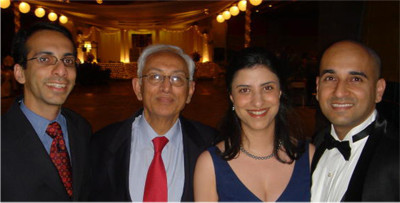
(From left) Navroz, Gandhi, Shazneen and Hanoz: a professional urban society
The recent North American Zoroastrian Congress in San Jose was well rated by Gandhi as very professionally organized and managed. "The whole idea of the congress is to bring the community together and showcase their own local community.” He was particularly happy that of the six awards, four were bagged by ZAGNY members, especially the award to Susan Karani, who he describes as "one of the finest Zoroastrians,” detailing her organization of a seminar on Zoroastrian ethics at the Darbe Mehr.
Graduating from Sydenham College, Gandhi received his BSc in economics from the London University (School of Economics) on a Tata scholarship and became a chartered accountant thereafter. He then went to the US, initially joining the firm of Deloitte and Touche. Working for the NYSE since many years now, he was one of those selected to ring the NYSE’s opening bell in August 2004. The ring of an electric bell opens and closes the trading on the famed exchange which deals in "18 trillion dollars worth of business listed securities — more than the gross national product of the whole world excluding the US,” he informs us. Gandhi and his associates were nominated by their colleagues in recognition of their community service, notes the FEZANA Journal (Winter 2004).
Married to the late Villy, an acknowledged social service volunteer ere she succumbed to cancer a few years ago, they have two sons. Hanoz works as a consultant after building up the dot com division of Bose — starting with two people and no sales, he built it up to gross 25 percent of the company turnover before leaving, says Gandhi. Hanoz is married to Shazneen, a lawyer in New York City, currently on assignment in Tokyo. Their second son, Nav-roze, is vice president of Constellation Energy Group, an energy commodities company located in Baltimore.
Gandhi, who lives in New Jersey and takes the subway to his office in the World Trade Center area recalls the events of September 11, 2001. When the first building was attacked was the time he normally walks up the escalator but, providentially, the day before he had gone for some work to Washington DC. "For three days and nights we couldn’t communicate with the area. The share markets were closed for the rest of the week. The services in the area were completely disrupted. The underground station remained out of operation for over two years,” he notes. Though several Zoroastrians work in the World Trade Center, not a single Zoroastrian life was lost. A meeting was called at the Darbe Mehr on the first Saturday after the event to collect donations, he remembers the community’s sense of relief and gratitude. Though in the security procedures enforced thereafter people would often be searched thoroughly, Gandhi says, adding, "individually and socially the Zoroastrians felt no backlash.” Involvement with the local community on the wider issues — Niloufer Randeria for instance has been involved in working for the tsunami victims — has ensured their acceptability.
◆ ◆ ◆
From the archive