
Politics and Policy
Striking a balance
With her five-year term as a member of the Legislative Assembly coming to an end, Dinaz Patrawala ponders her next move
"In the olden days, buildings were always built with servants’ quarters and a special servants’ entrance. Today, hardly any buildings provide such facilities for servants. Yet, people in high-rise buildings need servants, liftmen, watchmen... It is important to understand that zopadpattis (slums) are present because of high-rise buildings, and both should learn to live in harmony,” says Dinaz Patrawala whose five-year term as member of the legislative assembly (MLA) from the Colaba constituency is drawing to a close. She is presently endeavoring to solve a difficult problem — striking a balance between the disadvantaged and the well-off.
"I had to mentally and physically adjust a lot in dealing with people living in the zopadpattis. I have eaten at the zopadpattis, spent nights over there in the muck and overflowing gutters, and know how they live,” she elaborates.
"On taking my rounds after being elected, I realized that shortage of water was the main problem. Just to get one handa (container) of water, women had to stand for hours in a long queue. Instead, they could devote the same time to their children. Once, a man was even killed due to a fight over water! There are 14 zopadpattis in the surrounding areas. We have given water to almost every zopadpatti after my being elected,” maintains Patrawala.
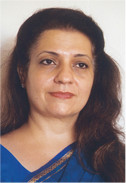
Patrawala: improving civic amenities
Her other priorities were maintenance and repairs of public toilets built by her late husband Marazban and improving drainage facilities, thereby removing blockages from small lanes. Even when she was hospitalized due to a back problem, she sent letters to the then Maharashtra chief minister Vilasrao Deshmukh, requesting him to make arrangements to spray insecticides during the malaria epidemic and suggested how solid waste could be managed in a better way, she recalls. Among her accomplishments she lists the free medical camps organized in the five main zopadpattis where cataract operations were performed, spectacles distributed and blood donation drives conducted. Being a Zoroastrian, she was among those who strove to get Parsi New Year declared a public holiday from 2004 onwards. She has helped fisher folk of Machimar Nagar whose trawlers were not allowed to berth in the vicinity of the Vikrant, relates the MLA. With the funds released by the Fisheries Department they can now keep their boats in their own jetty. Patrawala has also tried her best to clean and beautify her constituency, control noise pollution and improve the condition of dilapidated structures.
"We get Rs 75 lakhs every year which is not a sufficient amount,” explains the MLA. "An expense of Rs 5,00,000 is easily incurred on the repairs and renovation of just one building!” During her term "We spent Rs 75 lakhs in repairing over 20 buildings. We also spent Rs 6,50,000 in providing drinking water to 150 families of Ambedkar Nagar, Rs 14 lakhs went in providing drinking water to 3,500 families of Murti Nagar (Parts II and III), Rs 50 lakhs were spent on improving the drainage system in five main zopadpattis... Much more is being done. We need at least two crores every year, which we have requested the State Government to sanction.”
Striking a balance between hawkers, pedestrians and high-rise buildings is another challenge she faces: "Hawkers are not present only in Mumbai. They are in Singapore and other countries as well. The difference is that in Singapore there are well-planned hawking zones where hawkers are placed in a neat and orderly fashion under umbrellas. There’s no cooking on and littering the roads abroad. We need to explain this to our hawkers and advise them to be fair in their dealings. At the same time, people living in high-rise buildings should cooperate. After all, they don’t need to take their cars out for groceries, etc. Hawkers are right there to serve them.” A committee comprising officers of the Mantralaya and union leaders of hawker groups has been set up to solve this issue.
From where does all this wisdom come in the once inexperienced Patrawala? Despite being a very shy and introvert lady, she joined the field of politics, a profession where one is required to socialize with the lowest and the highest echelons. "I was quite shaken up and heartbroken by the sudden demise of my husband, Marazban,” who had won the seat on behalf of the ruling party but died before taking oath. "Many well-wishers condoled with me saying that they had lost a friend, a brother, a father; that without him they were helpless and that I should carry on his work. I was absolutely detached from politics. But I thought that nobody would give me a job at my age (she was 49 when Marazban died in 1999)! So, in a way, it would serve a dual purpose of earning as well as serving people. Besides, had Marazban been alive, he would certainly have been happy seeing me help the poor and downtrodden.”
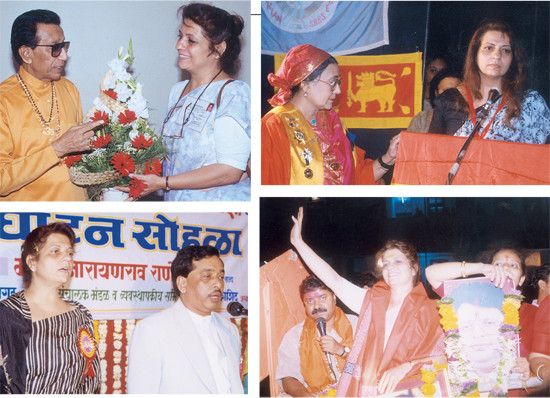
Clockwise from top left: Patrawala with Bal Thackeray; with Meher Master-Moos; in a victory procession after winning the elections and with Rane
Marazban being a Congressman, Dinaz had approached the then Bombay Regional Congress Committee (BRCC) president for a ticket to stand for by-elections. Dinaz proceeds: "(He) said outright that I was not fit for politics, that I was never a grassroots worker, didn’t understand Marathi, lacked a journalism background, that Colaba constituency, which is supposed to be the prime one in Mumbai, housing the University, the Mantralaya, the Sachivalaya and the Stock Exchange, is a ‘gutter’ in which I’m trying to fall, that I should first fight a municipal corporation election and then dream of becoming an MLA. Where did all these rules go for his son (who recently won a seat in the Lok Sabha elections)?” Being a novice, Dinaz felt that the then BRCC president was perhaps right so she resigned herself to do social work.
Little did Dinaz know that there was another political party contemplating her standing for and winning the by-elections. She was contacted by the secretary of Udhav Thackeray (son of Shiv Sena supremo Bal Thackeray) enquiring whether she would be interested in standing for elections as a Shiv Sena candidate. The reason, according to Dinaz, "was mainly the tag of being Marazban Patrawala’s wife, that they thought they had a good chance of winning a seat with me. Another reason is that the Shiv Sena has helped many a widow in times of crises.” Dinaz felt that the Shiv Sena was a "violent party and, being a Parsi, violence doesn’t gel with our nature.” But people close to Marazban gently prodded her. Former Maharashtra chief minister Narayan Rane (of the Shiv Sena) then phoned her, and she agreed to take a plunge in politics.
Now fluent in Marathi, she understands Thackeray and his ideologies of using violence where it is required. Sadly, Dinaz deplores, "the grassroots Shiv Sainiks do not follow his ideology and instead take the law in their own hands for the smallest of reasons.” Dinaz claims that Thackeray has never been anti-Muslim: "In fact some of the people working at ‘Matoshree’ are Muslims: He has a soft corner for Parsis. He is very humorous, knowledgeable and forthright. Balasaheb is a visionary. For instance, years ago he had warned Mumbaiites about the problem of urbanization. My party does not wish to trample upon people’s rights, but see what Mumbai has become today!... People who are born and brought up in Mumbai should be made comfortable.”
Dinaz was born on October 10, 1952 in a middle-class family to Russy and Mani Mistry. Russy was a qualified electrical engineer and owned Dawson and Company which made billiard tables. Mani was a teacher in a local school in Bhavnagar, Gujarat, who, after marriage, turned to domesticity. Younger brother Pesi is factory manager to a health foods concern marketed under the name of Anjali Mukherjee. The politician reminisces: "We were a very private family which hardly socialized. As a child, my father used to buy me story books. We didn’t have a television. Watching movies in theaters were a rare treat.” Dinaz was an average student of St Anne’s High School and, later, of Jai Hind College. Just before her final Bachelor of Arts in 1976 she took a three-year break from studies as she felt "the need to work” to support her family. During those years she worked with Air India as an airhostess and later joined the Taj Mahal Hotel as a telephone operator in 1978. She graduated in 1979. Patrawala continues: "Marazban, soon after giving his barrister exam, had come down from London. We met at the Taj staff ball. We liked each other and started dating. My parents liked him at first sight.” Marazban and Dinaz had to wait for six years to get married in 1984 as "we didn’t have a place to stay.” Marazban lived in a one-room flat in Mazagaon and was allotted a flat in Cusrow Baug under "a 40-year-old application his mother had made to the Bombay Parsi Punchayet!” Their son, Kaarl (18), recently passed his Standard XII exams from the Cathedral and John Connon School and is a first year BCom student at the H. R. College of Commerce. Like his father, Kaarl intends to take up law after graduation but is not interested in politics.
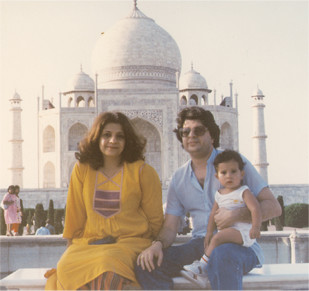
With late husband Marazban and son Kaarl
According to Dinaz, the Parsi community is quite self-sufficient, especially in Cusrow Baug. She says: "Since many Parsi senior citizens are attacked in the city, we have made an arrangement with the Colaba Police, which is ever ready to help Colaba residents at any point of time, to survey the Baug every night and check for any antisocial elements. There are two constables who visit senior citizens at least once a week.” In fact there have been Zoroastrians outside her constituency who have approached her with housing and other problems which she has tried to solve.
Her views on interfaith marriages are liberal: "If a couple’s happiness lies outside the religion, then nothing else should matter... I have come across so many non-Parsis wanting to become Parsis. But our religion does not allow that. On the other hand, Parsi women who marry outside the community are ostracized. This is another balance we need to strike.”
She strongly believes in changing with the modern times. As far as dakhmenashini is concerned, "you can’t stick to old customs if they’re not feasible. If dead bodies are just lying at the Doongerwadi due to lack of vultures, it is better we breed vultures, which, I know, is very difficult in a concrete jungle like Mumbai. Otherwise, cremation is the best alternative.”
She also feels that Parsis should be allowed to adopt non-Parsi children, "after all, everybody was not a Parsi when Zarathushtra needed followers. Our Prophet had to bring them into the Zoroastrian faith. I feel that conversion should be allowed, as only then the religion could be brought out, followed and expanded.”
Dinaz would like Parsi youngsters to follow the footsteps of community stalwarts who have made a mark in society. She knows that what she has achieved is not enough. "Problems such as poverty, education, etc will carry on,” but her source of inspiration being Rane — "who has himself had a modest upbringing and is so hard working” — she plans to move ahead and work on a Slum Re-Development Scheme where slums are demolished and slum dwellers accommodated in buildings, complete with basic amenities. "It depends on how much people trust me. If one thinks that one can use this Scheme as a political gimmick to win elections, then nothing will be achieved. We need to tell developers to follow the Thana model, execute a sample model first and show it to the slum dwellers. If this Scheme comes through, Mumbai will be a beautiful place, with less garbage.”
Aware of the fact that in politics one cannot please everybody all the time she says: "Somebody or the other will always be disgruntled who will definitely try to malign a good name.” She though has managed to earn respect for the Patrawala name and legacy with her charm, hard work and well-honed political skills.
◆ ◆ ◆
From the archive