
Events & Personalities
Turel's tour de force
Crushed by the weight of her co-passengers when their vehicle met with an accident on the Gujarat highway on June 10, 2004, 17-year-old Tasneem Pardiwala was a bag of pain. With her spine fractured in two places, the pain in her lower neck, right shoulder and mid back permitted limited movement of the arms, none in the legs, though mercifully, she could perceive sensations all over her body. Her bladder was catheterized; her breathing seemed normal, notes a press release.
It was a grueling journey from a nearby hospital in Bhuj to her arrival late on June 12 at Bombay Hospital where she was whisked away on entry for X-rays, CT and MRI scans and electrical tests known as the Somato Sensory Evoked Potential — SSEP — to document the speed of messages from and to the brain via the spinal cord. The reports indicated that spinal surgery was urgently called for, so on Sunday, June 13 Dr Keki Turel, head of the department of neurosurgery at Bombay Hospital, and his team swung into action.
What turned out to be a 17-hour marathon began with the surgeon eliminating the fractured vertebra at the base of the neck with the aid of a hi-speed drill as shards of the broken bone were impinging on the vertebral canal thus easing the pressure on the spinal cord. In place of the eliminated vertebra Turel is said have used a sliver of bone harvested from the pelvis and retained it in place with a titanium plate screwed into the neighboring vertebrae on either side.
Next the patient was turned on her left side. Exposing the vertebral column through the lower part of the rib cage Turel located the totally shattered vertebra in the small of the back, drilling away the bits which compressed the spinal cord. To fill the ensuing space the team created a solid titanium cage filled with bone chips, further shoring up the stability of the spine with a titanium plate screwed to it as well as the adjacent vertebrae.
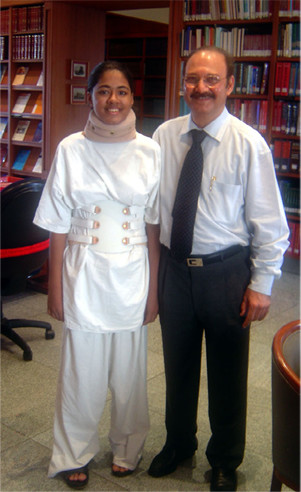
Pardiwala (left) and Turel
The extensive surgery proceeded through the day and night ending in the early hours of June 14. To their joy Tasneem awoke "absolutely bright and crisp!” The following day saw power return to her legs. By the fourth post operative day she had been made to sit up and walk. Post operative X-rays showed perfect alignment of the spine and complete decompression of the spinal canal at both sites, notes the write-up. The spectacular effort of the neurosurgical team was boosted by the complementary commitment of the neuroradiologist, anesthetist, the operating room and ICU staff and the skill of the physiotherapist as Tasneem recovered, Turel shares the credits with the entire team.
After about a fortnight’s hospitalization, Tasneem was back on her feet, "100 percent normal, with all bodily functions fully restored.” The Bohri community is said to have shouldered the entire expense of the treatment.
When Parsiana contacted Turel to explain some of the technical terms used in the release he had just completed celebrating "the first birthday” of a 38-year-old lady who would have been given up as brain dead had her family physician not rushed her to a hospital ICU and called Turel at 1 a.m. "to see if anything could be done.” Within the half hour his team was ready at Bombay Hospital. The patient was wheeled straight onto the surgery table. Turel says they removed the bone cover of the brain, released the pressure caused by the hemorrhage and allowed the swollen brain to return to normal. Until they had found the cause of the problem in the following days and rectified it, the patient was maintained without the bone cover of the brain. Today she is entirely normal and happy to be alive, Turel tells us.
The surgeon adds that but for timely surgical intervention these cases might have joined "the long list of ‘spinal cripples’ adding to the mental and financial agony of the patient, the family and the exchequer.”
Arnavaz S. Mama
◆ ◆ ◆
From the archive