
Books
The recreation of wealth
"Not many books are in demand 20 years after first publication,” notes the introduction to the fourth edition of author Russi M. Lala’s book The Creation of Wealth: The Tatas from the 19th to the 21st Century. The 303-page hard cover edition published by Penguin Books India Private Limited (11, Community Centre, Panchsheel Park, New Delhi 110017) and priced at Rs 450, is a revised and updated version deleting some portion of the earlier edition and adding "developments between 1992 and 2003.”
These developments include the challenges posed by liberalization, the dramatic turnarounds in Tata Motors (formerly TELCO) and Tata Chemicals, the planned success of Tata Steel (formerly TISCO), the growth plans for Tata Consultancy Services (which went public this August) and the Tata philosophy.
In the foreword to the third edition J. R. D. Tata had written the Tatas had been "criticized at times for not being enterprising enough in diversifying into new fields. I personally believe it reflected not so much a lack of enterprise as the impact of two forces on the firm’s policies and progress: on the one hand, an unwillingness to compromise certain principles but for which, in the licence and permit raj in which private enterprise has had to operate in our country for the past 40 years or so, growth and diversification would undoubtedly have been greater; on the other hand, long, perhaps too long, adherence to the belief that Tatas’ principal role was to develop basic industries, as a result of which they are today more vulnerable than others to government controls, and even to nationalization.”
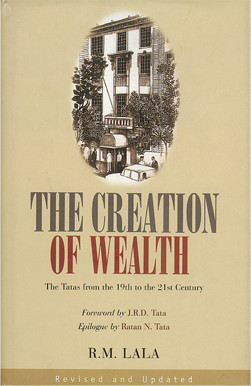
Rather than review the book once again in Parsiana we thought it fitting to reproduce certain excerpts like the epilogue in the fourth edition which has been penned by Ratan N. Tata, the present chairman of the group. He notes, "When I reflect on the 10-odd years that I have been chairman of the group, I cannot help but recall the day Jeh told me that he was stepping down and that he was appointing me in his place as group chairman.
"I remember it was a Monday afternoon at 12.30, on March 23, 1991, which is the appinted time that I met him every week, and it was the Monday following a week he had spent in the hospital recovering from an angina attack which he had in Jamshedpur. I had been in to see him every day in the hospital and we had talked mostly of non-business issues. On this afternoon he confronted me with his usual ‘Well, what’s new?’ which was his standard greeting to me every Monday. I said, ‘Nothing Jeh, we only met on Friday. There’s nothing new since then.’ He smiled and said, ‘I have something new. I’ve decided to retire as chairman and to appoint you in my place as Tata Sons’ chairman.’ Needless to say I was overwhelmed — and a bit speechless. He went on to say, ‘I haven’t decided the day because I have to consult Ajit Kerkar.’ That sort of jolted me a bit. He then clarified that Ajit was very good at picking auspicious dates and he wanted the day to be an auspicious one.
"So on that presumably auspicious day decided on by Kerkar, the momentous board meeting was held at which time he very eloquently and touchingly spoke about his years as chairman, how much he’d enjoyed them, what he felt he had tried to contribute during his time, what he thought his achievements were and his frustrations. He talked a great deal about the firm and what it stood for. And then his reason for ‘passing the baton,’ as he put it, to a younger person.
"Obviously my response to his eloquence was absolutely lost to the winds. I was nervous, awe-struck and therefore quite ineloquent. As we left the meeting, I walked him back to his office and with his very characteristic humility he turned to me and said, ‘Do you want me to move out of my office?’ I said, ‘Of course not Jeh — don’t even think about that. That office is yours. It’s your space and nothing is really going to change. I look to you as somebody I will always turn to.’ And although I said that and I meant it, I did have some concerns that Jeh would be in the office every day, that he would interfere and that he would forget that he was not any longer the chairman, that he would be irritable and render somewhat impotent the moves that I was hoping to make.
"All these fears I had were unfounded because he was just fantastic. He was indeed in the office every day, but he never interfered. He acted as the senior statesman. He was available for counselling, he was available for advice, he was available for guidance. He was my best adviser. When I turned to him he was supportive of many of the moves I tried to make. He was an encouragement to me in my early days and he had become like a second father to me, which he continued to be till the end. I often told him that I wished that both of us were 10 years younger so that we could have enjoyed the relationship that we had developed for a longer period in time.
"And it’s known to many that Jeh and I shared many views, but that we also differed in many of our views, or had differences in terms of approach. More often than not, Jeh was right, and I was wrong. But he allowed those differences to exist. We agreed to disagree very often. But most of the time we were on the same path, maybe the route to the end might have been different. The short period of time that we worked together in our new roles was a wonderful and a very worthwhile experience. I truly am sorry that he passed away (November 29, 1993) so soon as he did after the change.”
Ratan Tata adds, "What I would like to leave behind is a group which is more institutionalized rather than personalized like it was in Jeh’s time. And a group which could continue to operate and grow effectively, irrespective of who the leader might be...
"I would hope that my successors would never compromise and turn to soft options to meet their ends, and never allow the Tata group to join the growing number of companies in India which have shed their values, forgotten about their integrity, and closed their eyes to maintaining ethical standards. If J. R. D. Tata was able to uphold the values of the firm and if I have been able to carry on the tradition through my tenure, I hope the future generations in Tatas will recognize these traditions as being critical to the fabric and the fundamentals on which our group was built and grew so successfully for over a century.”
Core values
On being appointed managing director of the Tata Iron and Steel Company in 1992 Dr J. J. Irani Kt jotted down the following points while on a flight from Bombay to Jamshedpur which have been reproduced in The Creation of Wealth.
"What I (as CEO) must do:
–Develop a personal vision — what do I want to accomplish in life.
–Tell the truth about current reality.
–Do the tough things no one else wants to do.
–Restructure the Top Team, if necessary.
–Build a powerful guiding coalition — management and board.
–Guide the creation of a shared vision.
–Take the responsibility of being the main change agent.
–Create endless opportunities for two-way communications.
–Create opportunities for innovations in the rank and file.
–Maintain focus.
–Realign Human Relations systems, overcome obstacles.
–Model the desired managerial behavior — above all maintain credibility.
–Preserve the core values of Tatas (and my own).
◆ ◆ ◆
From the archive