
Books
Good sports
Icons from the World of Sports by Gulu Ezekiel. Published in 2003 by Puffin Books, a division of Penguin Books India (Private) Limited, 11, Community Centre, Panchsheel Park, New Delhi 110017. Pp: 125. Price: Rs 175.
The author, Gul-Fraaz Mohan Ezekiel is known in the sports world simply as "Gulu” Ezekiel and the name has over the years become as famous as the game of cricket of which he has been one of the most prolific and enduring commentators and writers. With his recently released Icons from the World of Sports, Ezekiel has now completely and conclusively shed his long-held image from being one of the world’s best cricket writers to an authoritative sports journalist. Icons brings you the life stories of 11 contemporary Indian sports megastars who have changed the sporting face of India by their achievements, inspiration and world class performances.
Highlighting in his most inimitable style the careers and exploits of Sachin Tendulkar, Leander Paes and Mahesh Bhupathi, Narain Karthikeyan, Chiranjeev Milkha Singh, Bhaichung Bhutia, Anjali Vedpathak Bhagwat, Dhanraj Pillay, Pullela Gopichand, Viswanathan Anand and Karnam Malleswari, Ezekiel has demonstrated complete mastery over the theoretical and practical aspects of 10 widely diverse sports. His observation on different intangibles such as fear, determination, imagery, perseverance and genetics is well balanced by his great understanding of corporate sponsorships, coaching and the role of money in general and pecuniary incentives in particular, in shaping world-beating performances. It is this conquest of technical and emotional details which makes this book different from the rag-tag collation of stories and statistics which have been in the past dumped upon an unsuspecting sports frenzied public by fly-by-night sports ‘gurus.’
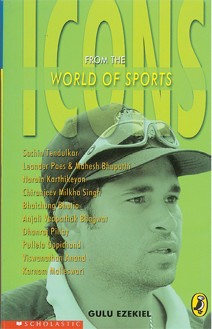
This book is a must-read for all sports buffs, especially competitive sportsmen. The book which has been dedicated to his parents Khorshed and Prof Joe Ezekiel has 11 very life-like portraits illustrated by Sujata Bansal. This is Ezekiel’s ninth book and by far the best and most motivating, clearly surpassing his celebrated Sachin: The Story of the World’s Greatest Batsman.
Despite the fact that we have had an overdose of cricket and ‘Sachinmania’ has reached cult proportions, the piece on Tendulkar is refreshingly different and absorbing especially the fact that Tendulkar was a bully in school and that in his epic world record stand of 664 runs with Vinod Kambli in 1988 against St Xavier’s School, he, as the captain, disregarded his coach and mentor Ramakant Achrekar’s diktat to declare the innings! That Sachin is only human is brought out by emphasizing that his school and test debuts yielded only 24 and 15 runs respectively.
Ezekiel: char-ting sports careers
The interplay of pride, ego and jealousy is very subtly stated in the section on Paes-Bhupathi to remind us of the dream that turned into a disaster and all this after the duo termed aptly by the world of tennis as the ‘Indian Express’ had raised the profile of tennis in India and put India on the world tennis map as a veritable powerhouse.
The story of Karthikeyan is a tear jerker in that it highlights that without corporate sponsorships the modern day sports gladiator is without his sword and armor. The racer squarely (and perhaps rightly) blames it on cricket. Cricket’s gain is all other sports’ loss, has always been the lament of Indian sportsmen. It is indeed an eye-opener to learn that aspirations of participating in just one Formula Three Championship requires a minimum budget of over two crore rupees and "buying a seat in a Formula One Team” costs a whopping Rs 25 crores!
Ezekiel’s inclusion of golfer Singh alongside the other 10 world beaters is intriguing. The shadow of his father, the legendary Milkha Singh will always loom large over Chiranjeev and it will be very difficult for him to be referred to as anything except Milkha Singh’s son!
The feature on Bhutia traces with pride the rise of an unknown kid from an unknown village, Tinkitam, in Sikkim, to be the first Indian to play professional football in Europe. Ezekiel is succinct in his characterization of Bhutia. "What distinguishes Bhaichung from the great Indian players of the past is his attitude and desire to challenge the best... he was not content to merely savor domestic success,” and all this despite the fact that every coach who has worked with Bhutia rightly felt that his fitness left a lot to be desired!
The shooting star Bhagwat’s tale is one of a late bloomer. Introduced to shooting in her late teens she attained ‘world champion’ status within about 10 years. The tremendous mental and physical stamina required to perform over long periods of time in shooting is also explained with stunning examples. Ezekiel accentuates the attitude of Bhagwat by recounting her answer to English journalist, Mike Sinclair’s question whether she would like to be known as the female Sachin Tendulkar when she snapped: "I have my own identity.”
Politics, factionalism, mismanagement and a complete disregard of the sportsperson by the administration has always been the bane of Indian sports. The cruelest brunt of this attitude has been borne by the mercurial and temperamental superstar of world hockey, Pillay, the son of a mali (gardener). The Arjuna, Padma Shree and Rajiv Gandhi Khel Ratna Award winner’s bitter comment: "I would not like my son to play hockey,” is indeed a sad reflection of the state of hockey in India.
Ezekiel charts the injury prone shuttler Gopichand’s exploits at winning the All-England Open in 2001 with clinical details and highlights how Gopichand "made a conscious effort not to remember the past record against a particular player” and how he was "never in awe of the world’s best.” He also commends Gopichand’s character for turning down a lucrative endorsement deal from a cola company which was based on his opinion that a sportsperson should not endorse a product that is bad for one’s health.
Considering that chess is played in 200 countries, Anand is arguably the greatest Indian sportsperson and holds the Indian record for winning the biggest single prize of $ 6,60,000 for the world crown in 2000 and his appearance money is about $ 1,00,000 per event! Yet, the most striking feature of Anand’s personality is his humility.
The journey of school dropout Malleswari from training at home with bamboo sticks and stones to training for years in a dilapidated and rusty vyayam mandali gym in rural interior Andhra Pradesh to world championship golds and an Olympic bronze is a story of sheer toil, determination, pain, sacrifice and complete single-mindedness against all odds. Malleswari is the lone woman Olympic medallist from India.
This book is absorbing, highly motivating, very crisp in format and style. A must-buy. The cover page though should have carried the photos of all 11 icons — after all, this book is not just about Tendulkar and cricket!
Dr Rohinton Mehta
◆ ◆ ◆
From the archive