
Cover Story
Weaving a fortune
Despite setbacks and disappointments, the Pestonjis of Hyderabad built a thriving textile business
"Making money is easy, but earning an honest rupee isn’t,” reveals Capt Kayarmin Pestonji who has been spearheading the retail and manufacturing industry in Andhra Pradesh. It is this nobility of thought and intent that has put his enterprise, Cherma’s group, in a league of its own. With the latest addition to the Cherma’s line of showrooms at Malakpet in Hyderabad, the total retail area is spread over 63,000 sq ft, a staff of about 700 and an annual turnover of 63 crore rupees.
Battling different challenges at various points in time Kayarmin and his wife Gool have managed to build one of the largest garment retail and export empires in the state of Andhra Pradesh. On August 1, 1980 the first retail shop called Cherma’s named after their daughters Cherazad and Maniza was started with a staff of nine people. Within a decade they had started another showroom Cherma’s Exclusive. Yet another company Cherma’s Exquisite Limited was started in 1985 for rationalization of purchases for a planned distribution of goods between various outlets and 1988 saw another showroom, Cherma’s Extension. The company started manufacturing in 1987 with units at Bombay and Erode in Periyar, Tamil Nadu.
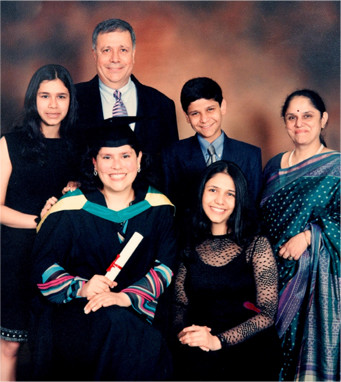
The Pestonjis: (L to R, standing) Jasmine, Kayarmin, Kaizad and Gool; (sitting) Cherazad and Maniza
The unit itself has various departments that deal with sampling, cutting, design and development, production, finishing, ironing and packing, all achieved with the help of cutting-edge technology. The production floor, a well lit and ventilated area, is divided into 14 lines and four modules. A line supervisor, line quality controller, in-line quality auditors and checkers monitor each line.
A decade later in 1998 Cherma’s Expansion, a modern vision showroom of ready-mades at Ameerpet in Hyderabad with a floor area of 18,000 sq ft, was launched. Just a year later Cherma’s Excellence started a business of textiles, fabrics and saris. The following year Pestonji started a manufacturing unit at the apparel export park at Gundlapochanpalli about 18 km on the National Highway from Hyderabad. This was an initiative taken on the request of the then chief minister of Andhra Pradesh, Chandra Babu Naidu.

Quality assurance is ensured as all garments are subject to stringent quality inspections at every stage of production. Not surprisingly Cherma’s clientele goes way beyond the local market and Indian shores. Their world-wide clients include Wal Mart, JC Penney, The Children’s Place and Kohl’s in the USA and EWM, Eurofashions, Otto Agn, Lowe Alpine and Switcher in Europe. The units have a present production capacity of three million garments, and the annual turnover of the group is over 25 million dollars. The group was awarded the best management award for its outstanding contribution in the maintenance of industrial relations, labor welfare and productivity. "We believe our strength lies in the welfare of our work force.” Towards this they have introduced welfare measures like a provident fund facility, insurance, medical facilities, safety precautions, maternity benefits, a creche which is run free of charge, free snacks, safe and clean drinking water, rest rooms and company transport for the staff.
A trifle emotional, Kayarmin says, "I started life with neither a silver nor a golden spoon in my mouth, but what my parents always ensured was that I had at least a stainless steel spoon in my mouth.”
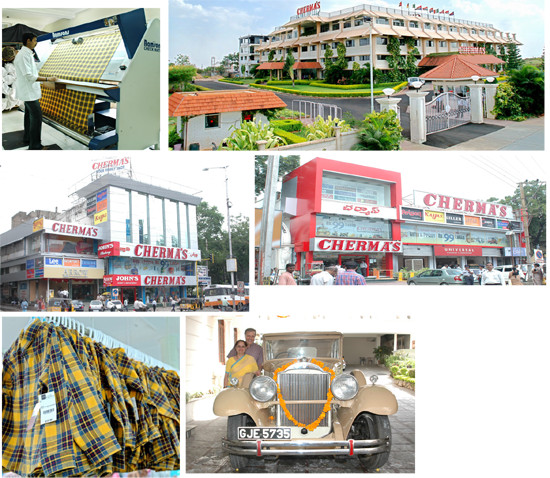
Top: The production floor and exteriors of Cherma’s factory; Center: Their showrooms at Hyderabad (left) and Secun-derabad; Bottom: ready-mades for sale, and Kayar-min and Gool with their 1933 Packard
Son of the late Ferozshah and Persis Pestonji, Kayarmin studied at St George’s Grammar School and later at the Nizam College, both in Hyderabad. The interview was repeatedly punctuated with comments about how his family have all contributed to the success of the business enterprise. Using the analogy of a Rolls Royce car he viewed himself as only the radiator grill and mascot. The family comprised all the other parts that actually ran the car! "Without my wife Gool’s untiring support and confidence I could not have done it,” he declares.
In order to pursue his passion for adventure which included car and motorbike rallies and of course flying in particular, Kayarmin started flying at the Andhra Pradesh Flying Club in 1967 and obtained his commercial pilot’s license in 1970. In 1972 he joined the Andhra Pradesh Flying Club as a flying instructor only because in those days he didn’t have a godfather to push his case as a pilot for Indian Airlines which was the only domestic airline at the time. Disappointed but not dejected, Kayarmin decided he had to look elsewhere to earn since his growing family needed more than just a flying instructor’s salary to make ends meet. To this end, he opened a little garage, bought and repaired old motorcycles including those of his college friends. These were sometimes brought all the way from Delhi because they were cheaply available there.
He married Gool in 1975 after an eight-year courtship. "We were as happy in those days as we are today, even though in those days we had very little — today we have everything but the responsibility is immense,” the soft-spoken, unassuming 55-year-old Kayarmin, dressed in "Kaizjas” jeans and a checked shirt, confesses at his palatial home on Chiragali Lane, Hyderabad. Greeted by an ambience distinctly redolent of the days of the nawabs and nizams without the decadence, we are also welcomed by Charles and Simba, a pair of majestic collies who grace the Pestonji home.
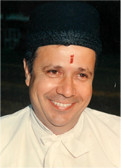
Kayarmin Pestonji: cor-porate flyer
"Our Lakshmis”
By 1978 two of their daughters Cherazad and Maniza were born. "Our Lakshmis” is how Kayarmin refers to them. "Gool had a job with the Canara Bank and life went along but by the time the month ended we looked forward to the pay cheques.” At this point things took a turn. Due to some dispute the Andhra Pradesh Flying Club was closed and the aircrafts sealed. Kayarmin suddenly found himself without a job. That is when his elder brother Dadafarid came to his aid and offered him an opportunity from which he has scarcely looked back. Kayarmin and Gool traveled to the interior parts of Andhra Pradesh to source handloom cloth from the primary cooperatives for Dadafarid who already had an established business in Bombay. Dadafarid told Kayarmin that he would pay him 10 paise per meter of cloth to oversee and supply the material to him on time. Lakhs of meters of cloth were at stake. On visiting the looms in the interior districts both Kayarmin and Gool were aghast to find that in spite of so much raw material being available, no work was being done. It was a challenging time and there was much to learn about colors, dyes, yarns, etc which Kayarmin learnt very quickly. He soon became a full-time weaver and the shuttles on the looms began to fly once more. Kayarmin now dealt directly with the weavers having become one himself and did away with the middleman — Andhra Pradesh Cooperative. By doing this he saved one rupee per meter and transferred the profits to himself and his brother by splitting it down half way. Excellent profits accrued as a result of this move since lakhs of meters were involved.
The next trial was when the government quotas for handloom fabric created a huge surplus situation for Dadafarid. Kayarmin rose to the task. He brought two truck fulls of garments for sale to Hyderabad. In search of premises to hold the sale Kayarmin requested the principal of his alma mater for permission to use the gym of the school. The sale was a huge success and in no time they had sold out everything. By this time Gool had given up her job at the Bank with two children to look after and a growing business to support apart from being the homemaker that she already was.
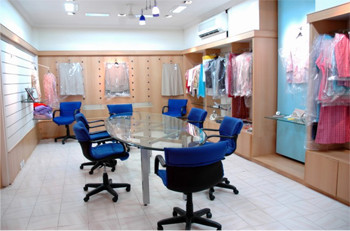
Cherma’s range of products
A serious need was felt by the family to have their own business space. In spite of the success of the sale, money for such a venture was still in short supply. The Babukhans who Kayarmin knew since his school days offered him space in one of their buildings at the Basheer Bagh Cross in Hyderabad. Having a fixed space the business flourished with Kayarmin finishing all the stocks his brother had. He also converted the fabric from the dead stock into garments and this also sold very quickly. Being closely associated with job-workers, the surplus market and the growing export market both Kayarmin and Gool decided to grow bigger. Once again family and friends rallied around with financial and other assistance. With six lakh meters of fabric of all varieties and textures on hand they started converting them into garments. Just as things began to look rosy they hit a major bump on the road. The Babukhans wanted their space back as the lease ran out. Kayarmin felt temporarily devastated. What now? By now they had developed a firm customer base and loyalty, and both Gool and Ferozshah felt that the time was now right for them to invest in their own permanent space and convert to a full-time business. Thus was launched Cherma.
The elder two daughters have now joined the parents in business. Cherazad, the eldest, who has completed her masters in garment technology from Nottingham University, UK heads the production and design team. Maniza who took her masters degree in international marketing and management from Leeds University in the UK is director, marketing. Jasmine and Kaizad, the younger siblings are still students and also hope to join in soon. Their inhouse line of ready-mades is called "Kaizjas” after the younger two children.
Success has brought in its wake trauma too. While entering his home one night after a day’s work, Kayarmin was stabbed 11 times on his arm and shoulder by unidentified people. "God wished me to live, that is the only reason I am still around. Otherwise there was no way I could have survived the attack,” he acknowledges. In the second instance, a huge fire in the Hyderabad showroom which raged continuously for 18 hours in spite of 40 fire engines at the site, was another major setback. Belying all conjecture, Kayarmin’s true spirit of ‘never say die,’ surfaced and he opened shop in less than two weeks to welcome customers the same Diwali. When battling the odds, the family saw the wonderful side of human beings as help poured in.
Feeling obliged to reciprocate the goodness of society they are involved with many social and community development projects. In 2002 Kayarmin and Gool were honored at both the state and national levels with the Rashtriya Samman, an award given in recognition of their honesty and promptness in paying taxes. Outside recognition is all very well, but the Pestonjis need no validation from anyone else. Their immense award and reward is in a job done well and with integrity. It is ironic. Starting life with wanting to fly aircrafts, Capt Pestonji had hardly dreamt of being a corporate flyer. But life has a way of denying us our dreams so that we may fulfill a larger destiny.
◆ ◆ ◆
From the archive