
Youth
‘Bonding the fabric’
Zoroastrian Children’s Day initiator Vispy Kapadia wants to make the occasion an annual event
Forty buses with over 900 Parsi children from schools located in different corners of Bombay — from Colaba to Borivli to Nalasopara — thronged Allbless Baug on November 23, 2003 to celebrate the first Zoroastrian Children’s Day. Two hundred and fifty children who gave a belated response which unfortunately reached the organizers just a couple of days prior to the event, had to be turned down due to lack of space. Nevertheless a few Parsi children were present with their parents at the Baug’s gate at 6.30 a.m., anxiously waiting for some passes to attend the function. Without hesitation, a man gave away the passes which he had reserved for his own family. The man was none other than the brainchild behind Zoroastrian Children’s Day himself, Kyoshi Shihan Vispy B. Kapadia, the man with an iron will to unite Parsi children from all walks and strata of society.
The aim behind celebrating Zoroastrian Children’s Day is the same as behind celebrating Children’s Day in India on November 14, Pandit Jawaharlal Nehru’s birthday — to give importance to children as they have a rightful place in the world. The day and date do not have any relevance to the Zoroastrian religion. It so happened that Allbless Baug was available only on that day. Kapadia adds: "As a Zoroastrian, I felt that at every level things are being done for Parsis except for our children. Also, there is so much of bickering within our community; I wanted to bring in a breath of fresh air. What better way to do that than to involve our children! I decided to start a Zoroastrian Children’s Day.”
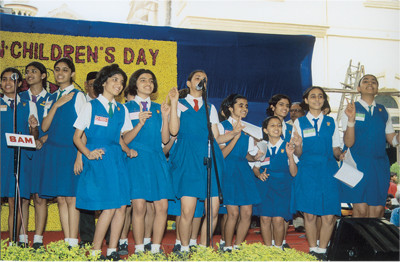
Children rendering religious songs
The essence of Zoroastrian Children’s Day is not just fun and frolic, but to "bond the fabric of our children,” to bring about an awakening in the Parsi children: "I want the sanctity of the Zoroastrian religion to be preserved. Parsis must wear a sudreh and kusti. It is sad that the Parsi youth discard these at the drop of a hat. Every Parsi child should pray every day at home. Grooming our children and imbibing in them the right values at a tender age is very important. What they learn at a young age will remain with them forever and they will automatically (learn) the good things such as caring for fellow Zoroastrians, supporting their kith and kin, respecting elders and teachers. Today, it is shocking to see children disregard their parents and teachers. You may go abroad, evolve in many ways, but you mustn’t forget the Zoroastrian traditions,” stresses Kapadia.
Initially, Kapadia had his apprehensions as to whether the children would enjoy one full day in each others’ company, in the absence of their parents. But his fears were unfounded: "They were so happy, they had never expected to attend such a big function with so many Parsi children from all over Bombay to interact with. Not a single person has criticized this event. I have received several appreciation letters and phone calls from children, parents and guests saying that the next Zoroastrian Children’s Day should be celebrated on an even larger scale. What more can I ask from God? That day it rained, unexpectedly. God, too, showered his blessings on us!”
Apart from a number of principals, teachers and local volunteers, a host of policemen were present to assist the young. At 8 a.m. sharp the young boys of the Dadar Athornan Boarding Parsee Madressa performed a jashan ceremony. The two high priests, Dasturs (Dr) Kaikhusroo JamaspAsa and Khurshed Dastoor arrived at 9 a.m. Kapadia hoisted the Zoroastrian Children’s Day flag followed by a hambandagi led by the principal of the Madressa Ervad (Dr) Ramiyar Karanjia. Speeches on various aspects of the Zoroastrian religion were delivered by the high priests and scholars such as Zoroastrian Studies founder Khojeste Mistree, Dr Homi Dhalla and Karanjia among others. Mistree with wife Firoza, grouped the children and briefed them on the basic tenets of Zoroastrianism, followed by a quiz.
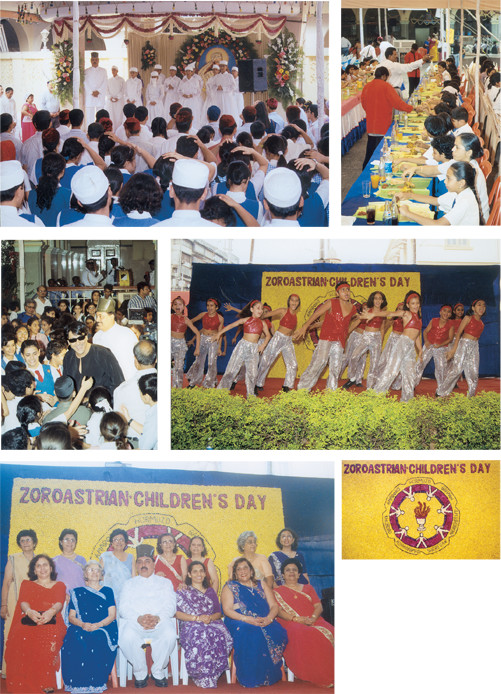
(From left) Top: Morning jashan and partaking of the hearty repast; Center: Davar mingling with children with Kapadia in the background and chil-dren entertaining the audience; Below: (standing) Sanjana, Abaan Patel, Commissariat, Tehmina Damanwalla, Marfatia, Dilnavaz Billimoria and Freny Mehta; (seated) Bagli, Daroga, Vispy and Shiraz Kapadia, Basla and Gool Ghadiali; floral emblem of the newly created logo
There were also other speakers such as ZOSTA (The Zoroastrian Student Teacher Association) founder-chairperson Dolat Doongaji, noted social worker Mithoo Jesia and others. The Baug was charged with both serious and fun-filled activities: a short play on the life of Prophet Zarathushtra performed by students of Activity High School, Dinyar Contractor’s skits and jokes, dances, etc. Kapadia comments: "Nearly 200 children went into a frenzy and danced with Shiamak Davar. Each and every proceeding had a professional touch, including the hoisting and the lowering of the flag.” The talented compere, Hoshedar Khambatta, did a wonderful job. Three Zoroastrians were felicitated: Ervad Darius P. Bajan, who has performed a number of kriyas and rituals, Ayesha Billimoria, outstanding athlete and Rayomand P. Sidhwa, one of the youngest mobeds to serve the Iranshah. Not only the speakers and helpers, each and every child left Allbless Baug with gifts galore. Participation certificates too were distributed to add to the happy memories.
One has to be fond of children to celebrate a day like this on such a magnitude. Kapadia, a father of three — Sanaya, Vahishta and Behram, did not ask for help from sponsors but dipped into his personal funds: "Whatever I am in life today, it is because of children. In turn, I will do whatever I can for them. We wanted to establish this Day with the basic idea of inculcating Parsipanu in every form, whether it is lagan nu bhonu (wedding repast) or dancing or singing Parsi songs or performing skits or delivering religious talks. I’m sure our children have gained insights into the various aspects of Zoroastrianism and will remember them. Speakers like Dasturji JamaspAsa, Noshir Dadrawala and others explained the meaning of muktad, the significance of the sudreh-kusti, etc in such a lucid, child-like manner, the applause they received from our children was tremendous.”
Kapadia’s main source of inspiration is his late daughter, Fareena, who died at a tender age of five: "My daughter was very compassionate towards the poor. Whenever she would come across any poor person, she would ask me whether he or she had eaten anything and prod me to give something to that person. She was an evolved child.”
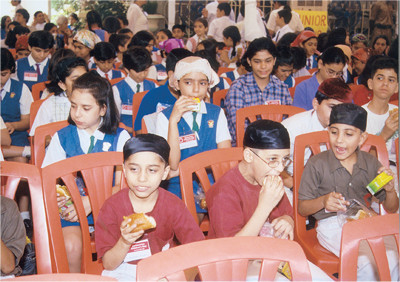
Snacktime at the function
He is fortunate to have the support of his dedicated and religious wife Shiraz: "There are times when things don’t go my way and I feel that I’ve bitten off more than what I can chew. That’s when Shiraz comes as a beacon of light offering me her moral and physical support.” Often, Shiraz has had to leave the children unattended at home to be able to help Vispy with the arrangements for the Zoroastrian Children’s Day.
Going about organizing this Day was a herculean task: "Firstly, without ZOSTA’s unstinted support, getting so many children together on this Day would not have been possible. Zenobia Daroga, chairperson of ZOSTA, was very receptive when I approached her with my brainchild. She got all the committee members and schools involved.” ZOSTA committee members comprise 20 principals of Parsi schools. Daroga and Perin Bagli, secretary of the ICSE (Indian Certificate of Secondary Education) schools in Maharashtra, "were the soul of this event.” Apart from being grateful to ZOSTA committee members secretary Zarine Basla, Diana Marfatia of the Byramjee Jeejeebhoy Parsee Charitable Institution (BJPCI) and Navaz Sanjana formerly of Girton High School, to name a few, who were wholeheartedly involved in this event, Kapadia is also appreciative of Silloo Commissariat, former principal of the Bai R. F. D. Panday Girls’ High School who was coordinator of all the SSC (Secondary School Certificate) schools in Bombay. He continues: "We had also to get volunteers, arrange for buses, approach caterer Nariman Dalal, panthaky of Mazgaon’s Patel Agiary, and Khodadad Irani, proprietor of Wibs, who served sumptuous and delicious breakfast and lunch, make arrangements for the Bombay police band, give invitations to the high priests and all the speakers, purchase gifts to be given away to each and every individual who attended the function, and so many other minute details...”
There was another significant thing to be taken care of, designing the Zoroastrian Children’s Day flag, the credit for which goes to Bagli. The flag shows seven Ameshaspands at the periphery, with children holding hands and the sacred fire burning brightly in the center.
Zoroastrian Children’s Day will be celebrated once a year. But to celebrate this one day, Kapadia will have to work towards the betterment of children for the remaining 364 days: "I intend to start a lot of programs for children. I’m planning to give membership cards to children so that communicating with them and bringing them together for big functions becomes easier. I have a few more surprises up my sleeve! I also want to do something for the Parsi youth.” A number of Parsis have volunteered to extend their support for the next year’s celebrations. The next Zoroastrian Children’s Day will be held in November 2004, "preferably, on a Sunday.”
Word of the event has spread across India and abroad. Kapadia has received letters from Parsis residing in Gujarat and other Indian states who wish to come to Bombay to celebrate the Day: "I will invite them and pay for all their expenses, maybe even treat them to a Bombay Darshan Tour. I want to encourage more and more Parsi children to interact with each other.” But he does not plan to hold the celebrations outside Bombay. "We are in a strong position here and can get things done fast. We cannot organize the celebrations outside Bombay or even abroad as it is very difficult to create the necessary infrastructure.”
All parents should encourage their children to be true Zoroastrians, come forward and work for the betterment of the community and for the Zoroastrian religion, he believes. "As long as I can build a strong fabric for our community at the grassroots level, I’ll enjoy every bit of the work I do.” He doesn’t know how long it will take him to achieve this goal: "One needs to focus on this as our children are our future.”
◆ ◆ ◆
From the archive