
Events & Personalities
Peace projects
At the conference on "Unity of minds” that dwelt on enlightened citizenship, the President of India Dr A. P. J. Abdul Kalam spoke about his vision of transforming the country into a developed nation powered by a robust economic growth and a value system. Religious leaders from all over the country were invited to express their views on the theme of the conference. The President was greeted at Terapanth Bhavan by young children chanting hymns, states a press release.
Representing the Parsi community of India, Dr Homi Dhalla stated that religious leaders should not confine themselves to the religious domain but speak out on important issues which affect society at large. He impressed on the need to curb population explosion which results in unemployment, poverty and ultimately crime. Referring to the alienation of Muslims after the September 11 attack in New York, he opined that religious leaders should encourage interfaith dialog and a higher tolerance of the views of others.
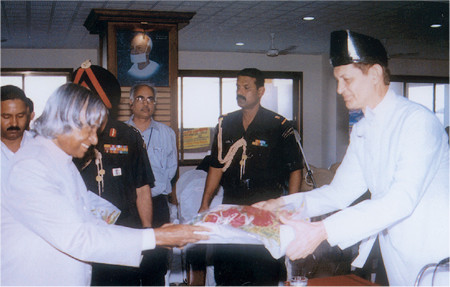
Abdul Kalam (left) with Dhalla
The meeting in Surat on October 15, 2003, held under the auspices of the Jain Vishwa Bharati Institute which is a deemed university in Rajasthan resulted in the chalking out of the Surat Spiritual Declaration which was presented to the President later in the evening at a public meeting. Impressing the nearly 10,000 strong gathering with his unwavering humanity and abiding humility the President showed deep concern in the Declaration and recommended the need for forging close ties among various religions that could result in communal harmony.
The signatories to the Declaration recommended the creation of garland projects to lift the nation enmeshed in a communal cauldron. They recommended the celebration of interreligious festivals, the initiation of multireligious projects in education, healthcare, water supply and for generation of employment, the need for religious educational institutions to serve as inclusive rather than exclusive centers, fostering a sense of peace and amity, the continuation of interfaith dialogs and the creation of an independent body to work as a focal point and a catalytic agent for the projects initiated. Included in the specially coined Peace Prayer was the central message of righteousness which is ingrained in Zoroastrianism: "Oh Almighty, bless the people to take a path of life with righteousness as righteousness gives the strength of character.”
◆ ◆ ◆
From the archive