
Business
Bombay’s business basics
The launch of the World Zarathushti Chamber of Commerce — Mumbai chapter marks a new beginning in the community’s commercial activities
"We pride being Zarathushti for our charitable disposition. We pride being Zarathushti for our impeccable integrity. We pride being Zarathushti for our enterprising spirit...We need to resurge as trail blazers and chart a course matching a bygone era which prosperity can emulate. Unfortunately we seem to be replacing this with complacency and self-centeredness,” declared Kersi Limath-walla, chairman of the Mumbai chapter of the World Zarathushti Chamber of Commerce (WZCC) which was launched on June 8, 2003 in the newly renovated airconditioned hall of the Banaji Atash Behram.
"The object of the Chamber is the economic well being of its members by providing them information and opportunities to do business on a global level, in an environment more conducive than ever before... There is no ownership, the members are the owners” of this business Chamber which will be strictly maintained "without the leanings and politics of some community bodies,” Limathwalla told the 200 plus gathering which included prospective and enrolled members as also many outstation Zoroastrians who were in Bombay that weekend to attend the executive council meeting of the Federation of Parsi Zoroastrian Anjumans of India. The WZCC which was set up during the World Zoroastrian Congress in Houston in 2000 already has four functional chapters in the USA, one each in London and Dubai, one in Delhi and the newly inaugurated Mumbai chapter which will operate from the Gamadia Polyclinic in Tardeo’s Gamadia Colony, on office space provided by the Bombay Parsi Punchayet (BPP).
"It is necessary that one should feel a sense of indebtedness to perform well in life...to pay back to one’s community, to the society, to the nation, to humanity in general and to Ahura Mazda for all the bounties showered,” concluded Limath-walla, after declaring, "Contentment can never be a virtue if it impedes your progress in life, if it hinders your pursuit of excellence, if it makes you selfish and uncaring for others around you.”

Following the jashan BPP chairman and eminent business economist Minoo Shroff lit the inaugural lamp to rekindle the entrepreneurial spirit in the Bombay community. Referring to the "social obligations of business and good governance” Shroff expected the new body to serve as an interconnection between business and business, an interface between business and government, to lobby with the government, to encourage, guide and show the road to success to upcoming entrepreneurs. "Don’t ask what you are going to get out of it but what you can contribute to it,” he advised the members. "We want entrepreneurial activity to be taken over by youngsters. The BPP will only be the guiding star in terms of logistics,” he declared, urging the community to show enthusiasm which is "like the baking powder of life. Otherwise the cake falls flat.”
Two keynote speakers were selected for the inaugural function: Cyrus Guzder, chairman and managing director of AFL Private Limited who gave a focussed discourse on "Why Parsis must become entrepreneurs again — turning your passion into a profitable business” and Areez Khambatta, founder chairman of Pioma Industries, the makers of Rasna soft drink concentrates, who gave a comprehensive speech on "Entrepreneurship.”
Calling to mind the typical attributes of an entrepreneur — hardworking, industrious, energetic; driven by a desire to make money; clever in his/her chosen field; neglectful of his/her family; prone to take risks — Guzder maintained, "Societies and nations owe a lot to entrepreneurs — they are the largest creators of wealth and employment.” Reminding the assembly that virtually all business activity and industry (except for core infrastructure) commences from a niche or small beginnings, Guzder noted, "Entrepreneurialism actually starts with an idea and it converts the idea into a commercial opportunity” by spotting a niche where you can make an entry into an activity, gaining a small toe-hold, thence building and growing.
He then cited innumerable examples of very successful businesses which were started by individuals on a very small scale: Air India, The Taj chain of hotels, DHL, Hotmail. "Entrepreneurs take the ideas of thinking communities (scientists, engineers, artists, designers) and convert these into products or services for people to consume,” mentioned Guzder pointing how people have minted money with catering, chocolate making, karate or dance classes, car hire services, housekeeping services, document management, warehouse management, event management, computer care... "Adding value through knowledge and better skills can then push the entrepreneur up the value chain,” reminded Guzder who viewed exhibitions and seminars as "a good starting point...(to) bring people and ideas together.”
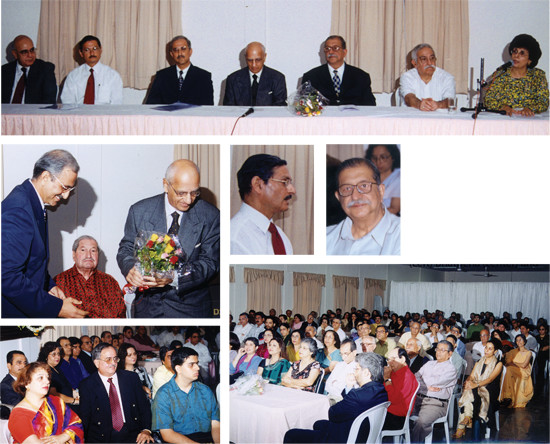
Top row (from left): Tamboly, C. Guzder, Limathwalla, Shroff, Khambatta, Mistry and Commissariat. Center row (from left): imathwalla presenting a bouquet to Shroff as Jamshed Guzder looks on; C. Guzder and Khambatta Photos: Sarosh Daruwalla (Left) Bhathena (center) and family with a section of the audience
With industrialists today choosing to reduce their head count and depend on outsourcing, the service sector is growing, giving individuals an opportunity to be self employed. The insurance, pharma and health care, education and training sector are the other avenues with potential, as identified by Guzder. The socialistic model adopted for post-independent India with misplaced emphasis on state entrepreneurship which gave the word "profit” a dirty connotation resulted in many lost opportunities. In the ’50s, ’60s and ’70s, it was the professionals who were respected, in the ’80s and ’90s, it was the managers and administrators, and following liberalization and globalization in the ’90s, the middle class have sought to graduate from managing to owning, observed Guzder who foresaw, "In the next few decades India will see a new set of entrepreneurs who are global in their vision and style.”
Quoting Ralph Waldo Emerson, "Every accomplishment starts with the decision to try,” Guzder reinforced, "So starting as a one-man enterprise you can develop and achieve global ambitions.”
Having "smelt the opportunity,” the creator of Rasna, Khambatta announced, "An entrepreneur creates opportunities not only for himself but for others and for society as a whole. These entrepreneurs were really creative persons driven by some restlessness and the ability to dare to take risks, to be the first and to be different from others, to create something and to be innovative... Whenever any innovative product is successful you will find a host of ‘me-too’ products by the ‘me-too’ entrepreneurs...Since the game of business is becoming more and more complex, one has not only to excel as an individual but to have excellent organizational support...”
An entrepreneur is required to surmount many challenges and obstacles, revealed Khambatta who insisted, "An entrepreneur is more than a businessman. He performs a very important and necessary function in a country’s economic development.”
Considering that advertising constitutes a major part of the product costs, an entrepreneur is required to acquire a thorough knowledge of marketing as also law and taxation, noted Khambatta who too like Guzder referred to the varied sectors where entrepreneurs can make a beginning and included plastics and electronics in his exhaustive list. "Sometimes an entrepreneur may select a business opportunity either through a chance event or through natural extension of his present occupation,” observed Khambatta who considered it his "bounden duty to see that the youths (are given) the necessary motivation and guidance at the right time to enable them to get a proper start in life.” A regular lecturer at the Entrepreneurship Development Institute in Ahmedabad, Khambatta offered to organize a special full-time progam of two or three weeks for about 15-20 interested participants.
"We look to India playing a leadership role,” noted WZCC president Rohinton Rivetna in his message on the occasion of the launch of the Mumbai chapter. Delhi entrepreneur Dadi Mistry who is on the international board of the WZCC referred to the headquarters of this body being in Chicago and the Delhi chapter functioning under president Farrokh Rustomji. He was hopeful that WZCC–India will start a chapter in Gujarat with Khambatta of Ahmedabad providing the lead.
The dynamic emcee Zarine Commissariat, member of the core working group, announced that the next meeting of the Mumbai chapter on July 18 had been planned as an interactive workshop. With industry and integrity engraved on its logo, the WZCC hopes to form a cyber-community with an extensive network of business and industries, professionals and students. By sharing information about achievements, aspirations and funding options, providing business counselling services, developing educational programs it seeks to build upon the Zarathushti brand equity and create an impact on society the world over.
Along with Limathwalla, the others serving on the managing committee of the Mumbai chapter are Kersi Commissariat, Zarir Bhathena, Minoo Mody and Merzy Chinoy.
Describing the evening’s keynote speakers as "examples of Zoroastrian entrepreneurial spirit at its very best,” an active member of the core working group of the Mumbai chapter, Dinshaw Tamboly noted in his vote of thanks, "A long overdue dream has become a reality. Looking at the commitment and dedication with which the Mumbai chapter has been steered” Tamboly was sanguine it "would provide an ideal platform for the Zoroastrian entrepreneurial spirit to flourish.” Expressing his gratitude to the day’s sponsors Hilla Builders, the budding entrepreneurs Tanaz Godiwalla and Sarosh Daruwalla, Homi Mullan, honorary secretarial coordinator of the WZCC-India and the BPP administration in the creation of this chapter, Tamboly added, "The WZCC is destined to succeed.” Calling upon the audience "to support this win-win project of our community,” he declared, "The future of any community or country depends on how it plans for the same.”
◆ ◆ ◆
From the archive