
Cover Story
The family spirit
Two Nagpur business houses - the Bapuna group and Dinshaw's Dairy Foods - join hands
Their product portfolio is varied. A chilled glass of their Super Jet beer may slake your thirst on a midsummer morning, a quaff of Imperial Falcon Whisky, Pure Gold Rum, Lady Di Vodka or Marie Antoinette Brandy can be an invigorating accompaniment to a winter’s tale. The elegant armchair, or intricately carved candlestand on your dining table may perchance be from Forms Lifestyles and you may well round off your meal with a scoop, stick or sundae from Dinshaw’s Ice cream!
For the Bapunas of Nagpur, the family spirit is the essence of their enterprise. Aspi Bapuna is the chairman of the group founded by his late father Dinshaw (see "A doyen of distilleries,” In Memoriam, Parsiana, November 2001 and "In high spirits,” Parsiana, December 1996). Aspi’s two brothers, twins Abad and Adil, are group vice chairman and managing director respectively of what is one of central India’s premier business houses.
With its headquarters in Nagpur and a turnover of Rs 700 crore, the group broadened its brand equity last September with the entry of Dinshaw’s Ice cream. "We are into a 50-50 equity participation,” explains Jimmy Rana, managing director of Dinshaw’s Dairy Foods Limited. With Dinshaw’s, a brand founded by his uncle Dinshaw Rana in the 1920s (see "The delights from Dinshaw’s,” Parsiana, September 1988 and "Dinshaw’s delicacies,” Business, Parsiana September 1999), a household name in Nagpur with an established presence in surrounding states as well, Jimmy had gone in for an "aggressive expansion,” setting up a Rs 40 crore, fully automated ice cream manufacturing plant at the Five Star Industrial Estate, Buti bori on the outskirts of Nagpur, only the second such plant in India where most manufacturers have semi-automated or manual ice cream processes. "It’s always a tough call for an entrepreneur who has built up on his own,” asserts Jimmy. "We were facing a severe cash crunch, equity participation was needed. People advised me that as part of the Bapuna group I wouldn’t be trampled upon!”
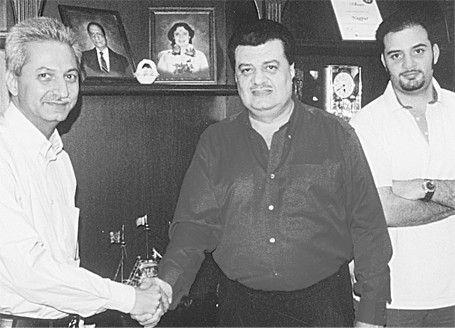
Firm commitment: (from left) Jimmy Rana, Aspi and Jamashp Bapuna
"The transition has been smooth and hiccup-free,” remarks Aspi. "The brand has become stronger, people have confidence. We have always had a soft spot for the ice cream as it is a Nagpur brand, as well as for the name Dinshaw. At a time and in an environment when many businesses are shutting down, it would have been sad if an old Parsi concern had closed or gone outside. In this way it has stayed in the city and in the community,” he adds.
"I am very happy to be a part of the Bapuna group,” Jimmy told Parsiana. "I feel more relaxed now, I can concentrate on my core strengths. The whole organization is back on the rails. In a year’s time you’ll see us going places!”
The young, third generation of Bapunas has already stepped on to the business platform. Aspi’s son, 24-year-old Jamashp, is joint managing director of Dinshaw’s with Jimmy Rana. Abad’s daughter 20-year-old Sanayia is firming fledgling business feet in the lifestyles sphere. Gwalior-based Adil’s son, 21-year-old Mazdiar, brews experience at their flagship company, Gwalior Distillers, travelling also to their new state of the art brewery, Tripti Alcobrew Limited, at Morena, about 30 km from Gwalior.
With the Bapunas providing flexibility to its financial structure, Dinshaw’s is looking to increase its present turnover of Rs 70 crores. Bapuna group vice president Shiraz Gimi, with almost 40 years of experience in marketing and advertising, is "absolutely focussed,” he says, on marketing Dinshaw’s. The first overseas consignment of 6,500 liters of ice cream left Indian shores in April, bound for Dubai and its very first test in the international market, jostling for space in supermarkets, hypermarkets and ice cream stations which see stiff competition from ice cream brands from all over the world. "In India, ice cream is a very seasonal business,” explains Jamashp. "The sale in summer is four times that in other seasons. In America, it may be -30°C outside, but they still eat ice cream,” says the young man who savored a year in high school in Vermont, USA before returning to India.
Making ice cream is a tricky business, continues Jamashp. For their light, popular new flavor, Tender Coconut, the raw material has to be sourced all the way from Kerala. "They have to be soft malai coconuts to achieve the right taste and consistency,” he notes. Luscious lichee, anjeer badam, mango malai kulfi, beaches (peaches!) and cream all involve the use of fragile fruit. Innovation is constantly on the anvil. For new flavors the idea starts with Jimmy and Jamashp working in tandem. Attractive names and presentation seek to touch the soft spot in the ice cream buff.
Taking Parsiana on a tour of the factory, Gimi points out the milk vats, the spiral hardening tunnels, the tall freezing drums, the extrusion line churning out fancy shapes, the duets and triple treats; pre-packed sundaes and half to four liter tubs packed by the bulk line. "The entire production process is fully computerized. We feed the recipe into the computer, the nuts, fresh or dry fruits, sauces, etc get added at the right stages,” elaborates production-in-charge Sheikh Khurshid Ahmed, adding that the fully automatic comet line for cones and cups can pack, pick up and place 18,000 pieces per hour. With an ISO 9001 certification, the plant has an installed capacity of 1,25,000 liters of ice cream per day. Parsiana’s trip to the vast -25°C cold room (where the ice cream is stored pending despatch) was brief and teeth chattering — cold comfort from Nagpur’s 40°+ outside temperature!
With around 9,000 large and small retail outlets in India, of which 900 are in Nagpur (including 90 parlors), Dinshaw’s is the market leader in central India’s city of oranges and in the Vidarbha district too. "Our cold chain is pretty long,” says Jamashp. With a good market in nine states [Maharashtra, Madhya Pradesh (MP), Chattisgarh, Jharkhand, Karnataka, Andhra Pradesh, Goa, Orissa and Uttar Pradesh (UP)] and a network of distributors and retailers, the company is looking to break into West Bengal as well, asserts Gimi. "We are aiming at a high end product, but we have to compete with the lowest and highest end of the spectrum. Amul, for example, plays on price. We are looking to create a niche, somewhere between Kwality Walls (the biggest player) and the local guy,” he adds.
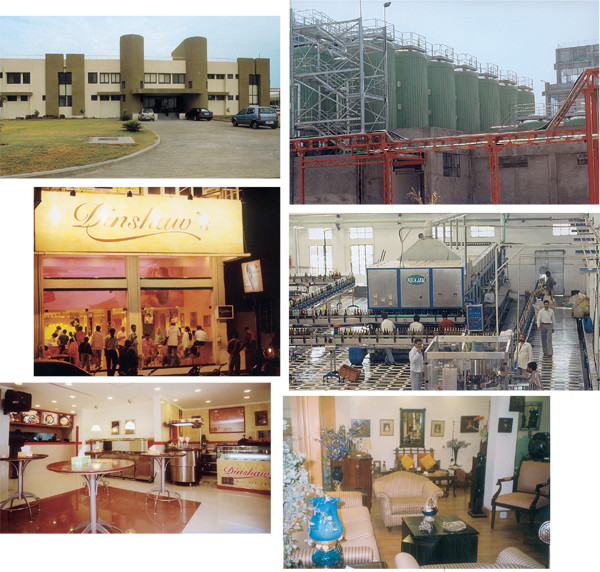
From top, left column: Ice cream factory in Nagpur; the parlor at Sadar and at Dubai. Center column: The brewery’s unitanks and bright beer tanks; bottle washer; the color and variety of Forms Lifestyles Photo: Hilla P. Guzder
Dinshaw’s prestigious parlor today in India is the newly renovated one in Nagpur at Residency Road, Sadar — also its oldest, started by Dinshaw Rana in the 1930s. "It is such an institution in Nagpur that if you say ‘Dinshaw’s ké saamné milna,’ (meet me opposite Dinshaw’s) Nagpurians will know exactly what you mean!” says Gimi laughingly. Computer touch screens display as well as describe the choices for the customer — Snowman, Lovers’ Nest, Orange Madness, Crouching Brownie, Hidden Flavor... ranging in price from five rupees for a cone or cup to Rs 90 for a delectable confection. Besides the factory-made ice creams, salesmen’s nimble fingers put together toppings and garnishings in fat or fluted glasses, boat shaped containers or colored platters. "This concept is new to Nagpur,” explains Aspi’s wife Mehru who, along with Villoo (Abad’s wife) and other ladies of the family, picked up a few tips from experts from Bombay’s catering college and then trained the parlor’s young staff to be speedy in service. Running the Sadar parlor as franchisee is Mehernosh Rana (the son of Dinshaw Rana’s son Sam) and his wife Niloufer who have separated their share from Jimmy.
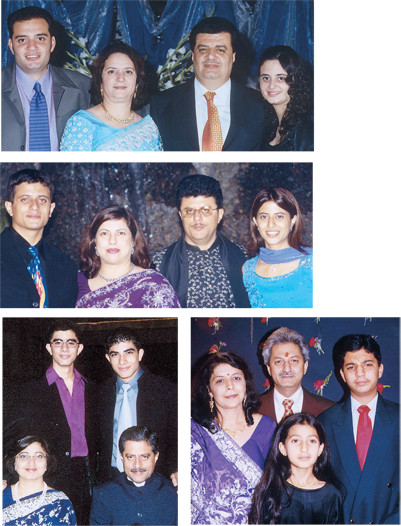
The Bapuna family (from left): Jamashp, Mehru, Aspi, Kashmira; Ramin, Villoo, Abad and Sanayia; Daisy and Adil (seated), Mazdiar and Pervez. The Ranas: Dinaz, Jimmy, Zian and Zervin
Roughly half of Dinshaw’s turnover comes from Dinshaw’s packaged milk with a substantial sale in Nagpur, Vidarbha and neighboring Chattisgarh and MP. Looking after the milk division at the Gittikhadan factory is Khushroo Buhariwalla, who is the brother of Jimmy’s wife Dinaz. With a processing and packing capacity touching one lakh liters per day, Dinshaw’s Dairy Foods proposes to double this to two lakh liters per day, according to the company fact file.
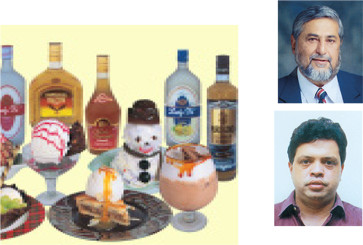
Above: The spirits and the cool confections; Gimi (top) and Bhagwagar
Biggest single point distillery
The mainstay of the Bapuna group is Gwalior Distillers Limited and associate companies in the liquor business, engaged in the manufacture of rectified spirit, extra neutral alcohol (ENA) from molasses and grain, and branded alcoholic beverages. The group has an installed capacity of two lakh liters per day of rectified spirit and 75,000 liters per day of ENA at two of its major distilleries (Gwalior and Rairu Distillers) situated at Rairu Farm, Bombay-Agra Road. Looking after operations is Adil who has been in Gwalior since 1981. "Ours is the biggest single point distillery in the country,” he notes. "Our multi pressure plant for distilleries was also the first in India.”
Apart from its own brands, the group bottles IMFL (Indian made foreign liquor) for leading liquor companies like United Breweries, Herbertsons, Seagrams, BDA, UDI, etc, states the company’s website www.bapunagroup. com Explains Aspi: "Seagrams, for example, is attracted by our quality, as well as reasonable pricing.” People say ‘oh, everybody makes money in liquor,’ but that’s not true, he emphasizes. There is stiff competition and liquor is a commodity just like any other. Adding to the tough task are the plethora of laws with regard to the manufacture and sale of liquor, excise duty, etc. "Selling in different states in India is like selling in different countries! Every state is more strict than the other,” he rues. Added to that is the poor power situation in MP. "Not only are there daily power cuts, but the quality of power is so bad that we have an in-house turbo generator and bio-gas generation for power,” adds Adil. "With distillation technology constantly changing, if you don’t upgrade you don’t stand a chance to survive in this industry.” With blending and bottling units in Nagpur as well, the group’s bottling capacity for branded alcoholic beverages is 25,000 cases per day and 15,000 cases per day for Indian country liquor, according to company sources. Their IMFL, rectified spirit and ENA find a market in Europe, the Middle East and South East Asian countries, according to their website. "Our philosophy is to run a clean business in an environment difficult to function in,” says Abad whose portfolio encompasses overseeing all the companies in the group.
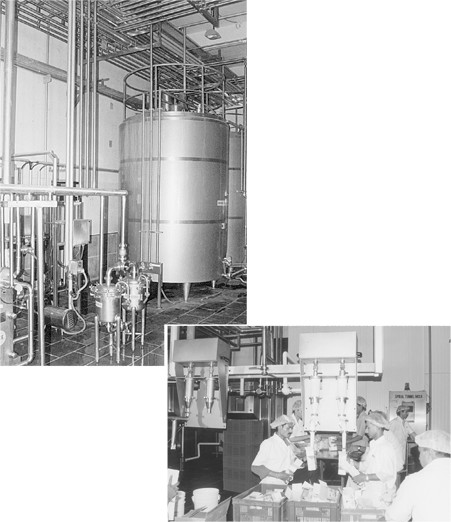
At the ice cream factory: mix preparation (left) and automatic bulk filling line
Adding fizz to group sales is "new baby” Tripti Alcobrew, the brewery which is less than a year old. "Our Super Jet, which is a strong beer, is among the highest selling beers in MP and Chattisgarh. Rhino, also strong, has a good segment in North India while Falcon, which is light, is also moving well. From 1.75 lakh cases we have already gone up to three lakh cases a month,” observes Adil whose younger son, 17-year-old Pervez, though hitherto in Gwalior is now in college in Nagpur. Aspi’s daughter 23-year-old Kashmira is doing chartered accountancy in Bombay. Abad’s son 19-year-old Ramin studies for his graduation in Nagpur, visiting the bottling plants there as time permits.
Forming lifestyles
Bringing diversity to the group is Forms which is a leading exporter of artefacts and fine furniture to catalog companies and prestigious stores in 21 countries,such as John Lewis in the UK, Pier 1 Imports and Pottery Barn in the USA, stores in Europe, etc. Forms was founded by Nagpur entrepreneur Rukhshad Bhagwagar with two craftsmen, in the back yard of his house in 1989. "That was the time neither the banks nor my family could understand why I wanted to make handicrafts!” Bhagwagar gives an impish grin. "By the year 2000, Forms had grown into quite a large enterprise. When my partner wanted to quit, I asked the Bapunas, who were close friends anyway, if they would like to come in,” Bhagwagar narrates the background. Amplifying his "excellent relations with the Bapunas,” Bhagwagar says: "We leave each other to work on our own.” "Forms has just taken off since we have come in in 2001,” declares Aspi.
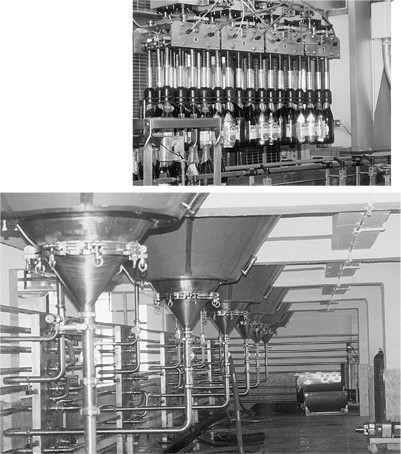
Making beer: case packer of the bottling line (alongside) and fermentation and lagering tanks (below)
With factory units at Forms Village on the outskirts of Nagpur and one each in UP and Chattisgarh, as well as an office and showroom in Delhi, Bhagwagar relates: "I have allowed my craftsmen to grow with me. Penniless workers whom I employed earlier have since branched out and now engage people themselves to execute our orders which are generally very large — 10,000 to 15,000 pieces of the same item, for example, mirror frames.” Post September 11 was a bad time. "We were hit by the Iraq war too, with some orders being cancelled. In case of any crisis, we (handicrafts) are the first to get knocked off!” but Bhagwagar’s enthusiasm and love for his work seem irrepressible! Foreign buyers love the Bastar art, the dhokra (lost wax method of making brass artefacts using bees wax), artefacts in bell metal, ceramic, iron or wood, he notes. "We make what the customer wants — you want a Chinese design or a European design, you get it; you want a farohar we will make it for you!”
Looking after Forms Lifestyles, their exclusive retail showroom at Sadar, as well as sales in India is quietly confident Sanayia. "We (Forms) are very well-known in Nagpur and have done a number of interiors,” she informs Parsiana. While keeping its colonial character in the shape of its red-hued British-built buildings, old churches, convents like the 100-year-old Francis de Sales, St Joseph’s Convent, etc, Nagpur has donned the modern garb. Main roads have fortuitously metamorphosed into broader, tree-lined avenues, traffic flowing smoothly over flyovers reminiscent of senior state sibling Bombay. Dotted all over are the chain stores — Nike, Reebok, Allen Solly, McDonalds, Westside, etc — which give the earlier provincial town a contemporary look. On the threshold of completing her management studies, Sanayia says she enjoys working in Nagpur and interacting with buyers and prospective customers.
The encouragement of sports has long been a part of the Bapuna group’s corporate philosophy. Annually sponsored tournaments in bridge, snooker, tennis and cricket provide a stepping stone for local talent to move on to a higher plane. The Parsi Pentangular Cricket Tournament and the Ranji Trophy Selection Tournament are among the main events. "My late mother Banu loved cricket,” recalls Aspi, warmth in his tone. "She was a noble person, very religious too. Though she is no longer with us, I feel her spiritual presence is always here for us.”
"My great-grandfather was a very rich man,” continues Aspi, tracing the family tree. Somewhere down the line, fortunes got whittled away. Dinshaw Bapuna himself began life in a family of six brothers and sisters in Nargol, doing his matriculation from the Surat Parsi Orphanage. As Dinshaw’s father Faramroze was a small farmer with a modest trade in liquor and toddy, Dinshaw soon took up a job in the Water Works Department of the Bombay Municipality. "Of his salary of Rs 35 per month, he would keep five rupees for himself and send Rs 30 for his parents and siblings in the village,” narrates his eldest son. Maths tuitions supplemented his income.
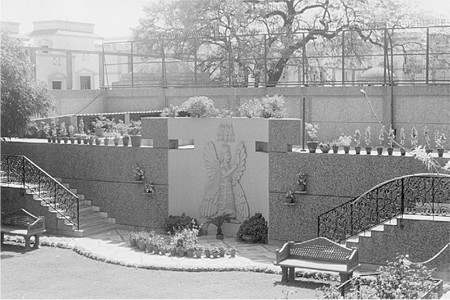
Verdant and serene — the Bapuna residence garden Photo: Hilla Guzder
When opportunity beckoned with a job opening in Nagpur as manager with Byramji Doongaji and Sons, Dinshaw shifted base to Nagpur. "He ultimately got himself into business — mining (manganese, chromite), stone quarrying, liquor shops,” Aspi narrates. In 1971 Vidarbha Distillers was set up with a considerable investment, making country liquor from mahua flowers. Gwalior Distillers Limited was incorporated in 1987. "Prior to 1979, distilleries were owned by the government and leased out to private parties to run. As the distilleries became old and decrepit, the government wanted to privatize,” Aspi draws a historical sketch. But the draught (changeover) was not smooth. "There was a big legal battle and we (all those who got licenses) won the case in the Supreme Court. That was in 1985.”
Business prospered and the Bapunas involved themselves in espousing social causes like the Red Cross and Rotary International and the beautification of public places, especially in Gwalior. "Adil is an avid gardener — he loves working with his hands in the garden,” says Abad of his twin. "I myself love good gardens though I may not work in them. We do resemble each other quite a lot, but we are not identical.”
The brothers have long been partners in progress. The family live together (except for Adil, wife Daisy and Mazdiar who are in Gwalior) in a new palatial mansion which gives space and togetherness — a fountain and flowers at the front, a Japanese rock garden and tranquil expanse of lawn at the back, a swimming pool coming up alongside. Mehru calls out to their dogs — two Dachshunds and five huge German Shepherds whose resonating bark reverberates the small glass floor where the visitor stands, looking down at the ferocious-looking canines! "I am ‘mummy’ and Aspi is ‘daddy’ to them,” smiles Mehru who loves animals.
"We (three brothers and two sisters Aban Magra and Pervin Avari) had the advantage of growing up together. One tends to drift apart emotionally if not brought up together. Our children too are more like brothers and sisters than cousins. The closed fist is strong, the open one weak,” explains Aspi, calm and resolute, measured yet quick in thought and speech. "I do not see myself as a patriarch. My brothers have a very important role... They are very much a part of me.”
Patriarch Dinshaw himself was for 23 years the president of the Shree Nagpur and Kamthi Parsi Zarthosti Anjuman, during which time the corpus of the Anjuman reportedly rose from Rs 16 lakhs to over Rs 60 lakhs and the immovable property from eight to Rs 46 lakhs. It was during his tenure that Nagpur’s Bai Hirabai N. M. Mulla Dar-e-Meher was renovated during its centenary year in ’95-’96. "My father had said that he would give not one rupee from Anjuman funds for repairs,” recalls Aspi. "We collected funds to the tune of Rs 40 lakhs for the renovation and left a substantial sum as corpus for the maintenance. The Anjuman was so strong we believed nothing could destroy it for 10 years at least,” says Aspi.
Strong on the subject of broad-mindedness, the man who has been Bapuna group chairman since 1990 firmly believes: "Parsis who are very religious or fanatically so should not impose their thoughts and wishes on others, or use religion as a weapon for their own gains.” In Nagpur, for example, there is no khandia system, it has not existed for the last 25 years, Aspi notes. The purpose of disposal of the dead is that it should be as fast as possible, whether by burial, cremation or any other, he says. With Nagpur’s hitherto considerable Parsi population depleted following the closure of the Empress Mills and the migration of many of its youth to what they perceived as greener pastures, the major part of the Zoroastrian population remaining (223 families comprising around 600 individuals, as listed in A Directory of the Nagpur Parsis, 2002 published by the Nagpur Parsi Gymkhana under the presidentship of Gimi) is around the age of 60 and above. Some families are doing well, some not so good, says Aspi. "Success is a combination of destiny, opportunity and hard work. Even if one of the ingredients is missing, you can’t succeed,” he philosophizes.
◆ ◆ ◆
From the archive