
Business
The brand master
Like his father, Piruz Khambatta is determined to add value to the Rasna brand name
"Our single biggest attachment is to the consumer,” says Piruz Khambatta, chairman and managing director of Rasna Private Limited which is the leader in the concentrate drinks category of the fast moving consumer goods market. Trumping multinational corporates like Coke and Pepsi the second generation soft drinks entrepreneur refuses to rest on his laurels. He notes the brand name Rasna is the leader in the beverages category with 93 percent of the market, according to a survey by The Economic Times, its annual sales topping Rs 2,000 crore plus Rs 50 crore worth of exports. Instead, Khambatta speaks of the need for awareness of changing consumer preferences and undertaking the challenge of expanding into new areas. Stressing that "brands need to be relevant,” he is aiming at the typical Hindu household where the biggest competition comes from tea, coffee and nimbupani (fresh lime and water). His thinking as a marketing man is to "make people consume more powders.” Their concentrates, captured as powders easily mixed with water or milk as the case may be, provide refreshing beverages at a price that the average man in the street can afford.
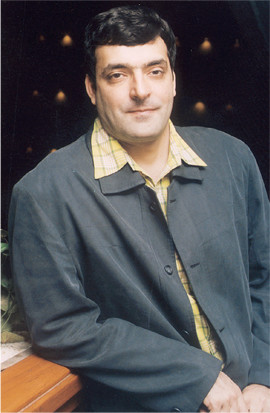
Khambatta "focused on the future”
The firm started by his food technologist father Areez has a complex web of distributors resulting in 17 lakh outlets for Rasna products in three separate product ranges: domestic, export ethnic which is targeted at Africa and other developing countries and the general export range. Offering fruit and cola flavors in a variety of packages, the rural consumer pays 50 paise per glass of orange, mango, nimbupani or cola not counting the cost of the sugar which he needs to add. Also others like Shahi Gulab, Kool Khus and Kesar Elaichi which can be added to milk. And in the ‘Shake Up’ range there’s strawberry, mango and chocolate. Add to them Body Fuel, a sports energy drink, cordials and jams, chutneys and Curry in a Hurry — a range of ready to eat dishes both canned and packaged — and Bollywood Bites, a selection of traditional Indian snacks aimed at the non-resident Indian.
A quintessential marketing man, Khambatta, the easygoing and informed scion who dresses in T-shirts and dons walking shoes to office, understands the virtues of advertising and celebrity promotion. Of their advertising expenditure spent in the region of 18 crore rupees, 15 crore goes into TV advertising, he says. Legendary cricketers Kapil Dev and Vivian Richards have endorsed the products as also Bollywood stars Karishma Kapoor and Hrithik Roshan. With advertising campaigns aimed at mothers and children, Khambatta says, "We were the first company to look at advertising to the whole family via children.” The little girl mouthing the jingle, "I love you Rasna,” on radio and TV is part of the brand image that Khambatta and his innovative father have built. "The Rasna brand is focused on the future, not the past. So the Rasna girl should look new generation,” maintains Piruz.
But the matter does not rest there. The year 2004 saw a doubling of their salesmen and the institution of five trainers from the Alchemist Academy to school them. To enthuse the sales staff he has instituted travel schemes "instead of white goods or scooters which they used to sell,” he notes. Export promotion in the Middle East entailed the inclusion of silver coins in the packages. It led to a 100 percent increase in sales in Dubai last year, he notes.
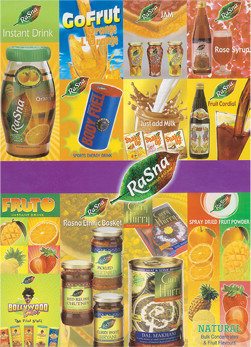
Disbursed production units, four in the north at Chandigarh, Pathankot, Dehradun and Ranchi; plus those at Silvasa, Daman, Ahmedabad and Kolol enables the company to avoid transport costs as well as ensure faster deliveries.
Figures come easily to Piruz Khambatta. Rasna’s 32 sales depots, 2,500 stockists and 700 substockists trip off his tongue. He notes happily that "17 crore glasses of Rasna were consumed this year.” They recently introduced two more flavors — Jaljira in the herbal range and Jucy pouches of ready to consume drinks in the whole of south India. They try and test their products for consumer reaction in small areas. "If the mass consumer doesn’t like it, it’s a flop,” he notes matter-of-factly.
We ask him if they have ever considered foreign collaboration. "We don’t need foreign collaboration,” he replies, adding, "We are exporting to 40 countries. We don’t need money. We are looking for ways and means of using it better.”
The son of Areez and Persis, Khambatta is a double graduate — in biochemistry and in law — and has attended several courses in management at the Wharton School in Philadelphia and the Indian Institute of Management, Calcutta. Co-chair of the West Zone of All India Food Processors’ Association, Piruz Khambatta has been chairman of the Confederation of Indian Industries’ (CII) Gujarat Council for two successive years and is active in the national and western regional committees of the CII as well as chairman of its Agro and Food Processing Council. His unswerving dedication to his tasks won him the Dadabhai Naoroji Millennium Award in 2003 in recognition of his achievements as a young entrepreneur. In 2004 the Ahmedabad Management Association conferred on him the AMA-Zydus Cadila Marketing Man of the Year Award. In December last year the Federation of Parsi Zoroastrian Anjumans of India bestowed on him the Jamshed and Shirin Guzder Award as best youth of 2003.
Working a long day, from early morning to late at night (he drove with the Parsiana editorial team to the airport so we could continue the interview in the car) — returning to a late dinner with his wife Binaisha long after the kids, daughter Arzeen and son Arzad are in bed — Khambatta says his visits to the fire temple four to five times a month, help him to feel relaxed amid the garden and the birds. "In Ahmedabad we have closer family ties. In Bombay, life is different,” he avers.
It is Khambatta’s perception that "too much intermarriage and conversion would change the community.” He prefers to "take the Parsis’ small numbers as a plus point… We have the choice of being very liberal when we can expect to contain non-Parsis in our midst. Or we can maintain what we are. It will depend on what choice community leaders take,” he told Parsiana the day after the brouhaha at the December 2004 Federation meet in Ahmedabad.
His advice is to "concentrate on community development, especially of the youth. Prevent a brain drain by providing more opportunities, better development in India.”
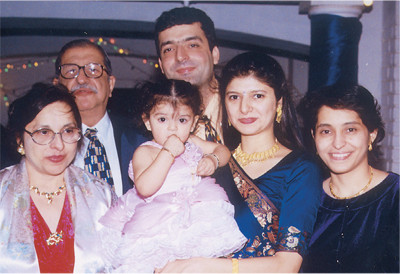
(L to R) Areez and Piruz with Persis, Arzeen, Binaisha and sister Ruzan
Taking a leaf from Gujarat chief minister Narendra Modi’s "pride of Gujarat” theory, Khambatta asserts, "We should also be proud, inculcate pride (among the community).” He suggests the creation of a Parsi museum on the lines of the Bahai temple in New Delhi — "a monument of a museum. If all the wealth (of the community) was put together, we could do it,” he believes. Claiming to have "fought for Gujarat industry along with Narendra Modi,” Khambatta defends the administration of his state, saying, "Riots were a part of Ahmedabad even when I was a child, even during Congress rule.”
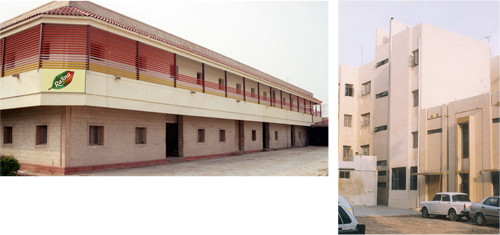
A section of the factory and the office of Pioma Industries
A letter to The Times of India in December 2004, soon after the meet convened by the National Commission for Minorities to discuss the declining numbers of Parsis as revealed in the Indian census of 2001, best sums up Khambatta’s position on the much debated demographic issue. He notes, "I am not too surprised to see the statistics of our decreasing tribe, but I am surprised at the sermons from all and sundry like ‘Allow conversion,’ ‘Produce more,’ ‘Marry early,’ ‘Accept intercaste marriage’…
"Ironically, Parsis were always a few. We never had the numbers and that is the reason why we cannot even win a municipal election, leave aside a Lok Sabha seat. We cannot think of a ‘Rath Yatra’ from Dadar Parsi Colony to Cusrow Baug and all the Parsis on the globe put together cannot fill the Eden Garden to cheer Ganguly’s boys.
"We could not do anything, where numbers matter, even 50 years ago. But what we could do is to produce the first bar of steel, the first Indian airline, the first Indian Field Marshal, the first open heart surgery… and the list is endless. Parsis have excelled wherever quality counts over quantity.
"Even when it comes to putting the country over religion, Parsis have always been first. Parsis are Indians first and our religion has always been contained within the four walls of our agiary and our homes. We have refused to accept any class division on any lines.
"Imagine India with half its population — we could have been a developed nation. So what we need is fewer, well educated, well-fed, well-to-do healthy Indians. Here also Parsis lead the way.”
◆ ◆ ◆
From the archive