
Observation
The ground fires
Near Baku in Azerbaijan, the home of possibly the oldest fire-temple, eternal flames are fuelled by underground gases
One of the earliest fire-temples is to be found at a place called Surakhani near Baku on the shores of the Caspian Sea in Azerbaijan. Worship of eternal fires at Surakhani predates most known religions; the area was considered sacred grounds by Zoroastrians, and later by Parsis who fled Persia to avoid conversion to Islam after the Arab conquests. The temple is situated about 10 miles from Baku and is considered by many scholars as one of the oldest altars in the world, still standing erect with flames that are burning there to this day. The gas which is generated by the subterranean store of oil, escaped from the fissures in the limestone crag and may have inspired the prayers of generations of Magi (or Zoroastrian priests).
Veneration of fire in Persia, of which, until the 18th century, Baku formed a part, is older than history. It may be that the fire in this temple at Surakhani has been un-extinguished for a period extending from before the time of Cyrus the Great (about 2600 BC).
On the site of the modern town of Baku once stood a city celebrated in the Sassanian times as the place where a mighty fire-temple stood, on the altars of which blazed perpetual flames of fire produced by ignited naphtha. To this place thousands of pilgrims paid their annual visits, till the second expedition of Heraclius (Christian emperor of Rome) against the Persians in 624 AD, when he wintered in these plains and destroyed the temples of the Zoroastrians.
For 2,500 years Baku has been famous for its petroleum springs. Historical evidence shows that for nearly 1,000 years, its oil has been exported in trade with surrounding nations. It has always been thought of as a bottomless well, inexhaustible supply. It is also the best harbor on the Caspian Sea — the only good natural harbor on the Caucasus side of the Caspian, and placed opposite what was once (probably) the outlet of the combined Oxus and Jaxartes (ancient name for the Syr Darya River in Central Asia) rivers; into the Balkan bay, which ran inland far further than at present, while the Oxus and Jaxartes joined and ran west, entering the Caspian rather than the Aral Sea. Indian trade in Pliny’s time (Plinius Secundus, a Roman nobleman who died in 79 AD during the Vesuvius volcanic eruption) made its way to Europe by this route. Caravans laden with goods from India could see at night the lurid glare of the fire-fountains of Apsheron heights jutting out into the sea in the bay.
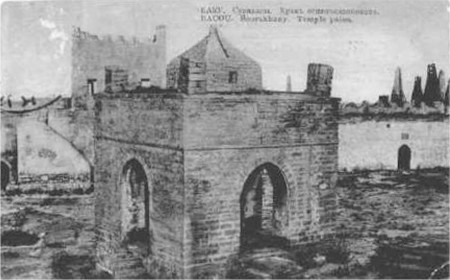
The fire-temple at Baku. The post-card’s caption reads "Baku. Sura-khany. Temple of Fire Worshippers.” It was sent to Belgium by mail from Baku in 1913
The Caspian Sea could be set on fire! Reports have been made of fires at dusk on the sea surface, ignited for the sake of visitors. One took a boat out of the harbor, sailing around a promontory until about half a mile from the shore, to a spot where gas wells bubbling to the surface made the sea appear to be boiling. The water’s depth would be about 3.5 fathoms and there would be a strong stench of naphtha; oil coating the surface painted the ripples in sunlight with a thin iridescent color. Then a piece of flaming tow was tossed over the ship’s rail. It might take one or two tries, but soon enough the surface of the waves could be lit, and wrapped in flames for several yards around, an eerie and beautiful sight could be observed of a cold fire dancing upon the sea’s breast. This fire would burn until a wind extinguished it; rowing away, one could glance back and still see it at a distance of a mile. There were several spots in the Caspian where naphtha gas bubbling up through the sea could be observed.
In the 1870s, Parsis from India were still making pilgrimages to Baku to witness the eternal flames which they believed burned there ever since the great flood described in the Bible. The Parsis believed that the fires will continue to burn spontaneously at Surakhani till the end of time itself.
John Hanway, in his book An Account of British Trade over the Caspian Sea published in 1754, describes the temple in the following words: "The everlasting fire lies about 10 miles north-east by east off the city of Baku, on a dry rocky land; there are several ancient stone temples there, including one small temple at which 40 or 50 Indian pilgrims may usually be seen. Near the temple is a low cleft of rock, in which is a horizontal gap — two feet from the ground, six feet long, and three feet broad — from which issues a constant flame, in color and gentleness like that of a spirit lamp, only more pure; and when the wind blows, this torch rises sometimes eight feet high. On a calm day, the fire burns lower. It leaves no soot or impression on the rock. The Indians (Parsis) worship it, saying that it caannot be resisted (put out), and if extinguished will only spring up in another place.
"All around this fire-temple, for a distance of two miles, if one digs a mere two or three inches into the ground and applies a live coal, the uncovered soil instantly takes fire — almost before the coal touches the earth. This flame heats the soil but neither consumes nor marks it, and it is not terribly hot. This soil, if carried away, does not light or burn. The ground is dry and stoney, and the stonier it is, the stronger and clearer is the flame kindled there. There is a sulphurous smell, like that of naphtha, but this is not too offensive.
"If a trench of soil is uncovered and lit at one end, the flame runs right down the trench, burning wherever the soil is turned. In the 1750s, eight horses perished in an accident when the soil of the shed which was their stable was accidentally set afire.
"If a cane or tube, even one of paper, is thrust into the ground here, and blown upon while a live coal is touched to the top — a fire issues forth. Merely coating the rim of the tube with clay will protect this tube from harm. In this way, the local people light their houses; three or four such tubes, lighted, will boil water in a pot, and thus they cook their food.
"Some of the younger springs had mouths eight or 10 feet across. The workers drain off the naphtha by troughs into pit reservoirs, purifying it by drawing it from reservoir to reservoir; during this process all water and heavier oil is left behind. The result smells bad, and only Zoroastrian people burn it to heat their houses, to light their lamps or boil their food. To solidify it for burning, they mix the naphtha with dirt or ashes. It must be stored in jars underground, at a distance from any building. Keeping it indoors is too dangerous as it can ignite by itself. Finally, something like a natural kerosene was to be found; it is a thinner fluid than black naphtha. The Russians drank it as a cordial and also as a medicine. It did not intoxicate. Applied externally, it was a cure for pains, gouts, cramps — with the caution that it must be painted on the afflicted part only, for it penetrated instantly into the blood and caused a short-lived but violent pain! If drunk, it was said to be good for kidney stones, for disorders of the breast, for venereal diseases and sore heads. It was shipped into India as a rarity.”
Description of Baku area in 1813 by Kinneir: "The quantity of naphtha produced in the plain to the south-east of the city is enormous. The oil is drawn from wells, some of which have been found to yield from 1,000 to 1,500 lbs a day. These wells are, to a certain degree, inexhaustible, as they are no sooner emptied than they again begin to fill, and the naphtha continues gradually to increase until it has attained its former level. It is used by the natives as a substitute for lamp-oil, and when ignited emits a clear light, with much smoke and a disagreeable smell. The whole country around Baku has at times the appearance of being enveloped in flames. It often seems as if the fire rolled down from the mountains in large masses with incredible velocity; and during the clear moonshine nights of November and December, a bright blue light is observed at times to cover the whole western range. This fire does not consume, and if a person finds himself in the middle of it, no warmth is felt.”

Associate research geneticist at the University of California, Dr Ardeshir B. Damania’s area of interest includes biodiversity conservation issues, early agriculture, crop domestication and plants of economic and medicinal values. His early career was with the Food and Agriculture Organization of the United Nations and he subsequently worked with the International Center for Agricultural Research in the Dry Areas.
◆ ◆ ◆
From the archive