
Books
Drawn to dates
Deputy chief vigilance officer of the Western Railway, Bakhtiar Dadabhoy's fascination for general knowledge led him to compile A Dictionary of Dates
Enjoy your dates. Any given date in a year is of significance — to historians, to politicians, to scientists... to Bakhtiar K. Dadabhoy whose 960-page A Dictionary of Dates lists over 6,000 happenings in the last 2,000 years.
"I shall feel gratified by the reader’s ‘Is that so?’ or the ‘I didn’t know that,’” writes Dadabhoy in his introduction citing how the Indian nationalist leader Pherozeshah Mehta and the creator of Asterix, Rene Goscinny share a birth and death anniversary. Whilst "standard” events find a mention in this educative and entertaining book, the inclusion of additional "information, anecdotes, quotations and trivia... reflect my own interests,” candidly admits the author.
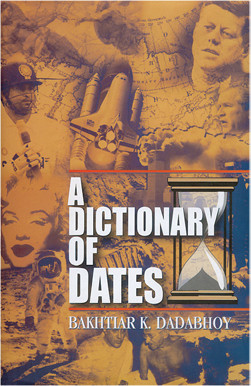
Take a dip into any day of the year, say, April 15. The author writes: "On this day... in 1865 Abraham Lincoln died at 7.30 a.m. after being shot the previous day by an actor, John Wilkes Booth at Ford’s Theatre in Washington, D.C. while he was watching the comedy Our American Cousin... Born on this day were: Leonardo da Vinci (1452-1519), the Italian artist, architect, sculptor, poet, philosopher, mathematician and inventor considered to be the most versatile genius of all time; Guru Nanak (1469-1539), Indian spiritual teacher who was the first guru of the Sikhs; Leonhard Euler (1707-83), Swiss mathematician and physicist, who made important contributions to geometry, calculus and mechanics... In 1912, the British luxury liner Titanic (the ship thought unsinkable) sank in the North Atlantic off Newfoundland, less than three hours after striking an iceberg... In 1955 McDonald’s, the world’s largest hamburger chain, was founded in De Plaines, Chicago by Ray Kroc. In 1986 Vivian Richards hit the fastest Test century measured in balls received (56) against England at Antigua...” These and a number of other incidents that happened on April 15 are noted in the book. With such entries spread across all the 365 (or 366) days of the year, embracing a rich diversity of subjects, A Dictionary of Dates, published by Rupa and Company (7/16, Ansari Road, Daryaganj, New Delhi 110002), is an ideal reference guide for any one with an interest in dates, apart from being a treat for the quiz enthusiast.
But how did Dadabhoy manage to get this wealth of information? He replies: "I have a huge variety of resources — Encyclopaedia Britannica, all the 20 volumes of the Grolier Encyclopaedia, a large reference library at home with dictionaries, reference books, et al. I just had to pick up the information and compile it.” The book, priced at Rs 695, is mostly sold to libraries and other institutions. A paperback edition is expected by the end of the year at half the price. The book has stood on the fourth, 10th and 10th positions for three successive weeks in the Best Seller (non-fiction category) list compiled by the Asian Age and on the fifth position as per the Gujarat Mitra (of Surat).
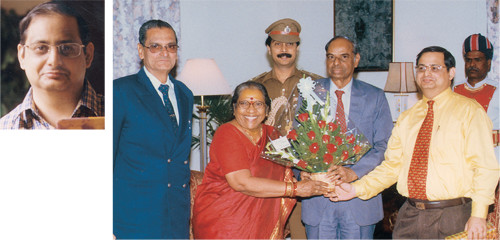
(Top) Dadabhoy: fascination for dates; (alongside) At the book release function (L to R): Keki, Ms Rangarajan, C. Rangarajan, governor of Andhra Pradesh and Bakhtiar
Having a love for quizzes and debates since childhood, few people may know that Dadabhoy stood second in the preliminary rounds of the popular BBC show, Mastermind India (where he had to answer 50 tough questions in just half an hour), or that he cleared the Indian Civil Service (ICS) examination after which he opted to join the Indian Railways.
Presently Dadabhoy is deputy chief vigilance officer (Operating and Commercial Branches) of the Western Railway. All station masters of the Western Railway, booking clerks, computerized reservation centers, goods clerks, parcel caretakers... are under his administration. The scheduling of trains, introduction of new services, also fall under his purview. He handles mainly bribery and corruption cases: "My job profile comprises carrying out investigations based on public complaints, preventive checks on people whom we know are of doubtful integrity, decoy checks, etc. A group of inspectors who work under me carry out all the raids.”
The Indian Railway Traffic Service is considered a Class I service of the Central Government. Joining at this level is not everybody’s cup of tea: "Writing a Civil Service examination isn’t a national time pass. The process of qualifying in the preliminary exams, the main ICS examination and, finally, the interview conducted by the Union Pubic Service Commission, takes nearly a year.”
Dadabhoy’s career kick started at the managerial level in 1987 at the young age of 23. For two years he was on probation, reporting to the Railway Staff College, Baroda, at a basic of Rs 2,200. Those were the Pre-Pay Commission days. His first posting immediately after probation was as assistant commercial manager at Churchgate, Bombay. By dint of hard work and a bit of good luck he grew up the ranks to become divisional operations manager (Bombay Division), senior electronic data processing manager, deputy chief commercial manager (Passenger — Marketing), senior divisional commercial manager (Bombay Division) and now deputy chief vigilance officer, equivalent to a director to the Government of India. Of all the positions held, he found being senior divisional commercial manager the most challenging: "The pace of work in that position is very hectic. There are pressures from the public as well as from our own officers.”
In his initial years, Dadabhoy found this huge organization quite "complicated.” It took him nearly five years to realize the various designations and posts: "I didn’t know for quite some time that there’s a separate category of staff which looks only after the clock at different stations!” Talk about downsizing the staff by introducing VRS (Voluntary Retirement Scheme), and Dadabhoy explains: "We are aware of all these concepts but to implement them is a different ball game altogether. The structure is filled with bureaucratic rules and procedures... I get visited by MPs (Member of Parliament), receive calls from ministers, receive request transfers and postings of staff, requests for dropping charge sheets. My principle is to be polite and do the right thing.”
Would privatization be the solution then? Dadabhoy disagrees: "We know what is wrong with the system and what needs to be done. But one person or even one group cannot do much. Plus there are the unions to be dealt with. Sometime ago, rail travel service agents were to be given terminals. Employees thought their jobs were at stake and there was a furore. You can’t privatize in bits and pieces, and there’s no one organization in India that can take over the entire Indian Railways!”
Dadabhoy has learnt from his experience. As deputy chief commercial manager (Passenger — Marketing), he was instrumental in introducing terminals that give tickets on the spot. This was in consultation with a group of Japanese officers. It turned out to be a failure "largely because people are not interested in making it successful.” In another case he had got the Tata Infotech touch kiosks installed to provide the status of waiting lists, accommodation, etc. for the convenience of long distance passengers. After working for a few years, "Tatas lost interest in maintaining the kiosks.”
Dadabhoy has received recognition twice from the financial commissioner of Indian Railways for his good work — for computerization of two modules, goods and coaching, for traffic costing — with cash rewards of Rs 10,000 and Rs 5,000, respectively.
Thanks to his efforts, railway passengers travelling to Udvada shall, in a couple of years’ time, avail of a host of facilities such as waiting rooms, coach guidance systems, PC-based announcement system, enhancement of the cover shed of the circulating area, platform development, renovation of urinals/toilets... Says Dadabhoy: "Being a small station, Udvada had the lowest classification amongst stations. We (the Western Railway) have now made a new rule that places of religious and tourist importance should be upgraded. Udvada falls under the list. Donations for water coolers, etc are welcome...
"Our representation in Government is important. It is in the interest of the community as it would result in a little more integration of Parsis in the national mainstream. "Keen to see Parsis become civil servants instead of joining foreign banks and private companies, Dadabhoy maintains, "Unfortunately, many Parsis don’t know how hot a Class I Government job is!”
These words are not at all surprising because not only is Dadabhoy a civil servant, but so was his father, who was with the Indian Police Service. Dadabhoy was born in a well-to-do family to Rati and Keki Dadabhoy on December 28, 1963. Rati has always been a housewife and Keki retired as director general of police, New Delhi, in 1992. Keki got transferred frequently . This gave their studious son a chance to see a lot of India and have exposure to different schools — St Xavier’s School, Loyola Hall and Amrut School, Burn Hall, St Paul’s, St. Mary’s and the Delhi Public School — in Ahmedabad, Srinagar, Rourkela and New Delhi. He made friends along the way. It helped him adjust quicker to an all-India service like the Indian Railways. He realizes: "If I would have spent my childhood only in one place, I wouldn’t be today having an all-India vision that is required in my job and I wouldn’t be speaking Hindi so fluently.”
The civil servant has an elder sister, Tushna Kotwal, a housewife, married to merchant marine engineer Phiroze Kotwal. But he himself is still an eligible bachelor, waiting for the right match, someone with whom he can "vibe intellectually” and someone who can "make me happy.”
He is religious and prefers "to go the traditional way, though it doesn’t make any difference after I take another body.” Dadabhoy has a message for readers: "Ours is a great community. Let us not do anything that sullies the bad name. If we enjoy a certain respect in society, it is for our integrity and straightforwardness. Let us always live up to that reputation. Some values are eternal. Money comes and money goes. Ultimately, values count.”
◆ ◆ ◆
From the archive