
Events & Personalities
The Sholapurwala story
Seated beside the placid pool of the Taj Mahal Hotel, she received congratulations with composure. In her red and gold sari, she navigated, gently assisted by two granddaughters, the couple of steps to cut the cake whose contours read 100. Amidst family, friends, flowers and festivity, Tehmina K. Sholapurwala celebrated in style her 100th birthday, with the well-known Poonawalla brothers — Dr Cyrus and Zavaray — and their Serum International Limited hosting a lavish party in her honor on March 9, 2002 in Bombay.
"I could not attend Tehmina’s 95th birthday celebration. At that time I had promised that I would like to give her a big (centenary) celebration,” said Cyrus, the dapper chairman of the Serum Institute of India (the country’s largest exporter of vaccines and immuno-biologicals, according to their brochure) and the Poonawalla Stud Farms (leaders in the racehorse breeding scene in India). Six months ago, when Tehmina fell ill, Cyrus was worried his desire would not be fulfilled. "I am very happy today to felicitate Tehmina and Pesi (her eldest son, who is a director of Serum International and the development adviser of Serum Institute),” he stated, presenting mother and son shawls and mementos. Long years ago when the Serum Institute was still finding its feet, narrated Cyrus, he would often drop in unannounced at the Sholapurwalas’breakfast table and would receive help and guidance towards building the business from both mother and son.
Zavaray, winner of several awards for equine breeding and welfare activities, commended the Sholapurwala family’s loyalty, declaring that Pesi’s dedication to the Poonawalla Group often surpassed even his dedication to himself! "I am overwhelmed,” replied the octogenarian Pesi, emotionally acknowledging the tributes.
As the guests feasted on the epicurean delights spread out under the canopy of stars and sky, relatives and friends wrote their recollections and experiences of the Sholapurwala family in a competition which attracted 13 on-the-spot entries! Shaking a leg enthusiastically amidst the other couples on the dance floor were Zavaray and his wife Behroze, celebrating their wedding anniversary.
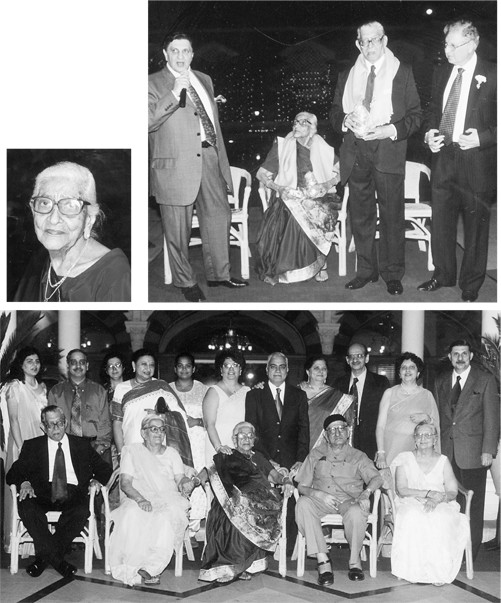
Centenarian Tehmina Sholapurwala (top left) and (alongside) with son Pesi (third from left), Dr Cyrus (with mike) and Zavaray Poonawalla; the Sholapurwala family
The "matriarch with the three musketeers (Pesi, Firoz and Hector)” as Tehmina is sometimes referred to, was born in 1902 in Dohad, some miles away from the now-notorious and even-then communally sensitive town of Godra in Gujarat. Her parents, Maneckji and Dinbai Contractor, lived in a big house in what was at that time virtually a tribal town with few facilities. Sent to a school in Baroda, Tehmina was soon recalled by her grandmother who believed girls should only be taught at home. At 17, she was married to Kaikhusharu, a police officer, and life for the couple thereafter involved a series of transfers. "My mother has lived in over 30 different houses,” says Pesi. A large part of her life was spent in Baroda, at that time a town of beautiful gardens where Indian classical music would be played every Sunday and Western classical music every full moon night. "My grandmother loves embroidery and has made many beautiful kors and purses,” Rukshana (Firoz’s daughter) told Parsiana. She has written a book on embroidery and her handiwork was admired even by the Maharani of Baroda, adds Pesi.
Tehmina’s talents encompass cooking and baking, particularly cakes. "It was she who encouraged me when I set up my catering venture in the mid-80s,” asserts Rukshana, noting that the matriarch still retains her zest for life. "She must go out morning and evening even now and she comes regularly by car to Dadar to visit us (from Cuffe Parade where she and Pesi, a bachelor, reside).” She has to climb up two flights of stairs here, exclaims Firoz’s wife Roshan adding that Tehmina has been, and still is, a pillar of strength to the whole family. "Though she forgets things sometimes, she has retained her wit and if there is a problem, she will surely come out with some remedy or other! She has been more than a mother to me,” declares the daughter-in-law.
While Dara, one of Tehmina’s sons, died in his early teens, a major crisis in her life developed in 1947 when Firoz was almost fatally injured (Kaikhusharu died a few months later). Pesi recounts the story: A police officer at that time in Godra, Firoz was on patrol duty on a cycle with a fellow officer in what was, even half a century ago, a volatile town when an assailant struck him violently on the head from behind with a wooden stick topped with a piece of iron. Though his hat provided some protection his skull cracked and he was rushed to the civil hospital. While he lay unconscious, the townspeople sang bhajans for several days for his recovery. The culprits were apprehended and even visited him in the hospital. But Godra had neither a brain surgeon nor facilities for such surgery. The railways provided a free coach and the patient was transported, at the risk of perishing during the journey, to well-known brain surgeon Dr S. R. Mulgaonkar’s hospital at Gowalia Tank in Bombay. A total of 16 operations, five of them major, over two years succeeded in removing most of the pieces of embedded bone, but even today there remains a channel in his head (covered mostly with a Parsi topi) and the brain membrane is visible. From being bedridden, Firoz became slowly mobile, though partial right leg and right arm paralysis remains. He then started a pharmaceutical business called Roc Pharmaceuticals, walking with the help of a stick and personally visiting doctors to promote his product, selling it off only recently.
"I have never seen my mother cry. She is a very strong person, though she has never used this strength in a wrong way,” asserts Pesi, adding with a twinkle that he had a strong suspicion she used to make up her own proverbs! "Mariam né Minnie ni vaché ék sari, ék péré to beeji ughaari (Mariam and Minnie share a sari, when one is covered the other is bare),” he quotes, as an example of his mother’s creativity!
Elaborating on Tehmina’s connection with the Poonawallas, Pesi says he joined the company in 1970 and while the laboratory was being built and strengthened at Hadapsar in Poona, Pesi started and consolidated the marketing set-up in Bombay. When Interfarma Distribution was formed in the same year Tehmina was one of the partners, withdrawing only in the 1980s when the company’s constitution was changed, though family bonds remained.
While Firoz has three daughters, Hector (who lives in Ahmedabad where he was an accountant with a bank and who could not attend the function because of the riots in Gujarat) has two sons based in Bangalore, one of whom, Zarir, runs a specialized laboratory under the name Zeonics which is recognized by the Government of India and which makes custom built items for defence purposes, narrates uncle Pesi with pride. Tehmina has five great-grandchildren. "We are a very close-knit family. There is no kajio-kankas (friction),” says Pesi, taking a proverbial chip off the old block!
Hilla P. Guzder
◆ ◆ ◆
From the archive