
History
Churchill falsely blamed?
Historian Dr Zareer Masani states that British Prime Minister Sir Winston Churchill took steps to mitigate the hardships caused by the Bengal Famine
British Prime Minister Sir Winston Churchill is frequently condemned for contributing to, or even causing, the Bengal Famine which supposedly took the lives of four million by diverting food from starving Indians to the British soldiers. In a lucid, comprehensive and well-researched lecture at The K. R. Cama Oriental Institute on December 16, 2022 entitled "Churchill and the Bengal Famine,” Dr Zareer Masani dismissed the allegations.
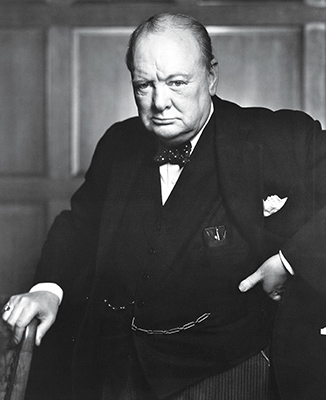
Sir Winston Churchill
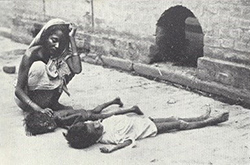
Bengal Famine victims Photos: Wikipedia
Masani has been verifying the background to the Bengal Famine in the archives of both the Government of India as well as the British War Cabinet and said he finds little evidence to lay the blame at Churchill’s door. He began by placing the famine in the context of World War (WW) II when the Japanese had occupied Burma, invading Bengal and bombing Calcutta. It was at this time that the famine raged across Bengal. "Most famine experts agree that famines can be caused by both nature and human agency, but never by any single individual,” said Masani. "So how has a 67-year-old British Prime Minister in poor health, 5,000 miles away, fighting near annihilation in a world war come to be charged with causing such a cataclysmic disaster?”
This, Masani felt, is a result of a sensational book, Churchill’s Secret War, (Tranquebar Press, 2010), by Madhusree Mukerjee, not a historian, but a Bengali American journalist. Amartya Sen, Nobel Prize winning economist, commented that the book was inadequately researched as the author’s conclusions were drawn on the basis of two out of 27 districts of Bengal. Said Masani, "The ‘confusion and callousness’ to which Sen alludes had very little to do with Churchill and was largely the result of wartime supply constraints, with most of Bengal’s boats commandeered or disabled, and uneasy relations between the elected, Muslim-led coalition government of Bengal and its largely Hindu grain merchants, notorious for hoarding and speculation.”
Mukerjee accuses Churchill of not allowing shipments of grain from Australia and Canada, destined for Europe, to be diverted to Bengal. There were also fantastic claims that grain was forcibly exported to Ceylon and Australian food shipments were compelled to bypass Calcutta. Masani countered these claims by stating that "Bengal only ever sent one food shipment to Ceylon that year, and it was an equal exchange of grain for rice. As for Australian food shipments being diverted from Calcutta, one has only to look at a map to see how nonsensical it would have been for Australian ships bound for Europe to come anywhere near the Bay of  Bengal and run the gauntlet of Japanese submarines.”
Bengal and run the gauntlet of Japanese submarines.”In the beginning of 1943, the Viceroy’s government in Delhi was initially disinclined to intervene and use its reserve powers but once it did the famine was brought under control and came to an end very soon. Masani emphasized the various initiatives taken by Churchill to mitigate the effects of the famine. He replaced the Viceroy, Lord Victor Linlithgow, with the more efficient Gen Archibald Wavell. On August 4, 1943, when the War Cabinet chaired by Churchill first realized the devastation caused by the famine, it decided that 150,000 tons of Iraqi barley and Australian wheat be sent to Bengal. Churchill himself insisted on September 24, the same year that "something must be done,” quoted Masani. Though Churchill emphasized the fact that Indians were not the only people who were starving on account of the War, he agreed to send a further 250,000 tons, to be shipped over the next four months.
Masani cited Churchill’s message to Wavell, "Every effort must be made, even by the diversion of shipping urgently needed for War purposes, to deal with local shortages.” On the basis of the British War Cabinet and Government of India archives, Masani concluded "that more than a million tons of grain arrived in Bengal between August 1943, when the War Cabinet first realized the severity of the famine, and the end of 1944, when the famine had petered out.”
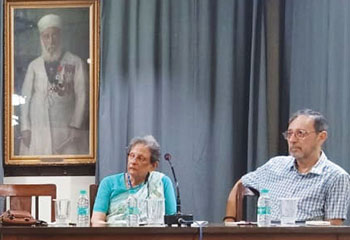
Top: Dr Zareer Masani; above: Drs Nawaz Mody (l) and Firdaus Gandavia
Masani did admit that like many of his generation Churchill was an "unashamed imperialist.” He has been accused of several harsh statements like "I hate Indians. They are a beastly people with a beastly religion,” said in anger when Congress launched the Quit India movement, seen by Churchill as a stab in the back at the height of WW II. However, one tends to overlook the praise he lavished on the bravery and the assistance of the Indian troops during WW II, noting in his war memoirs: "The unsurpassed bravery of Indian soldiers and officers, both Moslem and Hindu, shine forever in the annals of war. Upwards of two-and-a-half million Indians volunteered to serve in the forces…The response of the Indian peoples, no less than the conduct of their soldiers, makes a glorious final page in the story of our Indian Empire.”
Much of Mukerjee’s diatribe against Churchill rests not on his actions, but on his words, said Masani. But, as he pointed out, one should judge people not by their words but by their actions. Churchill and his government played an important role in alleviating the hardships caused by the famine rather than causing or exacerbating the situation, asserted Masani.
Masani is qualified to opine on the subject. With a DPhil in Modern History from Oxford and a particular interest in imperial history, politics and history form a vital part of Masani’s DNA. His father was Minoo Masani who founded the Swatantra Party in 1959 and his grandfather was Sir Rustom Masani, an eminent historian and educationalist. Zareer is the author of several books of historical interest and has also written a widely acclaimed family memoir, And All Is Said: a memoir of a Home Divided. He has spent two decades as a producer for BBC Radio 4 and is now a freelance historian, journalist and broadcaster. He has recently been elected as a fellow of the Royal Historical Society.
◆ ◆ ◆
From the archive