
Events & Personalities
“The human touch”
Noting that "the basic nature of medicine is care,” reputed physician Dr Farokh Udwadia believes medicine is "as old as man… It was born with the awakening of human consciousness. The greatest saga of man is the history of medicine.” He was addressing a select audience at the 219th anniversary of the prestigious Asiatic Society, Mumbai (ASM) on November 26, 2022 at the library premises at Horniman Circle.
The subject of his half hour talk was the importance of the humanities in the art and science of healing. "A knowledge of the humanities makes for a better physician,” stated Udwadia. While "science and technology changed the face of medicine…it also robbed it of its heart… Art is intertwined with the science of medicine.” If there were only science, doctors would "lose the human touch.” If they related only to "machines and gadgets and not the patients, medicine would lose its core, its heart. The bond between doctor and patients would go away.” A relationship of mutual trust was essential.
Stressing the importance of the humanities to medicine, Udwadia noted that when music is played a drop in blood pressure is effected. "Those who were exposed to music, left hospital earlier... Music works on a portion of the brain.” Some studies have shown that listening to Mozart, "enhances cognition.”
A doctor is of paramount importance. Medicine is not only a profession but also "a calling,” Udwadia said. Doctors have to "live among the dying and the dead.” They have to treat those suffering from physical and emotional suffering, while retaining their sense of compassion.
The subject of his half hour talk was the importance of the humanities in the art and science of healing. "A knowledge of the humanities makes for a better physician,” stated Udwadia. While "science and technology changed the face of medicine…it also robbed it of its heart… Art is intertwined with the science of medicine.” If there were only science, doctors would "lose the human touch.” If they related only to "machines and gadgets and not the patients, medicine would lose its core, its heart. The bond between doctor and patients would go away.” A relationship of mutual trust was essential.
Stressing the importance of the humanities to medicine, Udwadia noted that when music is played a drop in blood pressure is effected. "Those who were exposed to music, left hospital earlier... Music works on a portion of the brain.” Some studies have shown that listening to Mozart, "enhances cognition.”
A doctor is of paramount importance. Medicine is not only a profession but also "a calling,” Udwadia said. Doctors have to "live among the dying and the dead.” They have to treat those suffering from physical and emotional suffering, while retaining their sense of compassion.
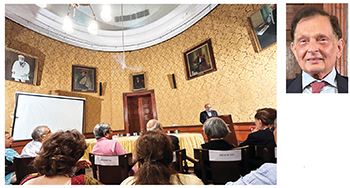
Above r: Dr Farokh Udwadia; above l: meet at Asiatic Society, Mumbai
Honorary secretary of the ASM, Prof Mangala Sirdeshpande, who had introduced Udwadia concluded by saying he should have been a writer or a professor of literature.
As November 26 is also the 14th anniversary of the terrorist attack on Bombay, ASM president Dr Vispy Balaporia asked the gathering to "think of the martyrs” who lost their lives during the four-day terrorist attack that paralyzed the city. The day is also the 73rd anniversary of the adoption of the Indian Constitution by the Constituent Assembly, noted lawyer and antiquities collector Rajan Jayakar. He narrated a brief history of how the "basic structure” of the Constitution was protected by dedicated lawyers from onslaughts by the late Prime Minister Indira Gandhi and some of her handpicked "committed” judges. Jayakar spoke of the lawyers who fought the landmark Golaknath and Kesavananda Bharati cases and made special mention of jurist Nani Palkhivala who successfully argued the cases before 11 and 13-member benches of the apex court. After the government lost in the Bharati case, a review petition before 13 judges was constituted. When after two or three days of hearings, Palkhivala inquired as to who had filed the review petition, it turned out no one had! The Chief Justice of India S. S. Ray had apparently initiated the petition, not the parties to the suit. The bench was dissolved.
Balaporia lamented how the government grant to the ASM had not increased despite rising costs. The shortage of funds had strained relationships with the employees and the assistance of a labor lawyer, Ayesha Damania was recommended. Balaporia’s first concern was the fees that would be charged but Damania responded she would do the work pro bono.
◆ ◆ ◆
From the archive