
Zoroastrians Abroad
Link with the language
"To present a paper at the Modern Language Association (MLA) or be part of the organization is a high honor indeed,” wrote Dr Feroza Jussawalla who has been connected with this body for nearly 50 years. Having taught in the US for 40 years at the universities of Utah, Texas-El Paso and New Mexico, she is actively involved with the South Asian Literary Association (SALA) which is a division of MLA. The US based MLA is considered the oldest and most prestigious organization of university professors who teach English, literature and languages, as also other modern languages. Conferences organized by MLA and SALA draw participation from faculty and university administrators from all over the world who are happy to share ideas, research and teaching resources.
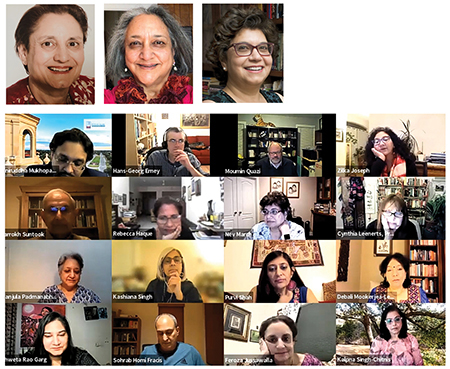
Top, l to r: Dr Feroza Jussawalla, Manjula Padmanabhan,
Nawaz Merchant at the online SALA conference (above)
For the two-day SALA conference organized in March 2022, more than 200 submissions were received from Egypt, Belgium, India, Pakistan and other regions of South Asia, stated Jussawalla who served as co-chair of the online meet. "A sub theme of this conference was ‘Pandemic Connections’ — what co-action did people make while locked up under quarantine? For me, it was an intense two-year-long connection with women in the Middle East,” mentioned Jussawalla who is professor emerita at the University of New Mexico and has co-edited two anthologies, Memory, Voice and Identity: Muslim Women’s Writing from Across the Middle East in 2021 and the recently published Muslim Women’s Writing from Across South and South East Asia. She is also the author of Family Quarrels: Towards a Criticism of Indian writing in English (1984).
"It became a mission for me to highlight Parsi creativity at the meet. One of the distinguishing features of the SALA conference is the Humara Mushaira (our poetic symposium), a concluding event that is meant to showcase the creativity of South Asian writers and provide them a platform to present their work... In this year’s Humara Mushaira, I used my position as co-chair to invite all the Parsi writers I had current connections with.”
The Mushaira was opened by prize winning writer Nev March (Nawaz Merchant) who read from her book, Murder in Old Bombay. Among the 21 creative writers who read were Sohrab Homi Fracis and Farrokh Suntook. The latter read from his debut novel, The People We Know, an allegorical novel that encapsulates the plight of the shrinking Parsi community.
Jussawalla read her poem "Garas,” published in her collection Chiffon Saris: I keep my saris/ in a safety deposit box —/ Garas my grandmother/ gave me Five-hundred-year-old crows/ perched on purple silk/ brought from China… of the Chinai family/ of Hyderabad, India.
"When I was asked to choose a keynote speaker and presenter, I immediately thought of my friend Manjula Padmanbhan, the distinguished, award winning writer and artist, whose fan I have been for many years. Manjula got her start as a writer and cartoonist at Parsiana. She fondly recalls her days with the magazine: ‘My time at Parsiana may seem brief: I worked full time for a little over two years, starting in mid-1973. I had just completed my BA (in Economics) and was studying for my MA (in History). During that short but extremely intense period, I got my life’s quota of training to be a journalist, illustrator and cartoonist.
"‘I also met a great host of Parsi and Irani artists, performers, writers and poets. Adil Jussawalla, Gieve Patel, Keki Daruwalla, Jehangir Sabavala, Zubin Mehta, Astad Deboo and Dadi Pudumjee are just a handful of the names that immediately spring to mind.
"‘I remember my initial resistance to an opinion that I often heard expressed by Parsis whom I met at the magazine: that the members of this tiny community of immigrants from Persia were more gifted and intellectually advanced than any other equivalent community in India. Gradually, however, I came around to agreeing with this view. I really did encounter an unusually high percentage of erudite, witty and exceptionally talented people during my time with the magazine. It was a wonderful introduction to the rest of my life. I look back with great fondness and gratitude.’”
◆ ◆ ◆
From the archive