
Zoroastrians Abroad
Sesquicentennial stamp
The benevolent visage of Pestonji Dosabhai Marker, attired in his dagla and pheto, is seen on the customized stamp issued by the Islamic Republic of Iran to mark the 150th year of his birth. On the bilingual stamp in Persian and English that was launched by the Zoroastrian Association of Yazd (ZAY) on November 10, 2021, the name of the legendary philanthropist appears as "Pashootan Ji Dusabai Marker” below which are inscribed the years of his birth and death, 1871-1965. The denomination of the stamp is shown as 3,000 Iranian rials (around five rupees).
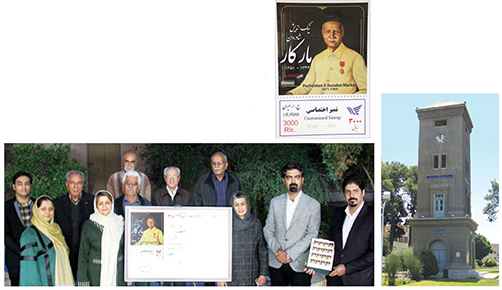
Top and above: Stamp of Pestonji Marker unveiled by the Zoroastrian Association of Yazd with
president Sepanta Niknam (2nd from r) Photos: berasad.com; above r: Marker Clock Tower Photo: Wikipedia
The unveiling ceremony for the stamp, organized on ZAY’s open-air premises was attended by the Association’s board of directors, it was reported on the online news portal berasad.com. Recalling his signal service to Iranian Zoroastrians, ZAY president Sepanta Niknam described Marker as one of the outstanding social workers of India known and respected by all residents of Yazd. He further mentioned that the cultural arm of ZAY has decided to perpetuate the memory of Zoroastrian philanthropists by issuing special stamps, hoping an album of Zoroastrian benefactors could be created. After the unveiling ceremony, a prominently placed white board allowed those present to write their comments lauding Marker’s manifold contributions.
News of the stamp release was first brought to the attention of Parsiana by reader Keki Lakdavala whose great-grandfather Sorabji was Pestonji’s brother. "Pestonji, who was not married, used to stay with my grandmother Bachamai,” recalled Lakdavala. Well-known Ambassador of Pakistan Jamsheed Marker’s grandfather Ardeshir too was Pestonji’s brother.
Known to be a simple, modest and self-effacing man, Pestonji had won the admiration of his co-religionists for his single-minded devotion to uplift Zarathushtis in India and Iran. His life sketch as presented in the Memorial Volume on Marker, excerpts from which are available online, revealed that he was educated at Bombay’s Elphinstone College. He started his career working in a solicitor’s office but later realized that operating as an independent businessman better enabled him to pursue his philanthropic work. In 1916 he established a school in Vesu where due importance was given to education and religious instruction. Additionally, he donated funds for the maintenance of wells and tanks in Vesu and provided for a medical officer to look after the health of the Parsis living there.
Learning from Manekji Limji Hataria about the deplorable conditions of Zarathushtis in Iran during the times of the Kajar regime and hearing personal accounts of hardships faced by Irani Zarathushti immigrants who opted to relocate to Bombay, Pestonji was greatly disturbed. Convinced that education was the means of uplifting the indigent and downtrodden, he started educational institutions in Yazd: an orphanage for Zarathushti boys followed by a high school for boys and a high school for girls where females could avail of an education as well as training facilities in handicrafts. Pestonji had built a special rapport with Mirza (title given to senior educators) Soroush Lohrasp, the long-standing principal of the Marker Orphanage, with whom he jointly worked to uplift Iranian Zarathushtis.
To monitor the progress of these institutions Pestonji made three trips to Iran where he was felicitated by the Shah of Iran as also large gatherings from the cities of Kerman, Shiraz, Isfahan and Tehran. When he visited Yazd, Pestonji was taken around the city in a huge procession. On one of his visits in 1924, he visited Persepolis where a jashan ceremony was held in the ancient ruins.
In addition to members of his community, the Iranian government too recognized his unique services to uplift and enlighten their people. He was conferred the insignia of the Neshan-e-Elmi and Neshan-e-Sepas in 1949. Later that year he received the Nishan-e-Humayun in Bombay. While education continued to be high on his list of charities, scholarships in pursuit of religious knowledge, religious literature, dar-e-mehers and health facilities too benefitted from his largesse.
A clock tower, known in Persian as Borj-e Sa’at-e Marker, continues to stand in Yazd to remind the city of Pestonji’s many charities. At a height of four meters, the clock tower that has been standing since 1942 is located in the middle of the Marker Clock Plaza. The movement system for the clock that was made in London by J. Smith & Sons Company requires its spring to be charged weekly, according to Wikipedia. On the four sides of the tower are inscribed couplets by a local poet, Naser. Lohrasp has been given credit for obtaining permission and supervising the construction of the Marker Plaza with gardens around it. The Plaza is situated on the road to Kerman just north of the Markerabad school entrance. The clock tower that continues to draw tourists is now maintained by the Yazd municipality while on the premises of the former schools built by Pestonji, ZAY has built a museum depicting the Zoroastrian way of life, reported Lakdavala.
◆ ◆ ◆
From the archive