
Zoroastrians Abroad
107, not 70
Sporting a pink sash over her pink dress on which was written "Birthday Girl,” Dina Sethna celebrated her 107th birthday with her family and members of the community and staff at the infirmary of the Bomanshaw Minocher-Homji Parsi Medical Relief Association in Karachi on October 31, 2021. The images of her birthday celebration and the feature on her in the daily, Dawn, started making their rounds on WhatsApp. While the Dawn article described her as "the oldest living Parsi in the world,” since Parsiana would like to verify this statement, we urge readers to write in to us to let us know of the oldest living Zoroastrian in their midst!
To glean more information on Sethna, Parsiana requested her daughter Sunnu Golwalla, editor of What’s On, the newsletter of the Karachi Zarthosti Banu Mandal, to give us insights into her mother’s life.
Responded Golwalla: "We as a family like simplicity and privacy but in today’s world of publicity it is a luxury I am unable to enjoy. Also, this request from Parsiana I cannot decline because my interest in writing started in the 1990s with the encouragement of the late Arnavaz Mama, then managing editor of Parsiana!
To glean more information on Sethna, Parsiana requested her daughter Sunnu Golwalla, editor of What’s On, the newsletter of the Karachi Zarthosti Banu Mandal, to give us insights into her mother’s life.
Responded Golwalla: "We as a family like simplicity and privacy but in today’s world of publicity it is a luxury I am unable to enjoy. Also, this request from Parsiana I cannot decline because my interest in writing started in the 1990s with the encouragement of the late Arnavaz Mama, then managing editor of Parsiana!
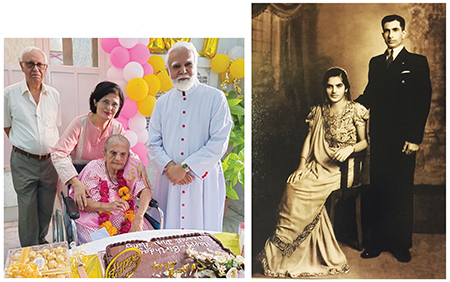
Above: Dina Sethna (center) with (from l) Farrokh and Sunnu Golwalla, and
Cardinal Joseph Coutts; above (r) : Dina and Homi Sethna on their wedding day
"When I returned to Karachi after the World Zoroastrian Congress in Houston in 2000, my mother asked me ‘Ali Jafarey ané Khojeste ni debate kévi hati (How was the debate between Jafarey and Khojeste Mistree)?’ I was stunned and asked her how she knew about it. ‘Kai, Parseena (she could never say Parsiana) ma aakho vukhat lakhaan aavéch (there is reference to it in Parsiana all the time).’ Yes she loves to read (even today) and I asked her how she can follow all this having studied for only three years. ‘Kai, mara Bejié seekhuveeyu [my younger brother Beji (Bejon) taught me].’ Actually it is her inner drive! Temperamentally she is an introvert and also hard of hearing and therefore shy to converse, but I converse with her by writing. In fact for years I have written and informed her of everything that happened during the day, because she takes such keen interest.
"In 2007 she could not even stand up as multiple fractures were in her spine. We had to hospitalize her and later shift her to the infirmary when she advised me ‘Jaa sudhee hoi saké potana pag pur oobhee réhjé (as far as possible try and stand on your own feet),’ a feat she attempts even today and we have to tie a soft duppatta around her waist to protect her.
"Born Dina Elavia, in Nasik, in 1914 where her father was a postmaster, her schooling was in one room with five children: she, her brothers Dara and Bejon, Manjula and her brother learning Gujarati, Math and English for three years. Manjula then got married and Mum’s brothers proceeded to Bombay where Bejon was an electrical engineer at GE and Dara was a stenographer. In her neighborhood was a young Parsi couple who encouraged her to learn the violin and even play lawn tennis! The Parsi couple was friendly with an English couple who went deer hunting. Her mother made huran na gos (venison) nu dhansak to the delight of both these couples.
"Later her family shifted to Bombay where she met Homi Sethna, married him in the 1940s and came to Karachi. When I started school she told me ‘Mohammedan chhokri sathé dosti na rakhti (do not befriend a Mohammedan girl)!’ In Pakistan we call them Muslims so in all honesty I retorted that there are no Mohammedan girls in my school. This must have puzzled her, but interestingly after living in Pakistan all these years her viewpoint changed. She has found our people generous and highly respectful of elders.
"Mum became a widow when we were in school, and lost her favorite eldest child Khurshed when he was only 24, which sadness has never left her. In the 1980s I married Farrokh Golwalla and soon my brother Godrej married Farrokh’s sister Nargiz. Farrokh used to take Mum out every evening when she lived with us, ensured she met her brothers in Bombay and also visited Lahore and Islamabad. Mum says about Farrokh: "sadguni maai no sadguni dikro (a fortunate mother to have a virtuous son like him).” Godrej and Nargiz relocated to USA soon after their marriage and have made their home there.
"Amusingly when she turned 100 and people sent cards with 100 written on it, she protested. So we asked what then her age was. Pat came ‘70!’ Probably that is the reason for her longevity?”
◆ ◆ ◆
4 readers wrote
Uulta-pulta order of events has taken away d flow. Chalo what can I say now.
My apology: on second reading I realised that your composition is to engage the reader. Best wishes.
With due respect, the 'flow' of the original is lost with paras rearranged.
With due respect, the 'flow' of the original is lost with paras rearranged.
From the archive