
Books
Blot on British justice
The Mystery of the Parsee Lawyer by Shrabani Basu. Published in 2021 by Bloomsbury, 50, Bedford Square, London WC1B 3DP, UK. Pp: xviii + 297. Price: £ 20.
In the fevered atmosphere that prevails in many western countries today where the issue of race has suddenly become so topical and so toxic, here comes another book which has the potential to add fuel to the raging fire. Unusually, the victim of racial prejudice in this story is a 27-year-old half-Parsi (spelt "Parsee” as was common during the Edwardian era in which the story is set) called George Edalji, the product of a mixed marriage between an Indian convert to Christianity, Shapurji, and his English wife 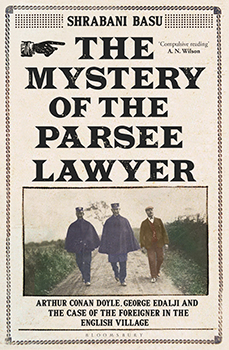 Charlotte who had been living in rural Staffordshire at the turn of the 20th century. What makes the story particularly compelling is that its dramatis personae included no less a figure than Sir Arthur Conan Doyle, the creator of Sherlock Holmes, who took on the role of detective and campaigner for justice in this rather sordid saga.
George, a shy and awkward boy who had trained as a solicitor, came under suspicion after a series of poison-pen letters surfaced in the quiet little village of Great Wyrley where he lived with his parents and in the vicinity of which a number of animals, mostly horses, had been maimed over a period of a few months. The letters began innocuously enough, but assumed ominous overtones fairly quickly — simultaneously, racist graffiti began appearing on the walls of the Edalji homestead, which indicated a clear intent on the part of someone to intimidate the family. The matter was referred to the police and, in a bizarre twist, the Edaljis’ teenage live-in maid was identified as the potential perpetrator on the basis of her handwriting. On being brought to court, she pleaded guilty to a lesser charge of issuing threats and was let off with a warning. The Edaljis also terminated her employment. Defiantly, the maid threatened to avenge her humiliation one day.
For the next three years the family was allowed to live in peace, but in 1892 trouble reared its head up again, this time in a more vexing way. As well as receiving anonymous letters as before, the Edaljis became victims of cruel pranks under which all manner of tradesmen in and around Great Wyrley were persuaded by the prankster to call on them with goods and services that they had never ordered (in addition, clergymen in neighboring parishes were hoaxed into believing that Shapurji, the head of the household, who was the vicar of Great Wyrley, had fallen ill and needed help with funerals and other services). The pranks and the harassment escalated, culminating in small objects and envelopes containing excreta being deposited in or outside the house. As this was happening, the police began to insinuate that it was all the handiwork of someone within the household, and began dropping heavy hints that the culprit was George. The local serjeant, William Upton, was especially antagonistic towards the Edaljis.
Charlotte who had been living in rural Staffordshire at the turn of the 20th century. What makes the story particularly compelling is that its dramatis personae included no less a figure than Sir Arthur Conan Doyle, the creator of Sherlock Holmes, who took on the role of detective and campaigner for justice in this rather sordid saga.George, a shy and awkward boy who had trained as a solicitor, came under suspicion after a series of poison-pen letters surfaced in the quiet little village of Great Wyrley where he lived with his parents and in the vicinity of which a number of animals, mostly horses, had been maimed over a period of a few months. The letters began innocuously enough, but assumed ominous overtones fairly quickly — simultaneously, racist graffiti began appearing on the walls of the Edalji homestead, which indicated a clear intent on the part of someone to intimidate the family. The matter was referred to the police and, in a bizarre twist, the Edaljis’ teenage live-in maid was identified as the potential perpetrator on the basis of her handwriting. On being brought to court, she pleaded guilty to a lesser charge of issuing threats and was let off with a warning. The Edaljis also terminated her employment. Defiantly, the maid threatened to avenge her humiliation one day.
For the next three years the family was allowed to live in peace, but in 1892 trouble reared its head up again, this time in a more vexing way. As well as receiving anonymous letters as before, the Edaljis became victims of cruel pranks under which all manner of tradesmen in and around Great Wyrley were persuaded by the prankster to call on them with goods and services that they had never ordered (in addition, clergymen in neighboring parishes were hoaxed into believing that Shapurji, the head of the household, who was the vicar of Great Wyrley, had fallen ill and needed help with funerals and other services). The pranks and the harassment escalated, culminating in small objects and envelopes containing excreta being deposited in or outside the house. As this was happening, the police began to insinuate that it was all the handiwork of someone within the household, and began dropping heavy hints that the culprit was George. The local serjeant, William Upton, was especially antagonistic towards the Edaljis.
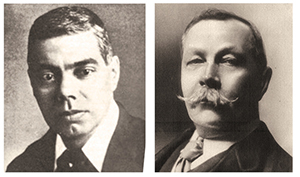
George Edalji (l) and Sir Arthur Conan Doyle
Faced with such hostility, Shapurji wrote to the chief constable of the Staffordshire force (the equivalent of a police commissioner), the Honorary George Anson, but all he got in response was a curt rebuff. As the author of this book Shrabani Basu (pictured) puts it, "Anson — an arch-Conservative — was not prepared to listen to the arguments of the ‘Hindoo vicar’ of Great Wyrley.”
 Anson’s racism was deeply entrenched: He had no sympathy for the colored family at the vicarage, and did not approve of the fact that a brown man had been given the role of preaching to a white parish. He had no hesitation in calling Shapurji — who had a harmless reputation — a liar. He was equally dismissive of Charlotte for marrying an Indian, and treated her with scant respect. He was particularly contemptuous of George and referred to him as "niggerish in appearance” and his sister Maud as "dumpy.”
 In this roller-coaster of a story, the anonymous letters and the pranks once again stopped as suddenly as they had started, and the Edaljis were able to resume a life of near-normality. George began to shine academically and not only did he do well in his school exams, winning many prizes, but he also obtained a law degree and qualified as a solicitor. He started his legal practice in nearby Birmingham and even wrote a book with the quaint title Railway Law for ‘the Man in the Train’ — a sort of guide for rail travellers which was well received. His professional life took off promisingly.
That state of bliss was, alas, not destined to last for long. An error of judgment on his part, which involved him standing surety for a fellow lawyer who turned out to be dishonest (and who misappropriated clients’ moneys and absconded), brought him to the verge of bankruptcy and ruin. Around the same time, further disaster struck in the form of a resumption of animal killings in Great Wyrley. This reignited the witch-hunt against George and, thanks to some skullduggery on the part of the police, led to the ignominy of his formal arrest on the charge of killing a horse.
The stage was now set for high drama in the courtroom where George was tried. The trial attracted huge public and media attention which is described with eloquence and lucidity in the book. Despite a strong — and highly plausible — defence mounted on George’s behalf, the jury returned a guilty verdict and George was sentenced to seven years’ hard labor. The harshness of the punishment was matched only by the vitriol that was poured over George by an uncaring Press which described him as a "degenerate” and a "monster.” The grief of the family could only be imagined. Basu notes poignantly that Shapurji was reeling under the injustice meted out to his son: "Was this the English legal system he had so admired, the Christian faith that he had devoted himself to?”
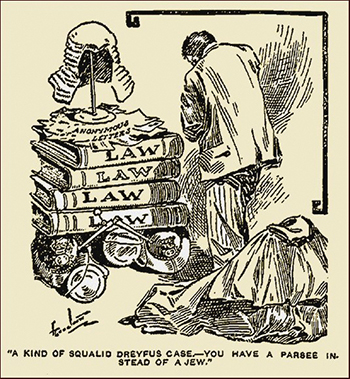
Illustration of Sir Arthur Conan Doyle’s article from
The Syracuse Journal, New York, 1907
Consolingly, a tidal wave of sympathy for the family’s plight and a strong sense of unease over George’s conviction began manifesting itself in the community. Of particular importance was support that the Edaljis received from a retired chief justice of the Bahamas, Roger Yelverton, and an eminent lawyer, Sir George Lewis, both of whom publicly proclaimed that a miscarriage of justice had taken place. A petition for George’s release garnered more than 10,000 signatures; simultaneously, a parliamentary committee presented a dossier to the Home Office highlighting the infirmities of the conviction. More tellingly, one of the local newspapers received a letter signed by a certain G. H. Darby in which the writer confessed that he had been the leader of a gang which had actually killed the cattle in Great Wyrley.
The upshot of all the campaigning was that the Home Office decided, grudgingly, to release George on licence three years into his incarceration, but he still remained a convicted criminal — a stain which he was desperate to remove. And that is where the creator of Holmes stepped in. The fascinating turn of events which followed forms the most captivating part of the book which is best left to readers to savor. Suffice it to note that George was, after much huffing and puffing on the part of the authorities, eventually given a free pardon as an act of royal clemency because a committee of inquiry set up by the Home Secretary unequivocally concluded that George’s conviction was "unsatisfactory.”
That verdict represented, at best, a bittersweet moment for George and those who campaigned for him because it was not accompanied, as might be expected, by any award of compensation for the three years that he had unjustly spent in prison. Doyle continued to press for compensation but without success. "The tribal loyalties of the establishment,” opines Basu, "had always irked Conan Doyle and it did so more than ever over the Edalji case.”
This is a book which, as well as being a gripping read, contains many parables of continuing relevance. It is well researched, skillfully edited and elegantly presented.
VENKAT IYER
Iyer is a UK-based barrister and legal academic.
◆ ◆ ◆
From the archive