
Events & Personalities
Surat case: “only academic”?
When the Gujarat High Court reserved its order in a July 2, 2021 hearing in the Surat Parsi Panchayat (SPP) case that pleaded for dakhmenashini for Covid victims, The Times of India (ToI) reported the next day that "the Court said that the plea was filed at a belated stage since guidelines were issued more than a year ago, and the case (had) only academic importance.” The plea sought to "protect the fundamental right to perform the last rites of community members who died of Covid-19 as per its tradition of dakhmenashini” (see "Plea for dakhmenashini,” Events and Personalities, Parsiana, June 7-20, 2021).
A video recording of the hearing is available on YouTube.
SPP’s counsel Asim Pandya argued that "there is no scientific data presented by the government to prohibit the Parsi community from carrying out dakhmenashini… The Centre has not opposed the demand and the local authorities claimed that they are following the guidelines only… The state government is silent on the issue.” Pandya submitted that the religious practices of the Parsis were "not taken into consideration” when preparing the guidelines. "He argued that only a law can stop people from practicing religious rituals and the guidelines are not a law,” stated ToI.
A video recording of the hearing is available on YouTube.
SPP’s counsel Asim Pandya argued that "there is no scientific data presented by the government to prohibit the Parsi community from carrying out dakhmenashini… The Centre has not opposed the demand and the local authorities claimed that they are following the guidelines only… The state government is silent on the issue.” Pandya submitted that the religious practices of the Parsis were "not taken into consideration” when preparing the guidelines. "He argued that only a law can stop people from practicing religious rituals and the guidelines are not a law,” stated ToI.
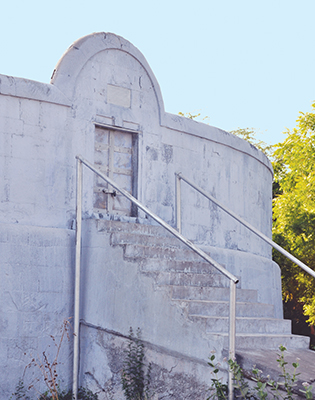
Surat dakhma
As the Court had on that day scheduled Covid related cases, senior advocate Percy Kavina who was representing some other party in a case, informed the justices that Parsis already have a practice of burial in many parts of India and this practice was "not anathema or sacrilegious.” ToI stated that Pandya argued "liberal people may take liberty, but this is an individual’s choice.” The judges commented that the present pandemic was novel and there is no question of "individual’s perception,” the daily noted. (Kavina had represented Goolrookh Gupta pro bono in her matter against the Valsad Parsi Anjuman resolution barring entry to the local agiary and Doongerwadi to Parsi women married to non-Parsis, even if they have had a civil marriage and continued to practice the Zoroastrian faith. The matter is before the Supreme Court.)
The online Parsi Junction weekly of July 4 noted that "although the Surat Panchayat had sought assistance and cooperation from all the Parsi anjumans of India,” it was "unfortunate” that the Bombay Parsi Punchayet (BPP) or The Federation of the Parsi Zoroastrian Anjumans of India "could not support Surat.” Reportedly, 14 anjumans, mainly from South Gujarat, but including Poona, Bangalore and Ajmer, gave affidavits in support of the SPP’s petition.
With the debate on the BPP’s stance on the SPP’s petition moved to widely circulated emails, BPP trustee Noshir Dadrawala stated on July 14 that "Just for the record, at yesterday’s BPP board meeting the board has unanimously agreed to file a petition in the Bombay High Court to consign those who succumb to Covid to the Towers of Silence.”
In an email to the community, conservative priest Ervad (Dr) Rooyintan Peer pointed out that the Gujarat High Court’s observation that the case had only academic importance was "intriguing.” He stated that in the early days of the pandemic in Surat and its vicinity, there were hardly a couple of Parsi deaths. "Even then, on the insistence of the Parsis of Surat, the SPP trustees took up this matter with the local authorities (in this case the Surat Municipal Corporation and the district collector) as early as in July 2020 and sent letters to the High Priests also seeking their opinions.” Noting that the number of "nearly 30 Covid-related deaths” would be very insignificant for the government authorities, but for the community, "this created a huge impact,” the SPP "(had) to approach the court, and not because the trustees of the SPP suddenly arose from deep slumber.”
Peer called Kavina’s statement of burial being an acceptable practice in other cities "highly irrelevant” to this case. "In this particular case, the devout Parsis of Surat, where there is a functional system of dakhmenashini, have appealed to have the first priority for the Parsi Covid victims to get them consigned to the dakhmas, according to their age-old religious tenets and customs and not to be disposed by any other method, cremation or burial.” Farrokh Jijina
◆ ◆ ◆
From the archive