
ART
“Don’t ask me about colour"
A friendship that blossomed over art led to the Mehlli Gobhai retrospective
Meherwan Minocher Gobhai (1931-2018), always known as Mehlli Gobhai, was one of India’s most distinguished and pathbreaking abstractionists. We got to know Mehlli when we were very young, as teenagers. We soon discovered how many interests we had in common: he became involved in our lives, and we in his. We would go over to see him, attend poetry readings and lectures together, often be on panel discussions together. There were the wonderful long phone calls, when we would discuss something we had heard the previous evening, or something he was reading. And then, for a period of 12 years or so, we spent our New Year holidays with him in Gholvad, his sylvan rural retreat north of Bombay. On an especially memorable occasion, when 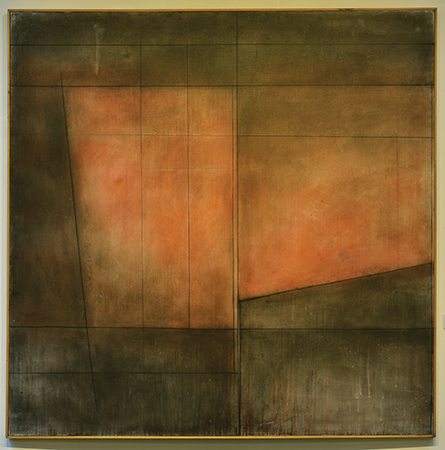 our friend and mentor, the curator Okwui Enwezor visited us in Bombay in March 2010, we hosted a Jamshedi Navroz dinner at home in his honor — and one of the close friends invited was Mehlli. He and Okwui shared a love for the city they had both adopted as a home on new shores, New York; they also shared a gift for conversation and making connections, and had much to say to the other.
When invited to curate his retrospective by Chemould Prescott Road at the National Gallery of Modern Art (NGMA), Bombay, we decided to give it the playful title of "Don’t Ask Me About Colour.” Mehlli regarded color as a temptation best submerged in the palette of sepia, umber, burnt sienna and charcoal grey that he came to favor. He did not avoid color so much as he refused to be intoxicated by it. In fact, the ground colors of all his later paintings — more familiar to viewers — were chalky pink and pale yellow. He would gradually build up the sienna, umber, and charcoal grey layers over this base. This was a form of discipline, of restraint that allowed the lines in his work to resonate, like notes in a dhrupad (North Indian school of vocal music) composition. In order to shake the prevailing image of Mehlli as a painter of somber, penumbral tonalities, we wanted to shock viewers with a Mehlli they had never known. So we opened the exhibition by showing, on the ground floor of the NGMA Bombay — for the first time ever — the intense, remarkably fresh polychrome paintings that had marked Mehlli’s transition from representation to abstraction during the late 1970s. We wanted viewers to come in, be amazed by these percussive yellows, blues, greens and reds, and to wonder if they had come to the right show.
These paintings from the 1970s, as well as his works from the 1980s, had been stored in Mehlli’s apartment on Lexington Avenue, New York, for the previous four decades. They were shipped back to Bombay only in 2016. Mehlli had never, in any case, exhibited these polychrome 1970s paintings. His first major appearances were with the dark, geometric works we displayed as the second movement of our visual symphony. These were shown in the group shows "Marking Black,” held in 1980 at the Bronx Museum of the Arts, and "Hard Line: Drawing as a Primary Medium,” held in 1984 at the Islip Art Museum, New York. We also presented Mehlli’s pathbreaking mixed-media works from the early 1980s, rendered in graphite, dry pastel and aluminum powder, reminiscent of views of the night sky. Viewers discovered his masterly life studies and his forays into print-making, as well as the children’s books he wrote and illustrated, several of them inspired by Indian folktales.
our friend and mentor, the curator Okwui Enwezor visited us in Bombay in March 2010, we hosted a Jamshedi Navroz dinner at home in his honor — and one of the close friends invited was Mehlli. He and Okwui shared a love for the city they had both adopted as a home on new shores, New York; they also shared a gift for conversation and making connections, and had much to say to the other. When invited to curate his retrospective by Chemould Prescott Road at the National Gallery of Modern Art (NGMA), Bombay, we decided to give it the playful title of "Don’t Ask Me About Colour.” Mehlli regarded color as a temptation best submerged in the palette of sepia, umber, burnt sienna and charcoal grey that he came to favor. He did not avoid color so much as he refused to be intoxicated by it. In fact, the ground colors of all his later paintings — more familiar to viewers — were chalky pink and pale yellow. He would gradually build up the sienna, umber, and charcoal grey layers over this base. This was a form of discipline, of restraint that allowed the lines in his work to resonate, like notes in a dhrupad (North Indian school of vocal music) composition. In order to shake the prevailing image of Mehlli as a painter of somber, penumbral tonalities, we wanted to shock viewers with a Mehlli they had never known. So we opened the exhibition by showing, on the ground floor of the NGMA Bombay — for the first time ever — the intense, remarkably fresh polychrome paintings that had marked Mehlli’s transition from representation to abstraction during the late 1970s. We wanted viewers to come in, be amazed by these percussive yellows, blues, greens and reds, and to wonder if they had come to the right show.
These paintings from the 1970s, as well as his works from the 1980s, had been stored in Mehlli’s apartment on Lexington Avenue, New York, for the previous four decades. They were shipped back to Bombay only in 2016. Mehlli had never, in any case, exhibited these polychrome 1970s paintings. His first major appearances were with the dark, geometric works we displayed as the second movement of our visual symphony. These were shown in the group shows "Marking Black,” held in 1980 at the Bronx Museum of the Arts, and "Hard Line: Drawing as a Primary Medium,” held in 1984 at the Islip Art Museum, New York. We also presented Mehlli’s pathbreaking mixed-media works from the early 1980s, rendered in graphite, dry pastel and aluminum powder, reminiscent of views of the night sky. Viewers discovered his masterly life studies and his forays into print-making, as well as the children’s books he wrote and illustrated, several of them inspired by Indian folktales.
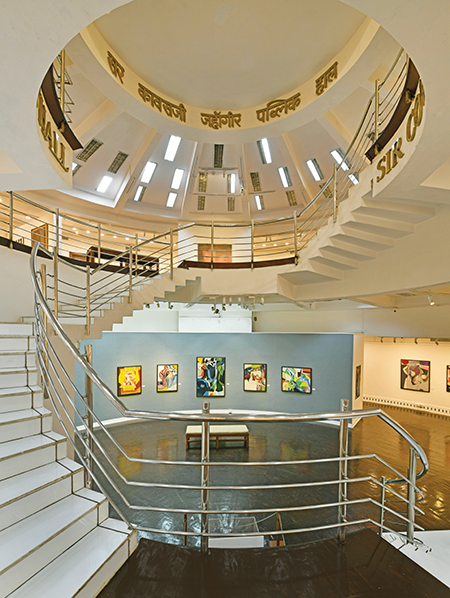
Top: Gobhai’s "interplay of glow and dusk";
above: a vista of the retrospective at the National Gallery of Modern Art
We wished, also, to develop a portrait of Mehlli as a participant in culture at large — as connoisseur, designer and collector. He was, for many years, an advertising professional, working as art director with the transnational agency, J. Walter Thompson. We showcased his work in advertising — including the art work for Air India’s witty, much-admired inserts in Time International in 1958 and 1959, as well as posters and brochures he designed for Ebrahim Alkazi’s Theatre Group. His extra-painterly commitments spanned theater (he trained as an actor with Alkazi), music (an interest inherited from his mother, a devotee of classical Western music, and which he pursued as a votary of the Hindustani and Carnatic traditions), dance (he savored Bharatanatyam), and folk culture (he enjoyed collecting textiles, especially shawls and rugs, which formed an integral part of the distinctive domestic environments he created in Bombay, New York and Gholvad).
Mehlli always defied social and cultural norms, despite his patrician social location. He believed in expressing his solidarity with those seeking social justice, whether it was in the cause of street children, or artists fighting against communalism, or environmental activists resisting the construction of a port in Dahanu, which would have displaced local communities. We exhibited a poster Mehlli made for SAHMAT in 1990, before the Bombay riots took place. While researching among his notebooks, we found the preparatory drawings for banners and posters, where he had written "Don’t wait for grief to bind us | Fight communalism now.” This proved prescient. The poster that we showed in the retrospective shows two figures embracing in empathy while a city burns. In Mehlli’s preparatory drawings, we see the ink strokes weaving bodies together, until they become less of flesh and limb, and more of pain and love.
"Don’t Ask Me About Color” also contextualized Mehlli’s art through select exhibits from his collection of rural art and traditional everyday objects, and works by young artists whom he championed. He was a passionate collector of objects, approaching them, not in the spirit of an art historian or a fussy connoisseur, but as a rasika (aesthete) whose imagination was open to the energies of rural and everyday art, to the curve of a bronze or gunmetal object once in daily use, the weave of a dhurrie, the fine striations made by a squirrel-hair brush. Mehlli was confident in his modernist lineage, never insecure — he regarded art as a continuum that embraced rural and urban, initiate and outsider, classical and contemporary alike. His collecting practice certainly bore the impress of a compassionate primitivism, a belief in a sylvan utopia of the forests alongside an awareness of the colonial and postcolonial exploitation of the forests and their people. Early in life, Mehlli had read anthropologist Verrier Elwin and art critics Mildred and W. G. Archer.
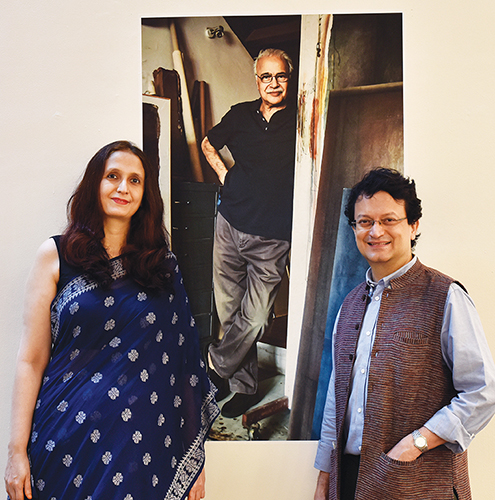
Nancy Adajania (l) and Ranjit Hoskote
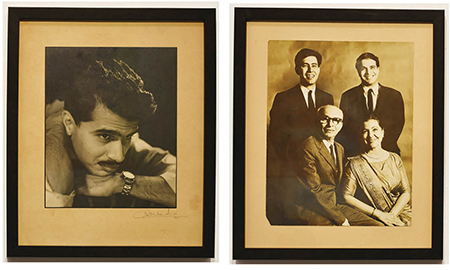
The artist in his younger days, and with parents Minocher and Perin and brother Cavas (standing, l)
He was educated at St Xavier’s College and the Government College of Law, Bombay, and later at the Royal College of Art, London, the Pratt Graphics Center and the Art Students League, New York. Gobhai lived in New York from the early 1960s to the mid-1980s. In the late 1980s, he returned to Bombay and became a dynamic, enthusiastic contributor to its cultural life.
He was partial to the drawings, rather than the paintings, of the Kota kalam (pen). This school of Rajput painting delighted in portraying the hunt, lions and humans in mortal combat, animals fighting each other. The robust violence of the subject is matched by the exquisite, detailed delicacy of treatment. Adjacent to a suite of such drawings, we showed a clip from the footage that Mehlli shot most probably in the late 1950s, as preparation for a film set in Kota, Banaras, Brindaban, Allahabad, Konarak and elsewhere in northern and eastern India. It features Sarasu, a Kota princess who was Mehlli’s friend, with her pet leopard cub. In the enclosure opposite, we showed another excerpt from this footage: the Ravan-dahan, the ceremonial burning of the giant effigy of the demon-king Ravana, a high point in the annual Ram-lila in northern India.
Until 2015, after which his health went into a gradual decline, Mehlli was a lively presence at exhibitions, lectures, seminars, panel discussions, poetry readings, and in the art world’s informal gatherings. He enriched every conversation with his empathy, nimble curiosity and kaleidoscopic imagination. He was equally at home with Euro-American art history, Hindu temple architecture and the natural realm. In his paintings, Mehlli combined an incisive geometry with a sensuous delight in textures suggestive of flint or burnished leather. Mistakenly compared to Mark Rothko, he was closer in spirit to Ad Reinhardt, both American artists. His sources of inspiration included patterned river stones, non-iconic wayside shrines, Chola bronzes and alchemical metaphors.
Mehlli’s Zoroastrian background gave him a lifelong fascination with light in its various modes, the spectrum of shadows that is its opposite, with the interplay of glow and dusk. One of his cherished possessions was a child’s handbook of Zoroastrian principles, presented to him on the occasion of his navjote by Dastur Maneckji Nusserwanji Dhalla, sent from Karachi, where the distinguished scholar-priest was based. Dhalla’s blessing, conveyed in red ink and copperplate writing, forms a link to a civilizational and diasporic history of which Mehlli was justifiably proud without ever trapping himself in mere self-congratulatory ethnocentrism.
It is a pity that this retrospective — on which we worked for three years, and which brought together nearly 200 art works, supplementary exhibits and archival documents — remained open to the public for barely 12 days. The NGMA closed down because of the Covid-19 lockdown, the show sat shrouded in silence and darkness for several months, and, in mid-June, we were asked to bring it down. We were not even allowed to keep it open for three final days, with masks and norms of social distancing strictly enforced, for the artist’s family and friends to visit. We are heartbroken, but console ourselves with the thought that Mehlli’s legacy resides as much in the works we exhibited at the retrospective, as in the lives he touched with his warmth, friendship, love and generosity.
◆ ◆ ◆
From the archive