
Cover Story
In memory of Mehlli
A painstakingly curated retrospective of the transcultural artist Mehlli Gobhai was cut short because of the pandemic
Mehlli (Gobhai) was afraid of retrospectives,” said art critic and poet Ranjit Hoskote who along with his wife Nancy Adajania curated a retrospective of the late abstractionist at the National Gallery of Modern Art (NGMA) titled, "Don’t Ask Me About Colour.” Such exhibitions should be held "after you’ve gone,” the artist felt, fearing for his mortality. Hoskote was addressing a distinguished gathering of Bombay’s art world, relatives of Gobhai and others at the March 6, 2020 inauguration. The exhibition displayed the artist’s works from 1947 to 2014, including the children’s books he wrote and illustrated, as also his collection of rural art.
Hoskote asked the audience to "think of (Gobhai’s) relation with color (see "Don’t ask me about colour,” pg 21).” Though the artist’s later works may appear monochromatic, yet an "archeological expedition of his painting” revealed "skins of color.” The invitation to the exhibition termed the colors "penumbral umber, sienna, sepia and grey blue tonalities,” highlighted through the lighting arranged by Adajania. While the paintings on the ground floor of the exhibition represented a riot of bright colors (they were for children’s books), his later works displayed on the higher floors were more austere, almost devoid of color. Gobhai’s cousin Noshir Gobhai and another relative Khurshed Pavri recalled another cousin Aloo Colah once commenting after being invited to a show of his works in New York, "Pan, Mehlli, paintings kah chhè (But where are the paintings)?”
Whether drawing for children, or "responding to the landscape of the Himalayas... he was a transcultural artist. He was not confined” to one genre. "He was a very good friend of Nancy and mine,” said Hoskote who has included Mehlli’s paintings in several exhibitions which he curated. "We became involved in each other’s lives. He took a genuine interest in the lives of others and other subjects. He was an incredibly generous, warm and giving person.”
"I have a strange feeling he is in our midst,” said Adajania voicing a sentiment made earlier by Mehlli’s advertising contemporary Gerson da Cunha. Mehlli died on September 13, 2018 at the age of 87. An art critic and author, Adajania believed "at the core of Gobhai’s works is a commitment to the human subject.” His was "the art of empathy, abstraction... antithetical.”
Writer and author Jerry Pinto who described himself as the "right and left hand of Gobhai (and) managed his studio,” referred to a large portion of the artist’s work "locked in storage for 30 long years” in New York. Much effort had to be made to bring the paintings to Bombay. When overseeing the display of Mehlli’s works, Pinto commented, "No one could have done more justice to the retrospective than Hoskote and Adajania.” Describing the artist as a "control freak,” Pinto remarked, "Nancy was doing what Mehlli would have done... adjusting the lighting, seeing to the settings, etc.” He thanked the art collectors who had loaned their paintings for the exhibition.
Hoskote asked the audience to "think of (Gobhai’s) relation with color (see "Don’t ask me about colour,” pg 21).” Though the artist’s later works may appear monochromatic, yet an "archeological expedition of his painting” revealed "skins of color.” The invitation to the exhibition termed the colors "penumbral umber, sienna, sepia and grey blue tonalities,” highlighted through the lighting arranged by Adajania. While the paintings on the ground floor of the exhibition represented a riot of bright colors (they were for children’s books), his later works displayed on the higher floors were more austere, almost devoid of color. Gobhai’s cousin Noshir Gobhai and another relative Khurshed Pavri recalled another cousin Aloo Colah once commenting after being invited to a show of his works in New York, "Pan, Mehlli, paintings kah chhè (But where are the paintings)?”
Whether drawing for children, or "responding to the landscape of the Himalayas... he was a transcultural artist. He was not confined” to one genre. "He was a very good friend of Nancy and mine,” said Hoskote who has included Mehlli’s paintings in several exhibitions which he curated. "We became involved in each other’s lives. He took a genuine interest in the lives of others and other subjects. He was an incredibly generous, warm and giving person.”
"I have a strange feeling he is in our midst,” said Adajania voicing a sentiment made earlier by Mehlli’s advertising contemporary Gerson da Cunha. Mehlli died on September 13, 2018 at the age of 87. An art critic and author, Adajania believed "at the core of Gobhai’s works is a commitment to the human subject.” His was "the art of empathy, abstraction... antithetical.”
Writer and author Jerry Pinto who described himself as the "right and left hand of Gobhai (and) managed his studio,” referred to a large portion of the artist’s work "locked in storage for 30 long years” in New York. Much effort had to be made to bring the paintings to Bombay. When overseeing the display of Mehlli’s works, Pinto commented, "No one could have done more justice to the retrospective than Hoskote and Adajania.” Describing the artist as a "control freak,” Pinto remarked, "Nancy was doing what Mehlli would have done... adjusting the lighting, seeing to the settings, etc.” He thanked the art collectors who had loaned their paintings for the exhibition.
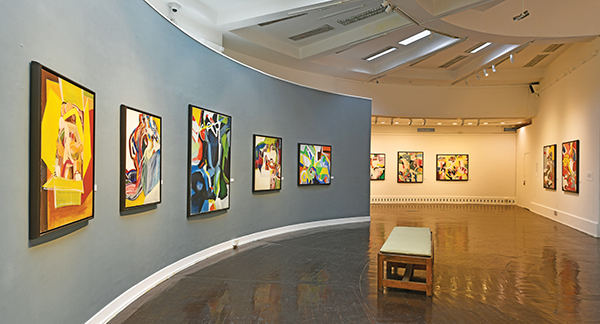
Mehlli Gobhai’s polychrome paintings displayed for the first time
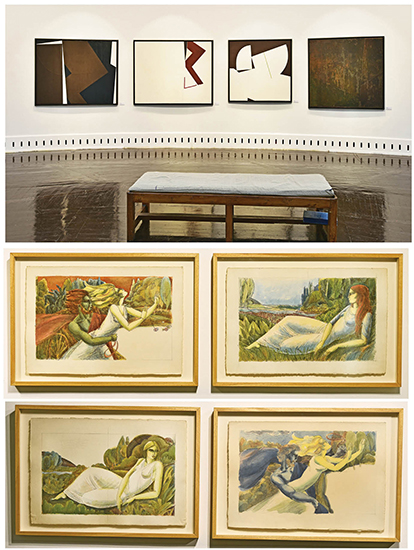
Top: Gobhai’s paintings in acrylic from the late 1970s and early ’80s;
above: four frames of preliminary artwork for an illustrated book Persephone
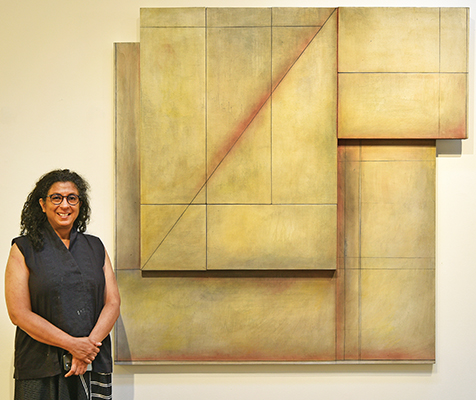
Shireen Gandhy Jungalwala, with a Gobhai painting from her collection
Chemould Prescott Road art gallerist Shireen Jungalwala, whose earlier family studio Chemould had a 40-year relationship with Mehlli, revealed that work on the retrospective had started four years ago.
A "whimsical character, quite austere (but also) very gentle, quiet, withdrawn,” is how art historian and founder of Cymroza Art Gallery Dr Pheroza Godrej described Gobhai. He "loved western and Indian classical music.” During the "No man is an island” exhibition, initially in Bombay and later Delhi, "He gave us a lot of encouragement.”
One reason that he did not sell many of his paintings is because "he abhorred the commercialization of art. He felt it should remain a national treasure,” explained Godrej. He was "quite critical of his colleagues sometimes” but was "a good sounding board for us.”
An old family friend, Godrej recalled Mehlli’s mother Perin "welcomed people in her home.” Godrej also referred to the efforts of the NGMA director, Anita Rupavataram, who managed to get the Gallery’s lease renewed and added a cafeteria. Rupavataram stated earlier at the event that the Gallery had installed LED screens, facial recognition software on the upgraded CCTVs, upgraded the air conditioning and the drainage system, conducted classes for kids, especially the disadvantaged, amongst other things.
da Cunha, who knew Mehlli for 70 years, referred to the artist being "an excellent ballroom dancer,” and owner of a small car. They both worked in J. Walter Thompson (JWT) advertising agency. When he was a reporter for the Press Trust of India (PTI), da Cunha had gone to meet Mehlli at JWT. While waiting for Mehlli, the creative director made da Cunha take a copywriting test and hired him at twice the salary he was earning at PTI! The artist "was fussy and hard to please,” da Cunha recalled. His illustration accompanied a well-known Air India advertisement. When India was receiving grain under the PL (Public Law) 480 aid program from the USA in the 1960s, Mehlli drew an illustration showing a hand with two grains of rice with the caption, "One grain is yours.” He was posted in the New York office of JWT and "became part of the city’s art world.” da Cunha used a painting of Mehlli for a cover of a book of poems he had penned.
"Art is an expression of the inner being,” stated artist and friend Vilas Shinde, an abstractionist and chairperson of the Bombay NGMA advisory committee. "The artist finds creativity through experience.”
The exhibition was to continue till April 25 but due to the lockdown ended on March 18.
◆ ◆ ◆
2 readers wrote
Please have facility to enlarge the text, if required, so that your articles are read and not just browsed!!
Please have facility to enlarge the text, if required, so that your articles are read and not just browsed!!
From the archive