
Books
“The dead cannot be defamed”
All were different… he or she had to be unforgettable decades after they had passed on…” Several are "faceless,” but "they lived exemplary lives,” stated lawyer, columnist and racing enthusiast Berjis Desai at the launch of his second book The Bawaji: Chronicles of a Vanishing Community on the lawns of Gallops restaurant at Bombay’s Mahalaxmi race course on November 2, 2019. The Bawaji is a compilation of 50 profiles written by Desai and published in Parsiana between 2017 and 2019 in a column titled "Unforgettable Bawas.”
Supreme Court Justice Rohinton Nariman, who released the volume, likened it to German composer Ludwig van Beethoven’s Symphony No. 9. "(Desai’s) idyllic world will never stale,” he stated, paraphrasing writer Evelyn Waugh’s tribute to novelist P. G. Wodehouse. Western music aficionado, physician and Padma Bhushan and Dhanvantari Award recipient Dr Farokh Udwadia, who presided over the function, said the book reminded him of Russian composer Modest Mussgorsky’s 1874 musical masterpiece Pictures at an exhibition.
Supreme Court Justice Rohinton Nariman, who released the volume, likened it to German composer Ludwig van Beethoven’s Symphony No. 9. "(Desai’s) idyllic world will never stale,” he stated, paraphrasing writer Evelyn Waugh’s tribute to novelist P. G. Wodehouse. Western music aficionado, physician and Padma Bhushan and Dhanvantari Award recipient Dr Farokh Udwadia, who presided over the function, said the book reminded him of Russian composer Modest Mussgorsky’s 1874 musical masterpiece Pictures at an exhibition.
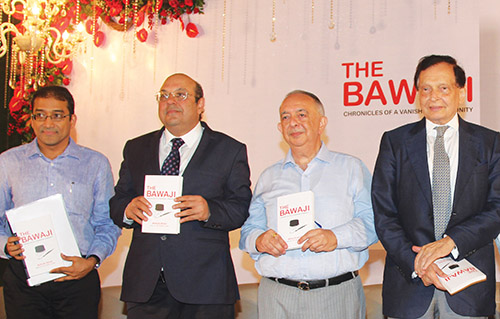
Above from l: Somasekhar Sundaresan, Rohinton Nariman, Berjis Desai, Dr Farokh Udwadia
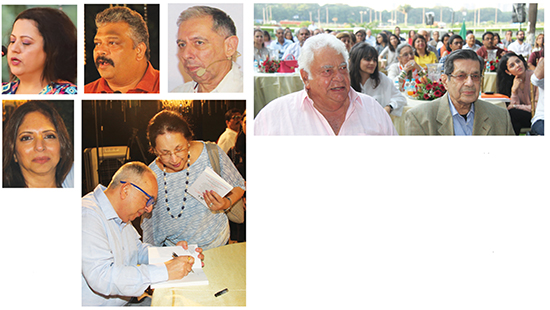
Clockwise from above: audience, Farokh Engineer (l) and
Dr Rustom Soonawala in foreground; Manek Guzder, B. Desai; Vandana Desai;
Farzana Mojgani; Ramjee Narasimhan; Nizwar Karanj
"The facts in Desai’s works would verge on farce, if presented in a drama,” noted Nariman, who said he was inspired by Desai to write about "my family and other animals,” his extended kith and kin. His wife’s fua (paternal aunt’s husband) when asked where the aunt was, would retort: "Hamna naahech…time laagsé…area jasti chhè cover karvanoch (She is bathing… this will take time… a large area has to be covered).” The uncle would insist on brushing the teeth of a stuffed leopard, and would tell all that he had eaten more French beans in his life than French president Charles De Gaulle himself. A nephew who did not want children was aghast when his wife was pregnant after two months of being married. "But, I am on the pill!” he exclaimed. Nariman listed his favorite characters from Desai’s works: the solicitor who ate the document that was to serve as evidence; the fixer who donned priest’s robes to burn the promissory notes against which he had borrowed money; the flirt who "rubbed the bare back of a bare acquaintance.”
His tips for possible future themes for Desai: stories behind the Wadia-built ships the HMS Minden on which the American national anthem Star Spangled Banner is believed to have been composed and the HMS Cornwallis on whose deck the Treaty of Nanking, by which Hong Kong was ceded to the British, was signed. Another colorful character was the unnamed Parsi mentioned in Vincent Cronin’s 1971 biography of Napoleon Bonaparte, Nariman stated. He reportedly jumped ship at St Helena and landed up at the exiled French leader’s mansion there, asking if he wanted a manservant. "Who was he?” queried Nariman.
Some more colorful community members for Desai to write about, according to Nariman: Anglican preacher of Parsi descent George Edalji who was publicly defended by Arthur Conan Doyle, creator of Sherlock Holmes, for his alleged animal maiming; Dr Buck Ruxton who was tried and found guilty of murdering and then mutilating the bodies of his wife and their maid; Bhicaji Balsara, notable for being amongst the first Indians to become a naturalized US citizen.
"There is a cadence to (Desai’s) words when he recounts the eccentricities and idiosyncrasies, the goodness and the badness of the community,” appreciated Udwadia. "There is no judgment in his writing… He describes the character and leaves you to judge.” The doctor called the author a "consummate artist who paints each canvas… and invites you to view each of them as you walk from one to the other.”
Udwadia hypothetically asked the audience what would happen if 30 or 40 of Desai’s characters were behind closed doors in a room, provided with whisky and snacks. "They would fight… Fighting is built into the Parsi gene… we fight on boards, committees and punchayets,” he smiled. "Unless a miracle happens, we will die as a community… The tragedy will be if Zoroastrianism dies in India… Perhaps it will thrive in countries far away,” prophesied the doctor. "Send your books to libraries all over the world so that when we as a community vanish, people will read of our joie de vivre, our madness and our honesty,” he advised Desai. The author said that he tended to agree with Udwadia. "A miracle may happen and the Parsis may survive…We are an anthropological rarity… Even the Cosmic will not permit (our) extinction!”
Narrating vignettes from his six decades of practicing medicine, Udwadia said that seven out of 10 Parsis are hypochondriacs. "The remaining are periodically hypochondriac.” "Why do you fight so much?” a young Udwadia had queried a particularly quarrelsome patient during the early years of his career. "Why don’t you get married and have six children…put your adrenaline to better use,” the physician had counseled, only to be told, "Then I would fight with my wife and that would not be fair to her.” "Mixed with our madness is a sense of fair play,” Udwadia commented.
"We lawyers must emulate (Udwadia) in reaching out to the common man,” noted securities law expert Somasekhar Sundaresan when introducing the physician. Referring to Nariman’s The Inner Fire: Faith, Choice, and Modern-Day Living in Zoroastrianism, Sundaresan stated that the book had the "universal appeal of righteousness.” While Desai’s readers are familiar with the goings-on in "neurotic Navsari and the French Riviera,” Sundaresan stated that "the best is yet to come.” Desai, he said, is contemplating a foray into fiction. "We are already drooling,” he laughed.
Ramjee Narasimhan, partner of Madras-based Zero Degree Publishing, the company that has brought out both of Desai’s books, told the audience that he was surprised at the number of people who trooped into his office to buy Oh! Those Parsis, "and not only from among Parsiana’s subscribers… It is the job of a publisher to take a writer far and wide… but it is Desai who has done that for us,” he said.
"I asked Berjis how he decides who to write about,” narrated the editor of Parsiana Jehangir Patel. The columnist had replied that "a person just lends himself” to his writing. "Writers are not generally social activists,” said Patel, noting that Desai was the exception to this general rule. He alluded to the lawyer’s prior work in ushering in adult franchise for the Bombay Parsi Punchayet (BPP) trusteeship elections in place of the archaic, prone to manipulation, cumbersome scheme that existed earlier. Desai currently serves on the core consultative committee that advises the BPP trustees.
Desai’s columns mention no personality by name, with the exception of Dastur Jamshed Kukadaru in "The saint.” While there is "nothing fictional” about Desai’s characters, some facts have been altered or "held back” to preserve privacy, the author said. Only four of the profiled people are alive, emphasized Desai. "The dead cannot be defamed and truth is a complete defense to any charge of libel,” he has stated in the Author’s Note. The volume is dedicated to his grandmother Jaijimai who had narrated "countless stories.”
Excerpts from the book read by Desai and actor Nizwar Karanj concerned: a pair of sisters who did not acknowledge the Indian government several years after Independence; "parents” of hundreds of children, "old and young” who benefitted from their philanthropy; the fraudster who painted his horse another color, only to have his game exposed by a sudden shower; warring baker brothers. While the hypochondriac who wanted her relatives to apply makeup to her face after she passed away drew many a chuckle, the public school boy and his mother who became bankrupt and were "too much in love with their sadness” after leading charmed lives, brought in a touch of the bitter-sweet.
It is time the apocryphal story of sugar-in-milk is retold, said Desai. Both the characters in the oral legend, Dastur Nariyosang Dhaval and King Jadi Rana, "had a sense of theater… Dhaval had not the slightest intention (for the early Zoroastrian migrants) to dissolve (within the people of the Indian subcontinent)… The Parsis floated like almonds in the milk… It is this uniqueness that enabled the community to survive for 1,300 years,” averred Desai.
The columnist’s first book Oh! Those Parsis: A to Z of the Parsi way of life was launched on August 3 this year (see "Effortlessly humorous,” Parsiana, August 21-September 6, 2019). That volume covered his columns in Parsiana titled "Bawa Musings” written between 2014 and 2017. No, the inspiration for the title Oh! Those Parsis was not the Euro-Caribbean vocal group Boney M’s number Rasputin that ends with "Oh! Those Russians,” clarified Desai. He quipped that "there are no Rasputins in the community any more, and no effective love machines.” (The song alludes to a liaison between the last Russian Czarina Alexandra Feodorovna, and mystic and self-proclaimed monk Rasputin.)
The evening was compered by lawyer Farzana Mojgani. The event was the first on the lawns of Gallops after nearly a decade while it was closed due to legal disputes between the Royal Western India Turf Club and the restaurant.
◆ ◆ ◆
From the archive