
“What the Buddha taught”
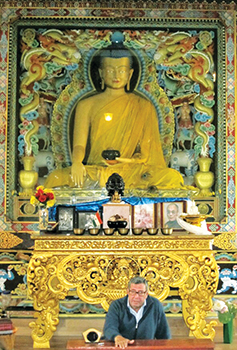 May I attempt to link two obviously unconnected, rather unrelated events, namely Aspi Mistry (pictured) turning to Buddhism for his spiritual sojourn ("What the Buddha taught,” Parsiana, February 7-20, 2020) and the "Best represented religion” in the interfaith arena in the same issue?
Since I was quite active in the interfaith movement decades ago, I believe the Zoroastrian presence would be very much enhanced by emphasizing how it is the only religion which has touched base with all other major religions and influenced them. Yes indeed, Buddhism too, especially after it spread out of India, though not as much as it influenced the Judeo-Christian and Islamic tradition. So vast is this influence that I cannot finish summing it up in a book I have been devoting all my time to for decades.
Mahayana Buddhism came into being not in India but under Iranian influence in the Afghanistan and Bam area in Kushan territory inspired by the Zoroastrian concept of the coming of the savior (saoshyant) which opened up hope in the future world. As The Cambridge History of Iran Vol. 3 (2), pp 557-623 observes: "There can be little doubt that the character of Buddha Amitabha owes much to Iranian concepts of cosmology and divinity: as a lord of ‘boundless light’ he bears the same title as Ameretat, one of the six Mazdean Amesha Spentas who surround the deity and are in some sense his emanation or attributes. Amitabha’s Western Paradise, like Maitreya’s Sukhavar, has its germ in Iranian beliefs — for such a thing China itself provided no earthly model.” It finds Iranian design and style in a Japanese temple, "although comparison is oftenest made with the Ajanta murals.” The headdress of the later Bodhisattvas "appears to be of Iranian inspiration.” After citing other Iranian influences, it adds: "It is likely that more was known in China of the Iranian story than appears from extant art and writing,” such as a story about a city built by King Vishtasp (Gushtasp).
"As was the case with the Chinese, the popular Buddhism of the Uighurs was influenced by the ideas and images of Iranian religion” which "softened” even the immutable law of karma "under the influence of Zoroastrianism.” And "The idea of ‘light’ and ‘West’ also suggests some Iranian origin.” There are too many such facts to be included here.
I’ll be glad to forward a paper I read in an international interfaith meeting in the 1990s to Parsiana, if desired. But it is so sad that despite being blessed with the light of Ahura Mazda for the first time ever in history, we have lost it to seek it elsewhere in its secondary sources. It is hard to blame this on anything other than the sad fact that the priests have lost the knowledge of our ancient languages, particularly Gathic, too early in our history to keep up with the illumination we were the first to be privy to.
However, now that modern research has overcome this problem we could find enough enlightenment in the Gathas, as also in meditation, which I have humbly put together on the Gathic lines and which I will place on the Internet soon; only tapes are available at present. May we be blessed with Mazda’s light!
Dr KERSEY H. ANTIA
Chicago, USA
Aspi Mistry responds:
All civilizations have their unique and universal achievements and development. And civilizations have progressed not when they try to project themselves as superior, stronger or more "civilized” than others. We have progressed not in competition but in confluence. It would be amazing if one can point out a single civilization in history that developed and progressed in isolation and without these influences and confluences.
Dr Antia says, in a rather patronizing manner, "But it is so sad that despite being blessed with the light of Ahura Mazda for the first time ever in history, we have lost it to seek it elsewhere in its secondary sources.” I would not ever refer to the wisdom of other spiritual traditions as secondary sources. And it is good to remind ourselves that sometimes we have to travel far from home to discover, as the Quran says, that which is as close to us as our jugular.