
The Z-Factor in world religions
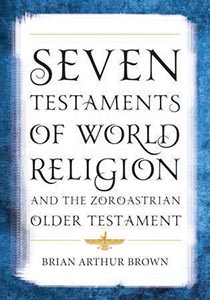
Seven Testaments of World Religion and the Zoroastrian Older Testament by Brian Arthur Brown. Published in 2020 by Rowman & Littlefield, a wholly owned subsidiary of The Rowman & Littlefield Publishing Group, Inc., 4501, Forbes Boulevard, Suite 200, Lanham, Maryland 20706, USA; website: www.rowman.com. Pp: xxv + 317. Price: Not mentioned.
A culmination of two decades of research, Rev (Dr) Brian Arthur Brown’s (pictured) Seven Testaments of World Religion and the Zoroastrian Older Testament trilogy was launched "virtually” in May 2020. Sadly, to the disappointment of the author, publisher, and internationally renowned scholar panelists from around the world, the long-awaited three-day Trilogy Launch Conference at 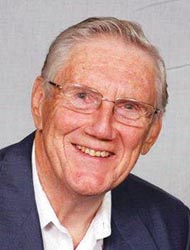 Niagara Falls, USA and Canada, had to be cancelled due to the pandemic.
With contributions from enlightened scholars from various faiths, and gleaning from his two earlier volumes, the tome presents a heightened emphasis on the debt owed to Zoroastrianism by all seven world religions: Judaism, Christianity, Islam, Taoism, Confucianism, Buddhism and Hinduism. He points out references in the Avestan texts — that he calls the "older testament” — to creation stories and apocalypse, Satan, final judgment, the messiah, salvation, heaven and hell, and other elements of religion that were inherited by Jewish prophets from Zoroastrian priests in Babylon and are recognizable in popular culture today as the Zoroastrian legacy to the modern world.
Brown traces how Zoroaster’s thoughts were spread along the Silk Route from Ecbatana in present-day Turkey to Dunhuang in China during the Axial Age (between 550 BCE and 400 BCE) by the Magi during the reign of Cyrus the Great. Some scholars accept the date of Zarathushtra to be in the 11th or 12th century BCE, but if one accepts the traditional dates for Zarathushtra (628-551 BCE), Brown posits the spread of his ideas could be placed in the immediate wake of Zoroaster’s life and prophetic ministry.
In several Appendices that follow the main text, Brown presents some interesting reading. In Appendix E, readers will be captivated with the breakthrough identification of Zoroaster’s tomb — in a crypt beneath the Blue Mosque, Mazar-i-Sharif, in Afghanistan. A planned expedition to this site has been postponed due to the pandemic. Appendix F features an article by Jenny Rose on trade between China and Central Asia that was begun in earnest by Sogdian merchants in the Achemenid period; and in Appendix G we read about the establishment of Sogdian communities in China in the fifth and sixth centuries. In Appendix H, we read the story of the An Lushan Rebellion in China — after which, in the eighth century CE, there was an integration of millions of Sogdian Zoroastrians into the mainstream of Chinese society, and Confucianism, enhanced by Zoroastrian spirituality, became a religion.
 Another quest embarked upon by Brown is to find the lost portions of the Avestan writings that were destroyed, first by Alexander, and again by the armies of Islam. He believes these missing chapters still exist, like the Dead Sea Scrolls of the Hebrew scriptures, and dubs them the "Dead Zee Scrolls.”
In his earlier work Three Testaments (2012) Brown explores the similarities and distinctive features of the Jewish, Christian and Islamic texts — the Torah, the New Testament and the Quran, and identifies passages in the Zoroastrian Avesta that correlate with similar verses in the scriptures of these three Abrahamic religions — which Brown calls the "Z factor.” While in Four Testaments (2016) he analyzes the foundational texts of the four Eastern traditions — Taoism, Confucianism, Buddhism and Hinduism — exploring areas of connection and divergence, and again illustrating the growing realization of a "Z factor” — a Zoroastrian backdrop to all major world religions.
Brown, a minister of the United Church of Canada, holds a PhD from the University of California and did post-doctoral studies at Harvard University. He is currently serving as scholar-in-residence at First Baptist Church and minister emeritus at St John’s United Church at Niagara Falls. Author of 20 books on the quest for peace and harmony among religions, he is a strong believer that religions of the world are connected and each has gems to share. Whereas previous interfaith texts focused on comparative religion, in which faiths are "compared,” Brown’s work shows how they are inter-connected, and gives insights into how concepts of various faiths can be "shared.”
He maintains that as a practicing Christian, he himself now has a "New Testament of Christianity, an Old Testament of Judaism, and an Older Testament which is the Zoroastrian foundation of it all” — an apt description of a growing interfaith appreciation.
Brown’s texts were vetted with scholars and religious leaders at the Society of Scholars of Zoroastrianism conference in Chicago in 2018 and subsequently at the Parliament of the World’s Religions in Toronto in 2018, and all their contributions were woven into the final text. One of the contributors was Kersi Shroff, attorney, US Library of Congress who is quoted on the back cover of Seven Testaments: "Brown succeeds in bringing the largely overlooked teachings of Zoroastrianism into the mainstream of religious thought, and he convincingly shows that its foundational concepts underlie all Seven Testaments.”
The Seven Testaments trilogy deserves to become a standard resource in departments of religious studies, interfaith circles and possibly a text book in classes and book clubs. Reading about the inter-connectedness and inter-dependence of all world faiths could prompt enriching interfaith dialog, and as we know, dialog leads to understanding, understanding leads to respect and respect leads to peace!
And what more do we all crave in this world at a time like this than peace — in our community, our country and the world.
Note: We are pleased to learn that in lieu of the Seven Testaments launch conference that was canceled, The United Nations Associations are planning a Zoom conference featuring the same panels on February 1-3, 2021. Anyone can participate to kick off the United Nations Week for Religious Harmony. The details are on the website of the author at www.BrianArthurBrown.com with periodic updates to come. ROSHAN RIVETNA
A key player in the promotion of academic advances in the worldwide Zoroastrian diaspora, Rivetna was editor of FEZANA Journal, the publication of the Federation of Zoroastrian Associations of North America, from 1991 to 2005.