
Sports
Take on triathlon
Not content with pursuing their individual events, four sportsmen dare to swim, cycle and run consecutively at national and international meets
"The whole idea was to do something new and interesting,” stated Dr Aashish Contractor. "Every year we seek different events to remain motivated and challenged,” noted Jamshid Pandole. Both these sportsmen from Bombay successfully completed the Turkey Ironman 70.3 also known as Half Ironman (total distance covered being 70.3 miles or 113 km) on November 3, 2019 that required them to undertake three consecutive activities: swim for 1.9 km, cycle for 90 km and run for 21.1 km.
Having completed the same feat last year, Kurush Wadia chose to participate in Kolhapur’s Olympic distance Triathlon (1.5 km swim, 40 km bike ride, 10 km run) on November 24, 2019 to claim second place in his age group of 31 to 45 years and fifth across all age groups. The challenge for him was to better his performance in "the mix of three sports while trying to focus on one particular sport more than others.” Also competing in the same event was Zarir Baliwalla in the age group of 45+ whose reason for opting for triathlons was to make his fitness regime "more interesting and less stressful on the knees.” His earlier high intensity running workouts, he realized, were straining his knees. This being his fourth triathlon, he mentioned that at "every triathlon you try and improve your timing.”
"The human body is capable of many fantastic feats when it is given the right amount of training with adequate rest periods,” stated Contractor who heads the Department of Rehabilitation and Sports Medicine at the Sir H. N. Reliance Foundation Hospital. Devoting 12 to 15 hours a week on training, some short sessions are for 45 minutes and others last for three hours. Whilst he has been running half and full marathons for years, swimming was Contractor’s weak point for which he required special coaching. Running and cycling at Cusrow Baug, Marine Drive or Worli was undertaken either individually or in conjunction with others, depending on work commitments.
Having completed the same feat last year, Kurush Wadia chose to participate in Kolhapur’s Olympic distance Triathlon (1.5 km swim, 40 km bike ride, 10 km run) on November 24, 2019 to claim second place in his age group of 31 to 45 years and fifth across all age groups. The challenge for him was to better his performance in "the mix of three sports while trying to focus on one particular sport more than others.” Also competing in the same event was Zarir Baliwalla in the age group of 45+ whose reason for opting for triathlons was to make his fitness regime "more interesting and less stressful on the knees.” His earlier high intensity running workouts, he realized, were straining his knees. This being his fourth triathlon, he mentioned that at "every triathlon you try and improve your timing.”
"The human body is capable of many fantastic feats when it is given the right amount of training with adequate rest periods,” stated Contractor who heads the Department of Rehabilitation and Sports Medicine at the Sir H. N. Reliance Foundation Hospital. Devoting 12 to 15 hours a week on training, some short sessions are for 45 minutes and others last for three hours. Whilst he has been running half and full marathons for years, swimming was Contractor’s weak point for which he required special coaching. Running and cycling at Cusrow Baug, Marine Drive or Worli was undertaken either individually or in conjunction with others, depending on work commitments.
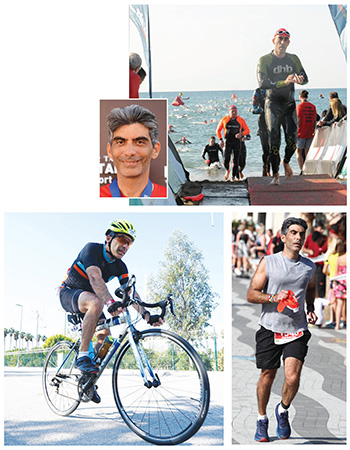
Top and above: Dr Aashish Contractor completes the swim,
proceeds on his bike and runs at the Turkey Ironman 70.3
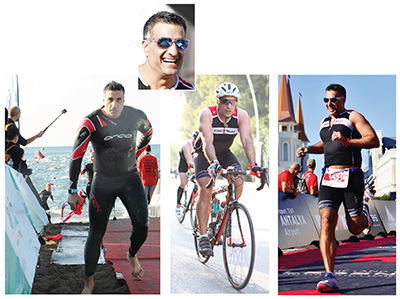
Top and above: Jamshid Pandole after his swim,
bike ride and run at the Turkey Ironman 70.3
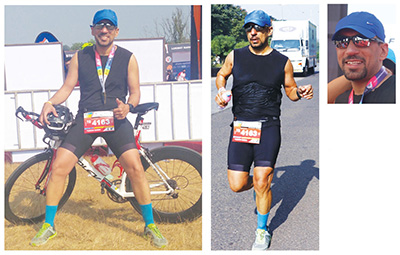
Above and l: Kurush Wadia earned a podium finish
at the Kolhapur Olympic distance Triathlon
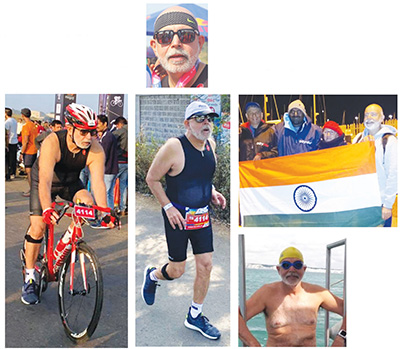
Top and above from l: Zarir Baliwalla on the bike and running at the Kolhapur Triathlon;
successful relay team and triumphant swimmer at the English Channel
"Having a goal and chasing it inculcates a sense of discipline that carries over to other aspects of life,” believes Contractor for whom "the learning from the journey is as important as the destination.” The 48-year-old triathlete completed his event in 5:55:09 hrs, taking 43.28 mins to swim, 11:54 mins on the first transition when they have to change from the swimsuit to the riding gear, 2:57:11 hrs to cycle, 4:50 mins on the second transition, and 1:57:47 hrs to run.
Originally planning to participate in the first India Ironman in Goa this year, since it filled up fast and there was no space, he decided on the nearest one, in Turkey, that was suitable from the weather and course perspective. His dream is to complete the Full Ironman challenge but has not set a time target fearing the "family would kill me” if he were to devote more hours on sports training. It is not that running alone assures good health, any enjoyable and regular physical activity of 30 to 60 mins undertaken four to five days in a week would be good, recommends the doctor. And for those blessed to be surrounded by greenery in the Parsi colonies, he advocates, "Take full advantage of the outdoors.”
A message from Contractor asking, "Should we sign up?” set the stage for Pandole to commence his training for the Turkey Ironman 70.3. Managing director of Avestar Advisory India, a global financial advisory boutique, Pandole is required to travel regularly but ensured that he devoted 10 to 12 hours on training each week. Swimming and running practice he would undertake individually while cycling was a group activity. Looking at practice sessions on YouTube helped too. Having played competitive squash whilst growing up, participating in Bombay-Poona cycling events and half Mumbai marathons, he noted, "Fitness has always been in the family.”
With around 1,500 participants from different nations, Pandole estimates there must have been a maximum of 15 Indians at the Turkey Ironman. Starting at 8.30 a.m. he completed his swim in 40:57 mins, spent 3:07:16 hrs on the bike and and 2:45:04 hrs on the run. Allowing for his first transition that took 7:24 mins and the second one, 5:56 mins, his total timing worked out to 6:46:36 hrs.
Seeking to compete against himself, 43-year-old Pandole remarked, "None of us had done even 10% of the total activities required of us. I have never swum more than 20 lengths, but here it was almost 84 lengths.” He tried to practice ocean swimming from the Gateway of India to the Lighthouse but the pollution and diesel in the water kept his throat burning for the next 24 hours, he recalls. In comparison, the water in Turkey was beautiful, although cold, requiring participants to wear a wetsuit. Since swimming in the open sea means there are no predetermined lanes, whilst trying to locate the buoys and jostle with the crowd, he kept veering to the left and must have swum nearly 200 m extra, he recalled. Of the three sports, running was the "most difficult” for him.
Convinced that "nothing is stronger in the human body than the human mind,” Pandole observed that sports is one activity where the outcome is directly proportional to "one’s training and effort, factors over which one has full control unlike the stock market over which one has no control.”
A senior manager at Larsen and Toubro Infotech and a self-coached athlete, for 36-year-old Wadia who started as a cyclist and later took to running half marathons, the transition to triathlons was a planned one, two-and-a -half years ago. In 2018 he completed Ironman 70.3 at Colombo, Sri Lanka in 6:41 hrs and at Belek, Turkey in 6:06 hrs.
The last few months leading up to the Kolhapur Triathlon "were about following a simple plan that focused on some high intensity workouts for swimming and cycling and logging mileage for running. With running, the focus was to be to able to simulate running on tired legs. The long-term goal being that this would also be helpful for the Tata Mumbai Marathon 2020 which will be my maiden full marathon,” he stated.
A day before the Kolhapur Triathlon, Wadia had "a practice swim in the lake with his friend and a ride on the race route to recce for elevation, turns and fast sections. This was followed by rest and submission of bicycle and transition bags. The night before was a simple meal that’s light on the stomach but provides adequate nutrition in terms of carbohydrates.”
On D-day, the race started off with a swim in Rajaram Talav that Wadia finished in 37 mins, and spent a further six minutes transitioning to the bicycle which is Wadia’s strongest event. He completed the ride in 1:05 hrs, took four minutes for the second transition and then finished his run in one hour. "Pace is relative to many factors but keeping the heart rate low” was important, he knew. "Not burning all matches too soon in the race was an important objective,” he recalled. (Among the fraternity of bike racers, burning a match implies putting in extra hard effort.) He appreciated that his mother, wife and daughter had come to cheer him along the route.
Competing in his fourth triathlon, Baliwalla, director of opticians Baliwalla and Homi Private Limited, was competing with 155 others in three age groups, 18-34, 35-44, 45+, the 58-year-old secured 12th rank in his age group of 45+ at the Kolhapur meet. He completed the swim in 35:11 mins, bike ride in 1:26:52 hrs and run in 1:23:12 hrs. With the first transition taking 9:36 mins and the second, 1:44, his total timing was 3:36:37 hrs.
His workouts on an average of five to six days a week varied between different activities. If it was swimming, it would last from 45 minutes to one hour. On running he would spend an hour at each session and the bike rides usually lasted from one-and-a-half to two hours. As he reached closer to the event date, the self-trained athlete opted for the more taxing "brick workouts (like bricks, two disciplines are stacked one after the other in the same workout with minimal interruption making an athlete feel his legs are akin to bricks).”
Prior to this event in Kolhapur, Baliwalla’s energies were focussed on swimming the 32 km English Channel as one of a four-member relay team. On July 12, 2019, their team boarded Viking Princess in Dover harbor, travelled to Samphire Hoe, and from there swam in hourly rotations, completing the challenge in 14:59 hours. When they started, the sea was calm with warm patches of sunshine. However a strong, gusty wind against the tide, causing big swells and an angry sea, left the swimmers cold, tired and battered but they persisted until they reached Wissant in France.
The four-member team was originally planned as an all-Indian effort. But when one of the swimmers backed out in the last month, they had to advertise internationally and were happy to get a positive response from Catherine Steffanuti from South Africa who joined Baliwalla, Sudarshan Chari and Moiz Rajkotwala. Only those who pass the qualifier round, swimming for two hours non-stop in 13.9°C water are permitted to undertake the challenge. For this challenge, swimmers are not permitted to wear a wetsuit "that gives you speed and buoyancy. Men are only permitted to wear V-cut trunks, a swim cap and goggles.” A person may or may not be able to handle cold water and if he/she can’t, it could lead to hypothermia and death, for which reason prior acclimatization in the cold water is deemed essential, Baliwalla shared insights. Once the team decides on the order for the participants in the relay, they have necessarily to maintain the same order throughout the challenge or the team is disqualified.
Besides the cold, the cost too could deter many from undertaking this adventure. To pass the qualifier round, participants need to make a first trip to the UK and if required opt for professional coaching. For the actual challenge, a team is required to pay £ 2,000 (Rs 1,86,907) to hire a boat with a registered pilot. The team is then assigned a window of one week during which time they have to be stationed in the UK for they may be summarily summoned to proceed on the main swim when the weather appears favorable.
Team HOPE, as they named themselves, was the only Indian team this year that completed the challenge. They jointly decided on the name HOPE signifying Holistic Oncology with Patient Empathy. Whilst preparing for the feat, they decided to make their effort meaningful by raising funds for the Pediatric Oncology Department at the Tata Memorial Hospital. Baliwalla who was "very moved by the plight of the children,” felt the need to help "the doctors who were doing outstanding work against all odds.” With the support of friends and well-wishers, the Samaritan sportsmen collected over Rs 12 lakhs for the cause.
◆ ◆ ◆
From the archive