
Cover Story
Complex commissioner
Arthur Crawford’s tenure as a Bombay municipal commissioner has left a mixed legacy
When Bombay’s first municipal commissioner Arthur Crawford (1835-1911) came in for public criticism for his extravagant spending of public funds, Sir Pherozeshah Mehta, among others, rose in his defense. Mehta, who became the commissioner later, compared the civic expenditure in Bombay as being minor compared with that of London or Paris. "Appointed during an emergency… Crawford had made Bombay into a healthy town and a beautiful one too ... with roads, boulevards, footpaths, large trees planted to shade footpaths, splendid fountains,” Mehta noted. Businessman and environmentalist Cyrus Guzder quoted this while chairing a function to launch Arthur Travers Crawford: A Riddle Wrapped Up In An Enigma by Dr Vijaya Gupchup at The K. R. Cama Oriental Institute (KRCOI) on August 29, 2019. The book has been published by the KRCOI. Crawford held the top municipal position from 1865 to 1871. His later assignments (1874-1888, after a brief period back in the UK to recoup his health) as commissioner of the southern and central divisions of Bombay presidency seem to have been "unremarkable,” Guzder stated.
An Avabai B. Wadia research fellow of KRCOI, Gupchup referred to the reports of the revenue and general administration departments of the Bombay Municipal Corporation (BMC); official correspondence at the British Library; quotations from contemporary Press, including the vernacular; and accounts of Mehta, scholar and first Indian national to be selected to become municipal commissioner of Bombay Rustom Masani, and chronicler J. R. B. Jeejeebhoy. Gupchup, who provided an overview of the book, acknowledges therein that a determined leader could change the face of the city. She also states how difficult it is to weigh the good he did for the city with the corruption charges in which he found himself entangled. The lengthiest section of the book is a detailed account of the commission of inquiry into allegations of corruption against Crawford, and the dilemmas it posed to the commission.
An Avabai B. Wadia research fellow of KRCOI, Gupchup referred to the reports of the revenue and general administration departments of the Bombay Municipal Corporation (BMC); official correspondence at the British Library; quotations from contemporary Press, including the vernacular; and accounts of Mehta, scholar and first Indian national to be selected to become municipal commissioner of Bombay Rustom Masani, and chronicler J. R. B. Jeejeebhoy. Gupchup, who provided an overview of the book, acknowledges therein that a determined leader could change the face of the city. She also states how difficult it is to weigh the good he did for the city with the corruption charges in which he found himself entangled. The lengthiest section of the book is a detailed account of the commission of inquiry into allegations of corruption against Crawford, and the dilemmas it posed to the commission.
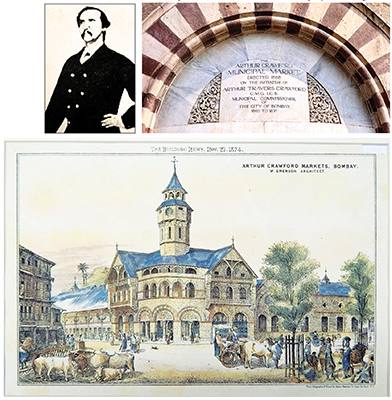
Clockwise from above l: "Enigmatic" municipal commissioner Arthur Crawford Photo: Wikipedia;
plaque at entrance to Crawford Market Photo: Noshir Gobhai;
hand colored original plan of Crawford Market Photo: stcroixarchitecture.com
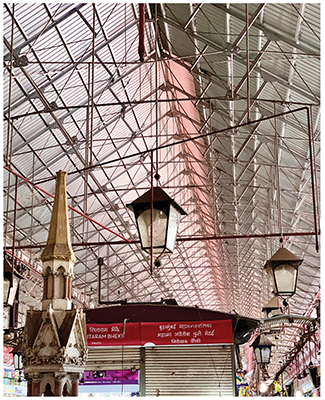
Interior view of Crawford Market Photo: Noshir Gobhai
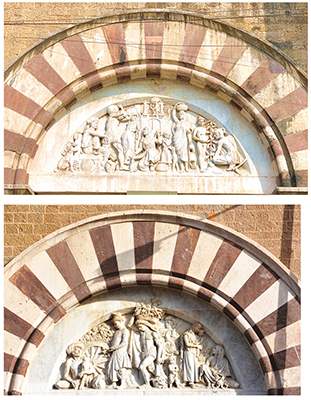
Decorations on the façade of Crawford Market depicting (top) agriculture and sale of vegetables
Photo: Noshir Gobhaiand (above) sale of fruit Photo: Abha Narain Lambah
The municipal commissioner’s personality "presents a conundrum — on the one hand, a person whose competence, energy, congeniality and determination to give the city a better environment, all contributed to his significant achievements and popularity,” stated Guzder. On the other, there were "fatal flaws” in his character and behavior that brought his career to an end and his personal life, "through a distressing decline into melancholy and grief,” he observed. "Was Crawford let off too leniently because he was English? Were the natives (involved in the inquiry) especially the mamlatdars (Indian judicial officers) dealt with too harshly?” asked Guzder.
Guzder took the audience through the civic scenario in the years before Crawford’s appointment: There were "initial experiments to create a triumvirate of three municipal commissioners, who were frequently working at cross purposes,” he said. Among the first of Crawford’s tasks was to commission a report on the working of the municipality, with reference to the rules for conservancy. A qualified medical practitioner was appointed to report on sanitary conditions. For swift execution of the recommendation in these reports, "a revised Municipal Act of 1865 was quickly enacted.” This Act vested extensive powers in one municipal commissioner, "subject to the overall control of a Bench of Justices who would approve his revenue and expense budgets.” Crawford inherited the "dregs of a depleted municipal budget,” yet he "set to work zealously,” noted Guzder.
The living conditions in the city then were "appalling,” said Guzder. The population had grown from 330,000 to 816,000 in a dozen years, with the density in the native town recorded at five square yards per person. "To put this in today’s perspective, it is equivalent to about 30,000 people living in the area the size of the Oval Maidan,” he illustrated.
The ward-wise administration of today’s Bombay is an evolution of the governance structure Crawford put into place. The commissioner went on to tackle sanitary issues: "No less than 17,183 wagon loads of garbage went out by rail to be dumped into a marsh in Kurla; hundreds of drains were opened and cleaned, thousands of chawls inspected; dangerous trades policed and removed; and 124 additional halalcores (night soil bearers) were recruited to carry waste to the flats (waste land),” explained Guzder. As a result of these measures, Crawford recorded that mortality had already fallen by a third and he aimed, in four years’ time, to make Bombay "the healthiest city in Her Majesty’s dominions.”
With more than 70 markets in the city selling fruits, vegetables and meat in insanitary conditions, he identified a large plot on the northern edge of the Esplanade for the market that later came to bear his name. Simultaneously, he moved the slaughter houses in the city to then far away Bandra. Communal burial grounds were relocated to Back Bay (today’s Marine Lines); many roads were repaired. A sewage canal with sluice gates at Love Grove, that stands even today, was constructed. While the Vihar Water Supply scheme was proving inadequate, Crawford initiated work on a plan to tap the Tulsi Lake Valley for potable water for Bombay.
When the commissioner assumed office, there were 220 streetlights in the city. A year later, there were 1,888. At the urging of Crawford, several were donated by prominent city families "like the Wadias, Sassoons, Petits and Tejpals, some lampposts carrying multiple lights… One news item referred to these new clusters of lights as ‘Crawford’s fireflies,’” narrated Guzder. The streets of Bhendi Bazaar, the Esplanade and Churchgate were now lit at night leading to a reduction in crime, despite which Crawford insisted on strengthening the police department.
Gupchup notes that "murmurings in the vernacular Press that Crawford was spending public funds extravagantly” appeared at the end of his first three-year term. The civic official’s private interest in the Panwell Brick Kiln and Machine Company was "withdrawn” after a public outcry. Some opposed granting him a second term. Despite Crawford’s defense by Mehta and his other friends, "public feelings of resentment did not abate – in part from residents of the native town who felt Crawford’s improvements had ignored their still congested localities while raising their tax burden.” The commissioner’s English detractors felt the municipal body was moving from its initial bankruptcy to a catastrophically larger one.
A self-confident Crawford defended his actions in these words: "In this dilemma, I had two courses given to me: the one to swim with the tide indifferent to death and disease… And the other to act boldly, trusting time, if need be, to prove me right. I adopted the latter, the only course open, I think, to any man of ordinary energy and courage, and I do not regret my decision.”
Mehta again jumped to Crawford’s defense when criticism against him continued unabated during his second term in office stating, "The man who effected in six years the wonderful transformation of the Bombay of 1865 into the Bombay of 1871 deserves to be emphatically proclaimed its savior and benefactor.” Those criticizing Crawford’s stewardship of the city, he said, "suffered from a total inability to understand the real historical significance of the municipal period during these six years.”
Crawford’s term in office came to an abrupt end owing to "congestion of the liver.” Though "20 dozen leeches had been applied within the last six weeks, the liver was so enlarged it extended nearly up to the nipple,” noted his doctor.
When an inquiry was ordered, the evidence against Crawford was compiled, as far as secrecy could allow, by the acting inspector general of police H. T. Ommanney. He interviewed scores of people thought to have incriminating evidence against both the commissioner’s character and his actions. Names such as the Nawab of Janjira, Divan of Kolhapur State Rao Bahadur Mahadev Vasudev Barve and other well-known figures were exposed in the Press as those who had paid bribes to Crawford for employment, promotion or property rights. "Those testifying against Crawford were promised immunity from prosecution, or official or departmental punishment,” noted Guzder.
According to Govind Talwalkar, author of Gopal Krishna Gokhale: His Life and Times, a June 1890 quarterly publication Westminster Review article alleged that Crawford’s illegal funds were transferred to Europe through a French bank, notes Wikipedia. Then, as a decoy, Crawford wrote two letters to his brother based in Bombay that he would commit suicide at Holkar Bridge in Poona. Dressed as a tramp, he boarded the third-class compartment of a Bombay-bound train from Poona. While in a hotel near the docks, the police got wind of his presence and arrested him. Crawford had tried to buy a ticket to Colombo. Crawford intended to escape to London "in order to escape further prosecution in India,” Guzder communicated to Parsiana.
In her book Gupchup describes the "large headache” the inquiry (headed by Judge Arthur Wilson of the Calcutta High Court) into the allegations against Crawford created for those who had to determine the punishment, as this decision rose all the way to the House of Commons. Investigations revealed that "nearly all public servants of a certain standing in the revenue and police departments were more or less implicated in this system of corruption,” he stated.
The commissioner’s "unofficial operations” were revealed by his principal agent-collector, one Hanmantrao under cross examination, noted Guzder, admitting to being "awestruck at the efficiency of Crawford’s unofficial operations.” "How else could Crawford’s mansion at Poona have hosted parties and receptions that put those of the governor to shame? And was he also not known to disappear occasionally with one or more ladies in tow? Perhaps he saw himself in the image of those East India Company nabobs,” mused Guzder.
Jeejeebhoy noted in his essay "An account of some unfortunate officials of the Bombay government” that the inquiry commission found Crawford "not guilty” of corruption or of borrowing from official subordinates. But "Crawford himself pleaded guilty to borrowing money from natives within his jurisdiction... The view taken by the Bombay government, however, in reviewing the report of the commission was more unfavorable.” Jeejeebhoy explained that "the secretary of state ordered the removal of his name from the list of Bombay civil servants.”
There are interesting accounts in Arthur Travers of how Crawford’s trial polarized the local community, noted Guzder. The Marathi newspaper Kesari acknowledged Crawford "as a great benefactor of the city and compassionate about the progress of natives... any kind-hearted reader would feel sorry for such a brave Crawford Saheb... but we must acknowledge a greater power, the ever alert Goddess of Justice.” Later, the same newspaper observed that if "Crawford is not to be punished for taking bribes, why should mamlatdars be punished for giving the bribes?”
Crawford remained unrepentant to the end, noted Guzder. "His only regret was that he did not incur much heavier debt, so assured was he of the ultimate benefit of strenuously improving the health and prosperity of the city!” stated Guzder.
Commending Gupchup for delivering an account of the "accomplishments of a municipal commissioner who...is unrivalled in our city’s history,” Guzder stated that the historian had "also unravelled for us a tale of a man of amiability but ruthless efficiency, a person who combined great empathy for citizens with scant regard for moral behavior; who left a strong institutional legacy, while injecting in it the virus of corruption; who built an extensive network of civil support and admiration for his work, while ruining the careers of many who were contaminated by his personal greed.”
Crawford’s remarkable contributions to making Bombay the "Gateway of India” are acknowledged, in an obituary to him in The Times (London), noted Guzder. It mentions his efforts at improving water supply, refuse removal, the fire brigade, substituting clean gas for dirty oil in street lighting, removing insanitary slaughter houses from within the city and establishing the Market. "But all are to (be) weighted against his lofty disregard for more financial considerations,” stated the obituary.
"Does our city now need another Arthur Crawford, though with a strong financial controller by his side?” mused Guzder, in conclusion.
Honorary secretary of the KRCOI, Dr Nawaz Mody, welcomed the audience and offered a vote of thanks to Gupchup, Guzder and the audience.
Recalling Crawford
"Very likely, (Bombay’s first municipal commissioner Arthur) Crawford might have dropped out of serious historical attention had he not left behind the monument that used to bear his name, Crawford Market (now Mahatma Jyotiba Phule Market), the only 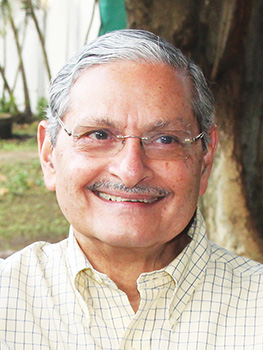 tangible evidence of his otherwise many and remarkable achievements,” stated businessman and environmentalist Cyrus Guzder. Dr Vijaya Gupchup devotes a chapter to the Market that bears his name in her book Arthur Travers Crawford: A Riddle Wrapped Up In An Enigma. Against prevailing wisdom within the Bombay Municipal Corporation, Crawford called for designs for the building from overseas. William Emerson, whose design was selected, went on to design many buildings in India, including Calcutta’s Victoria Memorial Hall.
The V-shaped Market building stands at the apex of a triangular piece of land, with a 130 ft high clock tower at the eastern side of the island city "so that the westerly breezes dispelled the odors away.” The Market set the standard for many general markets across the country, Guzder noted. "None, however, could rival the alternating use of red-and-white Kurla stone, intricately designed cast iron lamp brackets in the shape of griffins, the large unglazed rose windows and three tympanums (semi-circular, decorative wall surface) inserted in the arched openings, beautifully carved by John Lockwood Kipling,” exulted Guzder. The one on the right of the main entrance to the Market depicts agriculture and the sale of vegetables; the one on the left, the sale of fruits in a busy market; the central one a dedication to Crawford, dated 1868.
tangible evidence of his otherwise many and remarkable achievements,” stated businessman and environmentalist Cyrus Guzder. Dr Vijaya Gupchup devotes a chapter to the Market that bears his name in her book Arthur Travers Crawford: A Riddle Wrapped Up In An Enigma. Against prevailing wisdom within the Bombay Municipal Corporation, Crawford called for designs for the building from overseas. William Emerson, whose design was selected, went on to design many buildings in India, including Calcutta’s Victoria Memorial Hall. The V-shaped Market building stands at the apex of a triangular piece of land, with a 130 ft high clock tower at the eastern side of the island city "so that the westerly breezes dispelled the odors away.” The Market set the standard for many general markets across the country, Guzder noted. "None, however, could rival the alternating use of red-and-white Kurla stone, intricately designed cast iron lamp brackets in the shape of griffins, the large unglazed rose windows and three tympanums (semi-circular, decorative wall surface) inserted in the arched openings, beautifully carved by John Lockwood Kipling,” exulted Guzder. The one on the right of the main entrance to the Market depicts agriculture and the sale of vegetables; the one on the left, the sale of fruits in a busy market; the central one a dedication to Crawford, dated 1868.
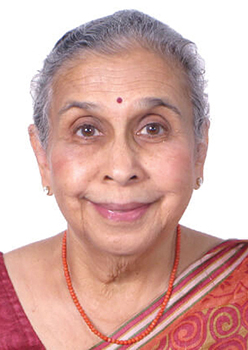
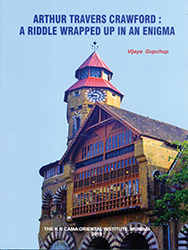
Top: Cyrus Guzder Photo: Jasmine D. Driver; above: Dr Vijaya Gupchup (l); documenting the conundrum of Crawford
Refurbishment work on the Market was begun in 2012 by conservation architects and historic building consultants Abha Narain Lambah Associates to restore the Market’s clock tower and redevelop the site to house new buildings for wholesale markets; the ongoing project "aims at comprehensive conservation… and a holistic upgradation of the civic plaza,” states their website.
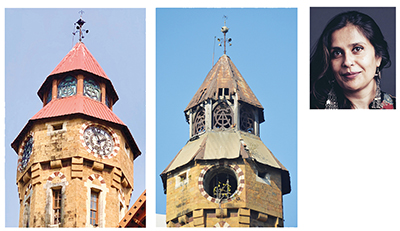
Above l: clock tower Photo: Noshir Gobhai,
clock tower during restoration Photo: Bombaywalla Historical Works;
right: Abha Narain Lambah
◆ ◆ ◆
From the archive