
Future of farming
A Rural Manifesto: Realizing India’s Future Through Her Villages by Feroze Varun Gandhi. Published in 2018 by Rupa Publications India Private Limited, G-161/1, B-4, Ground Floor, Gulmohar House, Yusuf Sarai Community Centre, New Delhi 110049. Pp: 825. Price: Rs 995.
As many readers may not know the least famous member of the Nehru-Gandhi political dynasty, here is a little background about him. Feroze Varun Gandhi (pictured) was born in Delhi on March 13, 1980 to Sanjay and Maneka Gandhi. He is the grandson of former Prime Minister of India, Indira Gandhi and her husband Feroze Gandhi, and the great-grandson of India’s first Prime Minister, Pandit Jawaharlal Nehru. Varun was born soon after Indira regained power in the 1980 general elections. Sanjay died in June 1980, in an air crash while performing stunts in a new airplane over Delhi, when Varun was only three months old. Before his death, Sanjay had expressed interest in raising his children in accordance with the Zoroastrian religion. Varun attended Rishi Valley School in Mandanapalle, Andhra Pradesh, Modern School C.P., New Delhi and the British School, New Delhi. He obtained his Bachelor of Science (Hons) degree in economics from the University of London. He had a good education and is well qualified to write this massive tome which is a tribute to India’s marginal, essentially subsistence farmer whose daily toil and sweat is as much an act of defiance as an article of faith.
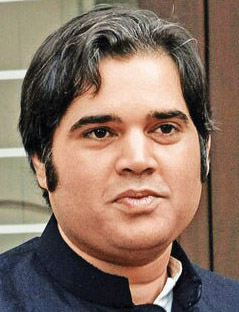 Varun is a third term member of parliament (MP) who represented the Pilibhit constituency in 2009, was elected from the Sultanpur constituency in 2014, and again from Pilibhit in 2019. He was the youngest ever national secretary of the Bharatiya Janata Party (BJP) from 2008 to 2011, the youngest ever national general secretary of the Party from 2011-14, and a member of its national executive. A member of the executive committee of the Commonwealth Parliamentary Association, Varun has been a member of several parliamentary standing committees, including those on defense and external affairs. He is a widely respected opinion leader and policy analyst, writing in English for The Hindu, The Economic Times, Hindustan Times and NDTV, and in Hindi for Amar Ujala, Navbharat Times, Rajasthan Patrika and Hindustan. He also writes in other important regional languages for Lokmat, Malayala Manorama, Sambad, Vijayvani, among others, which reportedly makes him the most widely read columnist in the country, reaching over 200 million readers. A poet by inclination, Varun published his first collection of poems, The Otherness of Self in 2000, at the age of 20. His second volume of poetry, Stillness, was published in 2015. He lives quietly in New Delhi with his wife Yamini and their daughter Anasuyaa.
A Rural Manifesto sparks a national conversation on rural distress, highlighting the potential solutions to putting the village economy on an even keel, while exploring how the vast majority of India ekes out a subsistence living. In this book covering facets of the Indian rural economy, Varun shines a bright light on the travails of the small holding farmer and asks searching questions on why the rural economy remains in the doldrums seven decades after independence from British rule. Through a series of vignettes, the book explores rural India’s innate perseverance and highlights potential solutions in policy with a focus on making the rural economy resilient.
The book has 11 chapters with a useful index appended. Each chapter has a comprehensive list of references at its end which is proof that the author has done thorough research. The chapters cover agricultural inputs, water availability, energy access, agricultural marketing, non-farm income, handicrafts, rural labor, rural education, rural healthcare, rural credit and deal with the way forward. The book is timely and very well-thought out, covering major topics pertaining to the small farmer who relies on his farm for subsistence and survival. Farmers have to juggle so many things before achieving success. For example, in the very first chapter he discusses agricultural inputs, which is most important since everything depends on it. Access to quality seeds is of paramount importance. And this is where governmental support to acquire these seeds comes in.
Varun certainly has his heart in the right place and preaches by example. He has repeatedly used his MP’s salary for helping the families of farmers who have committed suicides, especially in his own constituency. While this is laudable, the young MP may consider devoting more time to convincing his Party’s government to resume publishing National Crime Records Bureau (NCRB) data on farmer suicides which have not been made public since 2016. The author suggests that village-wise lists can be prepared of farmers who have availed of unsustainable amounts of credit, and are thus "potential suicide candidates.” He suggests that the 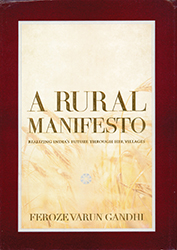 Reserve Bank of India and the National Bank for Agriculture and Rural Development (NABARD) can analyze such lists for policy interventions, and local administrations could utilize them to ensure timely loan restructuring and counselling.
Israel realized at a very early stage in its history that pumping ground water was unsustainable and hence devised the system of "drip irrigation” that proved very successful. The author makes a pitch for drip irrigation for India, but notes its "high initial cost ($ 500-1,500 per acre)” could make it prohibitively expensive for an Indian subsistence farmer. Most drip irrigation systems available in India were for land-holdings of one acre or more. The small size of the farms immediately translated into a design constraint. Small farmers could not afford the expensive drip irrigation systems. Also, electricity was not always available. Using drip irrigation systems normally requires continuous power supply for three to four hours, a luxury most Indian villages do not have. Varun recognizes the impact of climate change on Indian agriculture which is a stark reality. He suggests that agro-met advisories at a district level need to be converted into block and village level advisories. Good advice indeed, but the reason this has not happened is that the meteorological department does not have enough radar equipment to provide such granular information.
The author shows remarkable depth of reading and understanding in the field; the level of knowledge he has acquired on agriculture displays perspicacity in his suggestions. The detailed referencing to books and journal articles is impressive, and he must have had quite a team to help him with such work which borders on scholarship.
Noting that 61% irrigation is now from groundwater while the share of districts with semi-critical or over exploited blocks is 33%, the author emphasizes the need to shift back to dryland farming. "Rajasthan, despite having the lowest rainfall in the country, is buffering by having subsidiary farm enterprises like dairy, poultry, sericulture and goat rearing. States like Haryana, with little rainfall, can be encouraged to shift back towards oilseed and coarse cereals. Rice cultivation can be increased in rain-fed Odisha and Assam.” With sensible proposals like these, one can only hope that the author would push harder for these proposals in Parliament. Two chapters, which are in my opinion most relevant are "On Agricultural Marketing” where the author discusses the onion shortages all over India in 2010-11. Under the sub-heading "The Great Onion Robbery,” the author focuses on how unscrupulous traders cornered the onion market by purchasing onions at Rs 34 per kg and sold them in the bazaars at Rs 80 per kg. Onions are basic to Indian cooking and high prices create turmoil in all households.
The chapter "On Water Availability” is particularly thought provoking. The author notes that "over 85% of the country’s water needs are now supplied by rapidly declining aquifers (an underground layer of permeable rock, sediment or soil that yields water).” From this reviewer’s extensive experience in agriculture in Asia and particularly the Middle East, aquifers do not get replenished with rain water. In the Middle East rain water does not go beyond a depth of three meters. Aquifers were formed when the earth was created. The water in them is millions of years old. Once they run dry after the water is pumped out for use in agriculture, they almost never recover. In India, the author notes, the aquifers’ water levels have been going down by 30 cm each year. In Syria, as observed by this reviewer, the water table is going down by one meter each year and may soon run dry. In Iran centuries of use of qanats to bring cool mountain water to the fields in the valleys has resulted in accumulation of excess of salinity in the soil that farmers have irrigated with qanat water, and if the qanats were to run dry, the soil across Iran would become so saline that nothing could be cultivated. However, for now, these amazing underground structures have allowed Persian farmers to succeed despite long dry periods when there was no surface water to be had.
This book is fairly comprehensive and all aspects of farming in India have been discussed, giving it a wide appeal. The author does not shy away from mentioning several reasons for farmer suicides in India. It was not poverty alone that drove farmers to take the extreme step. There were other reasons also, such as oppression from creditors; middlemen who often also acted as loan givers charging compound interest; and landlords who frequently raised rents, and demanded their pound of flesh no matter what difficulties the weather had resulted in.
I highly recommend this book for general readership, and especially for those studying farm economics and rural development. I urge all MPs and law-makers in India and neighboring countries to read the book so that they fully understand the workings of the rural economy and the machinations behind how the food grown by the humble farmer reaches the tables of the rich. It is because, as Mahatma Gandhi (no relation to Feroze Varun Gandhi) used to say, "India lives in her villages” and not in the glamorous cities to which rural folk flock, dreaming of a better future. I give this book five stars.
Dr ARDESHIR B. DAMANIA
Dr Ardeshir B. Damania is associate research geneticist at the University of California, Davis, USA.