
Events & Personalities
Pestonji, the Parsi-Christian
A portrait of Hormuzdji Pestonji (pictured, below right), among the first Parsi converts to Christianity, was on sale/exhibition at art historian Dilnavaz Mehta’s show "Rare finds – Hindoostan revisited” at Cymroza Gallery between December 5 and 12, 2018. Mehta pointed out the colored and tinted lithograph of Pestonji dating from 1854 while walking the Parsiana representative through the lithographs, engravings, etchings, aquatints, illustrations, old maps and books on display. Pestonji is depicted with his right hand clasping his left wrist, dressed in a long dagli and wearing black head gear with pointed shoes. Accompanying him is Narayan Shishadri, who Mehta identified as a Maratha Brahmin and a fellow convert.
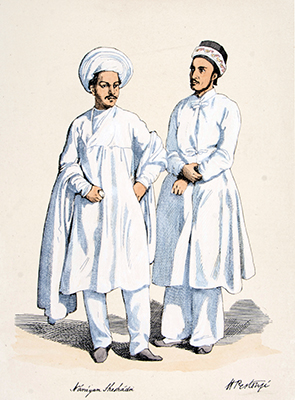 Pestonji’s conversion took place in 1839, and "was immediately followed by the most bitter manifestations of hostility on the part of his own people and his community. His wife was taken from him, and his little daughter was only recovered by a legal process,” notes the write-up accompanying the image. Mehta explained that Pestonji was later an ordained missionary of the Free Church of Scotland, "zealous in his holy work, and an acceptable preacher to English congregations.”
The painting was done by one of the earliest women artists in India, Helen Colin Mackenzie. In a write-up on Mackenzie, Mehta notes that the artist published some of her drawings as a series in 1854 titled Illustrations of the Mission, the Camp and the Zenana or Six Years in India. Wife of a colonel in the British Indian Army, the amateur artist and writer had the opportunity to travel around India painting "portraits of the people she encountered during her travel.” Pestonji finds a mention in Mackenzie’s Storms and sunshine of a soldier’s life. With other missionaries, he escorted her to "the interesting Buddhist caves of Salsette.”
In Chapter 3 of his book The Parsis of India: Preservation of Identity in Bombay City, titled "The challenge to identity: the Parsi boys’ conversion case,” historian Jesse Palsetia noted that Pestonji’s conversion occurred one day after that of another Parsi Dhanjibhai Nauroji in May 1839. This event "put the Parsis in confrontation with the colonial environment over the fundamental issue of Parsi religious identity.” Following the conversions, many of the previous beliefs of the community "came into question,” noted Palsetia. "Their knowledge of their religion, and their seeming invulnerability to criticism from other faiths... were matters of debate,” he wrote.
Mehta, who has been holding her exhibition of artefacts "at least every alternate year” since 1999 (see "Rare Finds revisited,” Events and Personalities, Parsiana, December 7, 2014), had over 1,000 items on show at Cymroza. "All new stock, and many new artists,” she revealed. Other items with a Parsi theme were a colored and painted lithograph by Mackenzie of Nasirwanji Carsetji Dada and his son; photographs of a wedding and a navjote, engravings of a group of Parsi women, and a merchant; an engraving of the Bombay Doongerwadi; a 1683 map of "Perse Moderne (Modern Persia).”
Pestonji’s conversion took place in 1839, and "was immediately followed by the most bitter manifestations of hostility on the part of his own people and his community. His wife was taken from him, and his little daughter was only recovered by a legal process,” notes the write-up accompanying the image. Mehta explained that Pestonji was later an ordained missionary of the Free Church of Scotland, "zealous in his holy work, and an acceptable preacher to English congregations.” The painting was done by one of the earliest women artists in India, Helen Colin Mackenzie. In a write-up on Mackenzie, Mehta notes that the artist published some of her drawings as a series in 1854 titled Illustrations of the Mission, the Camp and the Zenana or Six Years in India. Wife of a colonel in the British Indian Army, the amateur artist and writer had the opportunity to travel around India painting "portraits of the people she encountered during her travel.” Pestonji finds a mention in Mackenzie’s Storms and sunshine of a soldier’s life. With other missionaries, he escorted her to "the interesting Buddhist caves of Salsette.”
In Chapter 3 of his book The Parsis of India: Preservation of Identity in Bombay City, titled "The challenge to identity: the Parsi boys’ conversion case,” historian Jesse Palsetia noted that Pestonji’s conversion occurred one day after that of another Parsi Dhanjibhai Nauroji in May 1839. This event "put the Parsis in confrontation with the colonial environment over the fundamental issue of Parsi religious identity.” Following the conversions, many of the previous beliefs of the community "came into question,” noted Palsetia. "Their knowledge of their religion, and their seeming invulnerability to criticism from other faiths... were matters of debate,” he wrote.
Mehta, who has been holding her exhibition of artefacts "at least every alternate year” since 1999 (see "Rare Finds revisited,” Events and Personalities, Parsiana, December 7, 2014), had over 1,000 items on show at Cymroza. "All new stock, and many new artists,” she revealed. Other items with a Parsi theme were a colored and painted lithograph by Mackenzie of Nasirwanji Carsetji Dada and his son; photographs of a wedding and a navjote, engravings of a group of Parsi women, and a merchant; an engraving of the Bombay Doongerwadi; a 1683 map of "Perse Moderne (Modern Persia).”
◆ ◆ ◆
From the archive