
In Memoriam
A creditable couple
The combination of Parsi and Marwari entrepreneurship saw the launching and popularization of the credit card movement in India as well as the concept of business centers. But when Shamsunder Aggarwal died this April and his wife, Perveez, five months later on September 19, there was little mention in the media of their contributions to either pioneering venture. Even when the founder of the credit card movement in the country, Kali Mody passed away five years ago the media took little note. Consumers take that little piece of plastic in their pockets and purses for granted without realizing the daunting risks that these entrepreneurs took.
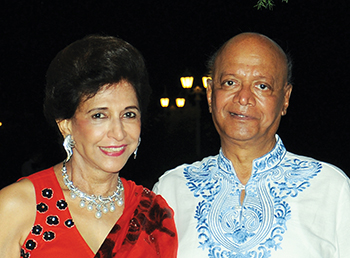
Perveez and Shamsunder Aggarwal: charm and hardsell
As card spending increased, Mody struggled to finance his Diners Club (DC) business franchise. Members took their time to pay while the establishments that accepted the card clamored for payment. The Aggarwal family became shareholders in the private limited company in 1966, six years after Mody launched the Indian card, then made of cardboard. In 1976 when the Aggarwal family that ran the multicrore metal business of Devidayal Industries, divided their assets, Shamsunder ventured from manufacturing to the service industry. "He wanted to do something modern,” recalled his daughter Vanita Bhandari.
The service industry then was not viewed as being very lucrative compared to manufacturing. But DC grew from being "the smallest business in the group to the largest,” she recalled. "Bifurcations are good for the eventual growth of business and industry,” Shamsunder told journalist Shirin Bahadurji of the erstwhile Bombay magazine (June 22-July 6, 1983).
Perveez’s involvement with DC began with assisting in the production of their in-house magazine Signature in 1977. With her contacts in the jewelry trade, she obtained a photograph of diamonds that graced the cover of the first issue. She wrote on a variety of subjects but her favorite was travel. At DC she would sit in the telephone operator’s cubicle in Dady House and observe the functioning of the office. Her flair for marketing eventually led her to seeking ways to increase the cardholder base which then numbered around 7,000. Bahadurji described her as the "embodiment of a marketing philosophy that combined charm with determined hardsell.” Until then DC did not advertise for cardholders aside from a one column, black and white, "With compliments from...” advertisement that Mody would release in Parsiana to support the publication. He later asked Parsiana if they would be interested in publishing Signature and the contract was signed with the Aggarwals in 1977 after DC changed hands.
Soliciting for card members was considered risky. In the past, card membership was by invitation, to known people of means. The risk of default is what deterred the company from taking on more members. But after Shamsunder computerized the accounts, with Perveez’s coaxing they set about growing the business. Shamsunder looked after the operations and accounts, and Perveez, marketing. "If my husband doesn’t see my point on a matter, I do more homework on it. Or, I choose a better moment to broach the topic again,” she told Bombay.
This was a business that needed large inputs of cash. Aside from the shares of DC, Shamsunder and Perveez also got possession of over two floors in Raheja Chambers at Nariman Point. The Diners’ office moved from the top floor of Dady House in Fountain to Nariman Point.
Wondering how to utilize the rest of the space, the Aggarwals started Diners World Travel (DWT) as Perveez, a former journalist and model from Nagpur had worked in Bombay as a travel agent for Katgaras’ Jeena and Company and then Guzders’ Indtravels. Shamsunder had been one of her clients. The New York University business school graduate defied family tradition and married outside of his community as did Perveez (née Rustamji).
On their travels abroad, Perveez had observed business centers offering cabins and table space for occupancy on a daily, weekly or monthly basis. The business appeared an ideal way to utilize commercial space without the danger of the occupant claiming tenancy. Nariman Point was then the most prestigious business address in Bombay. Mody and Colgan, the firm of Kali’s brother Piloo and his American wife Vina, both architects and family friends were roped in to design the Nariman Point Diners Business Center (later renamed DBS Business Center) in 1980. "We were not sure whether the Indian market was ready for such an innovative idea,” Perveez mentioned in an editorial in the first issue of DBS News in 1990 (April-June), the organization’s newsletter. But the concept boomed with many new entrants setting up centers all over India. "I saw my parents working very hard. Mom used to travel all over India to locate prospects for DBS… they were driven, they were ambitious,” said Bhandari on November 1, 2018.
Shamsunder realized the credit card business was ideal for bankers. They alone had the resources to fund the business. And they could offer more financial services to the cardholders. A union under the militant leader Dr Datta Samant was formed and differences between the management and the employees simmered. The Aggarwals had 70,000 members when they sold DC to Citibank in 1990. Citibank used DC to enter the Indian credit card industry and issue Visa and Mastercards. They anticipated volumes of millions of members. People then marveled at how a mere list of members could fetch such a large amount. They "didn’t regret selling to Citibank,” says Bhandari. "An entrepreneur has to enter the business at the right time and leave at the right time,” stated Perveez addressing the Fifth All India Zoroastrian Youth Conference in Nagpur, November 4-6, 1991, as reported by Jehangir Bisney (Parsiana, February 1992).
Perveez’s family was from Nagpur and she had studied at St Joseph’s Convent School and the Lady Amritbai Daga and Smt Ratnidevi Purohit College for Women there. After graduating in Arts she earned a diploma in journalism from Syracuse University that conducted a course at Nagpur’s Hislop College. She kept abreast of developments in the community and assisted Parsis whenever she could. She also respected her inlaws’ family and Hindu traditions.
After the Aggarwals sold the DC business, Perveez used to wonder how she would spend her time. DWT occupied some of her time. Her younger sister Rukshana Mehta managed the show for a number of years till her husband Darayes was posted abroad by the World Bank. DBS, launched in 1980, was well established. Perveez took more interest in social causes and was founder chairperson of the Women in Management Committee of the Bombay Management Association, executive committee member of the Indian Merchants’ Chamber Ladies’ Wing, and chairperson of the Fund Raising Committee of the Women Graduates Union.
"The best dowry I could give my daughter was the ability to stand on her own feet,” she had told The Afternoon Despatch and Courier on April 13, 1995. Perveez "spearheaded women’s empowerment,” stated Bhandari. Recipient of the Kingfisher Fashion Award 2001 for being a pioneer in the world of fashion, organizing several fund-raising events, under the label of "My Beautiful Embroideries” she initiated a business selling saris, kurtas and jackets. Her bespoke pieces were in good demand by discriminating buyers. Perveez pushed on sales of the embroidered outfits knowing that many craftspeople, especially Muslims, were dependent on her orders. This is a business her daughter Bhandari and her two sons, Kaviraj and Aditya intend to grow.
Perveez had an outstanding collection of blue and white vases and porcelain which her father Rustam collected with his wife Parin’s assistance. Rukshana recalled Parin as being "a lovely lady, very dedicated” to her husband.
DBS continues to expand and now has nine centers in all the metropolitan cities in India. Aditya, in the last four years, has opened centers in Andheri and New Bombay. Kaviraj runs a visa facilitation service for several countries. Perveez’s estranged son Vikram is not involved in the family business but has an office in Victoria House opposite the Bombay Samachar office from where his wife Shaheen, who taught speech and drama at Cathedral and John Connon School, runs "Speech Matters” classes. Their son, Nirvaan is studying in the US and their daughter Nadya will follow once she finishes her 12th.
Vikram believes being born in an interfaith family could leave you belonging to neither religion. "You are forced to adapt to both… You have to manage differences.” His wife Shaheen who is also the offspring of a Muslim father and Christian mother says, "Religion is secondary. What matter is the person’s background, values and culture.” She remembers Perveez as "an amazing lady… what a wife she was.”
◆ ◆ ◆
From the archive