
Readers' Forum
“In Dina’s stead”
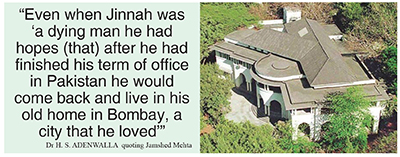
I read with interest "In Dina’s stead” (Events and Personalities, Parsiana, September 21, 2018). I do hope Muhammad Ali Jinnah’s house at Bombay’s Malabar Hill (pictured, pg 8) will rightly go to Jinnah’s grandson Nusli Wadia.
Why does the government of this country want to perpetuate this vendetta against Jinnah who, according to Independence activists Sarojini Naidu and Gopal Krishna Gokhale, stood for Hindu-Muslim unity all his life? Twice Jinnah would have opted for undivided India, free from British Raj. The first was in 1916 when the Lucknow Pact was passed at a joint session of the Congress and the Muslim League. He was then a member of both. We will not go into the history of how it was unceremoniously scuttled (see Jaswant Singh’s Jinnah: India — Partition Independence, published in 2009 and Jinnah: Creator of Pakistan by Hector Bolitho).
The second time was in 1932 when the British Prime Minister Ramsay MacDonald accepted Babasaheb Ambedkar’s demand for the same representation for the Dalits as given to the Muslims. Jinnah accepted it with alacrity. Mahatma Gandhi, under the plea that it would divide the Hindus, went on a hunger strike unto death. Ultimately Ambedkar was forced to yield.
If Jinnah had succeeded in 1919 and in 1932 this great country would not have been partitioned. After this, there could not have been a more frustrated man than Jinnah. It was only when he realized that the Congress had no intention of giving the Muslims a fair representation that he persisted with his unrelenting demand for Pakistan. Ayesha Jalal in her book The sole spokesman says that even then, like an astute lawyer, he used it as a bargaining counter. When he achieved Pakistan, he was surprised and perhaps a little disappointed. Former mayor of Karachi, Jamshed Nusserwanji Mehta said that even when Jinnah was "a dying man, he had hopes (that) after he had finished his term of office in Pakistan, he would come back and live in his old home in Bombay, a city that he loved.”
Why does the government of this country want to perpetuate this vendetta against Jinnah who, according to Independence activists Sarojini Naidu and Gopal Krishna Gokhale, stood for Hindu-Muslim unity all his life? Twice Jinnah would have opted for undivided India, free from British Raj. The first was in 1916 when the Lucknow Pact was passed at a joint session of the Congress and the Muslim League. He was then a member of both. We will not go into the history of how it was unceremoniously scuttled (see Jaswant Singh’s Jinnah: India — Partition Independence, published in 2009 and Jinnah: Creator of Pakistan by Hector Bolitho).
The second time was in 1932 when the British Prime Minister Ramsay MacDonald accepted Babasaheb Ambedkar’s demand for the same representation for the Dalits as given to the Muslims. Jinnah accepted it with alacrity. Mahatma Gandhi, under the plea that it would divide the Hindus, went on a hunger strike unto death. Ultimately Ambedkar was forced to yield.
If Jinnah had succeeded in 1919 and in 1932 this great country would not have been partitioned. After this, there could not have been a more frustrated man than Jinnah. It was only when he realized that the Congress had no intention of giving the Muslims a fair representation that he persisted with his unrelenting demand for Pakistan. Ayesha Jalal in her book The sole spokesman says that even then, like an astute lawyer, he used it as a bargaining counter. When he achieved Pakistan, he was surprised and perhaps a little disappointed. Former mayor of Karachi, Jamshed Nusserwanji Mehta said that even when Jinnah was "a dying man, he had hopes (that) after he had finished his term of office in Pakistan, he would come back and live in his old home in Bombay, a city that he loved.”
 It would be a fine gesture on the part of the government of this country to give up its claim on Jinnah House under the contention that it is evacuee property as it was willed by Jinnah to his sister. There is no probate on this will and therefore it does not stand in law. Dina Wadia’s counsel Fali Nariman has presented to the court that Jinnah was a Khoja Shia and was not governed by Muslim succession law but by Hindu customary law as Jinnah’s grandfather was a Hindu and hence, by law, his daughter is entitled to intestate succession. Therefore, Jinnah’s house belonged to his daughter and now it belongs to his grandson. It does not belong to India and certainly it does not belong to Pakistan. Pakistan may have become an enemy of India, Jinnah never was.
 Read his speech after Partition at the Constituent Assembly of Pakistan. Read what Mehta is recorded to have said, "Even in the end he never gave up his desire for Hindu-Muslim unity. He was an honest, fearless and incorruptible liberal to the end. A man of indomitable courage, sterling character and superb integrity.” Naidu said of him, "He had a lasting charm of character animated by a brave conception of duty and an austere and lovely code of private honor and public integrity.” Such was the mettle of this remarkable man whom contemporary Indian history wants to vilify and to deny his legitimate heirs the right to his property.
Dr H. S. ADENWALLA
Trichur
charlespinto102@gmail.com
◆ ◆ ◆
From the archive