
Zoroastrians Abroad
Pooling his resources
Through grit and determination, Farrokh Patel has built a multimillion dollar swimming pool liners and covers business
"I don’t like people telling me what to do,” says New Jersey based businessman Farrokh Patel. His American nomenclature "Frank” therefore perfectly suits his outgoing, gruff personality. A self-made millionaire, the Bombay-born, Calcutta raised entrepreneur’s recipe for success is never take no for an answer. Time and again on this June 5 while narrating his story to Parsiana in his Branchburg, New Jersey swimming pool liners and covers factory he said the key to building a business is perseverance: refusing to give up or be cowed down. The result: his family run companies Pegasus Products Inc and The Cover Company were included amongst the 100 largest Indian owned companies in the USA in 2007.
He was also the recipient of the World Zarathushti Chamber of Commerce (WZCC) Outstanding Zarathushti Entrepreneur Award in 2003. The citation referred to his assistance to WZCC and others including "outsourcing work through a work-study program for a school for disadvantaged children.” A member of the New York chapter, Patel is an example of the kind of interaction the body aims to inculcate, the citation noted (see "Sitting on a pot of gold,” Parsiana, March 21, 2008).
He was also the recipient of the World Zarathushti Chamber of Commerce (WZCC) Outstanding Zarathushti Entrepreneur Award in 2003. The citation referred to his assistance to WZCC and others including "outsourcing work through a work-study program for a school for disadvantaged children.” A member of the New York chapter, Patel is an example of the kind of interaction the body aims to inculcate, the citation noted (see "Sitting on a pot of gold,” Parsiana, March 21, 2008).
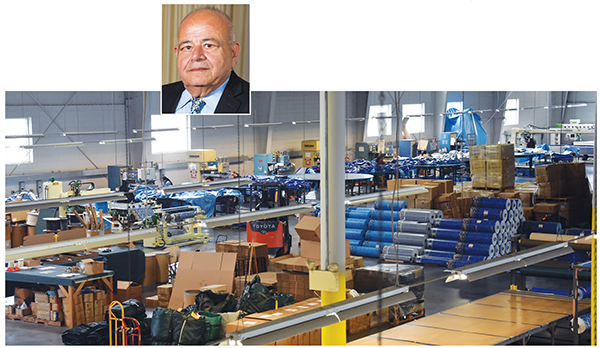
Pegasus shopfloor; inset: Farrokh Patel: persistence pays
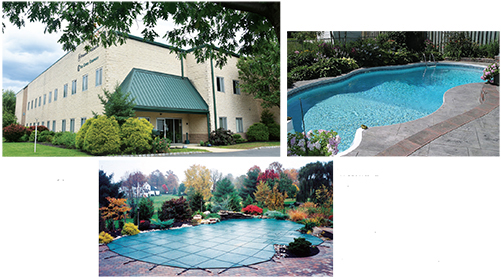
Factory building; (r) vinyl lined swimming pool Photo: Wikipedia; pool cover
A socially and environmentally friendly businessman, in November 2009 Patel installed 442 solar panels which produce 101 kilowatts of "pollution-free energy — enough to power our entire factory.”
Of the 81,000 sq ft factory and office Patel has rented out 31,000 sq ft to Amneal Pharmaceuticals. The Pegasus shopfloor comprises several cutting and heat sealing machines, colorful rolls of vinyl, and finished products all neatly stacked. Walking us through the premises he cheerfully greets his employees by name, joking with some and giving others a friendly pat. A radio on the shopfloor was playing the song, I want to dance with somebody.
On part of the adjoining land that belongs to his company, Patel is constructing another 50,000 sq ft factory to which Pegasus will shift. He intends to rent the existing 81,000 facility to Amneal, the rent from which would help pay for the cost of construction of the new premises. "We’re getting a new factory for free,” jests the savvy businessman.
The vinyl liners Pegasus produces are used to line the inside of swimming pools, while the covers are placed on top when the pools are not in use, especially during the winter months. There are basically four types of pools: above ground pools which are the cheapest, pools made from fiberglass, modular paneled ones lined with vinyl that are costlier, and cement or gunite pools that are the priciest. Where temperatures are extreme as in the northern states, cement pools may suffer damage as the frost can cause the tiles to heave. So the other varieties are more popular. A basic below ground pool costs around USD 30,000+ (Rs 20,58,091) while the cement ones go for around USD 45,000+ (Rs 30,87,137). Running costs are extra.
Who are the consumers for swimming pools? "Everybody who has a home buys, depending on their income level,” says Patel. Harried mothers may want a pool to "Get the kids out of my hair,” especially during vacations. Families may first opt for the less expensive, above ground pools, and later move on to costlier ones.
Around 30 to 40% of the pools in the USA are made from cement, the rest are vinyl lined, approximates Patel. The demand for the vinyl liners, however, is from January to July. "That’s the end of the season.” To make up for the slack period, the astute Patel in 1990, eight years after he founded Pegasus, started The Cover Company which makes covers for all varieties of swimming pools under the brand name Coverlon.
"The strength of a cover is in the number of anchoring screws embedded into the surrounding grounds,” he notes. Patel narrates the incident where a drunken woman in Ohio at 2 a.m. drove her car over a swimming pool cover and fell asleep! The cover, which Patel had supplied through a dealer, bore the weight of the car till she was discovered the next morning at 6 when her distraught husband, while phoning the police to file a missing person report, looked out of his window and noticed the car lodged on the pool cover.
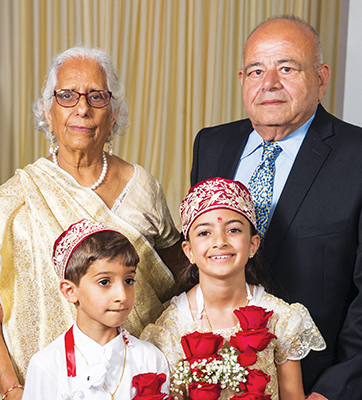
Gool and Farrokh with grandchildren Torin (l) and Ara at navjote
Patel became acquainted with the liner business when selling plastic sheets for Harte and Company which had a division named Diamond Shamrock. "I used to sell plastic made liners. These included vinyl sheets, shower curtains and pool liners. He would even write out the orders for one of his customers. "In 1972 there was a vinyl shortage. The price was going up from 25 (Rs 17) to 35 cents (Rs 24) a pound,” he recalled. Patel informed his clients of the upcoming price increase due to the surging oil prices and urged them to buy before the cost went up. But this particular client did not. Patel anyway went ahead and booked two trailer loads of material in the customer’s name. When the price increase came into effect, almost overnight, Patel told him no order had been booked. The client was crestfallen but then Patel disclosed he had ordered the quantity on his behalf! "From that day on I became his best friend.”
Later when Patel told the client he wanted to start his own liner business, he replied, "I’ll help you as much as I can.” Patel started Pegasus in 1982 with USD 10,000 (Rs 6,89,628) and "one cutting table. We cut by hand.” He received his first order at 9 a.m. from a company he used to supply vinyl to. He made the delivery by 3 p.m. The surprised party said he would make payment "if the liner fits” and would place an order for four more. The liner fit and from that day "we started rolling,” says Patel. In the first year alone sales exceeded a quarter of a million dollars, states wzcc.com. Aside from liners, Pegasus also made vinyl for billboards and even army tents that were used in "Desert Storm” (the 1990-91 US-Iraq war).
Westward ho!
"I always wanted to come to the US. My Dad (Rutton) didn’t like it. He was the national sales manager for Philips India. I was an only child.” Farrokh completed his bachelor’s degree in commerce from St Xavier’s College, Calcutta and was studying law, a subject he says he excelled in, at the University of Calcutta. But the itch to go abroad remained and when he received admission at the Stern School of Business in New York University, he left for the US in 1962. While studying there he met his wife-to-be, Gool Sumariwalla, who was completing her master’s degree in pharmaceuticals at Columbia University. She subsequently joined Merck. Farrokh finished his master’s degree in business administration and started on a PhD but did not complete it. He later joined Union Carbide, having worked with the company in sales in India. The company had a policy of not rehiring people who worked in India. Patel persisted, as he always does, and was taken on. He later joined Diamond Shamrock before starting Pegasus.
After Farrokh’s father passed away, his mother, Freny (née Driver) came to reside in the US. Of Farrokh’s three daughters, two, Shenaz and Roshan are involved with the family business while Zarine, a doctor, is a diagnostic radiology specialist who is affiliated with several hospitals and medical centers. Roshan and her husband, Brandon Kelly, performed the navjote of their two children Ara and Torin this July 21.
A socially conscious Zoroastrian, Patel not only contributed funds for, but also headed the building committee that oversaw the construction, of the 22,000 sq ft new Arbab Rustam Guiv Dar-e-Mehr Zoroastrian Temple in Pomona, New York, about an hour’s drive from New York City. He offered to help oversee the construction but added his usual proviso, "I don’t want any interference.” Committee members and others routed their suggestions through Edul Daver, the main fund-raiser and project’s "visionary” who then tacitly approached Patel. Architect Dinyar Wadia designed the structure and would visit the site periodically. The contract was awarded to REDCOM Design and Construction, LLC on May 9, 2014 and the place of worship was ready for inauguration two years later on March 21, 2016.
In "The dar-e-mehr dream,” Parsiana, April 21, 2016 journalist Porus Cooper noted Patel "supervised the construction and was a prolific fund-raiser.” ZAGNY president Astad Clubwala referred to him as "the rock,” Cooper noted.
Farrokh was amongst the 20 or so founders of the Zoroastrian Association of Greater New York (ZAGNY) in 1973, notes former ZAGNY president Lovji Cama (see "Nurturer in New York,” Parsiana September 21, 2015) and was instrumental in locating the donors, Arbab Rustam and Morvarid Guiv, for the creation of the very first dar-e-mehr in the USA which was situated in New Rochelle, New York.
As is often the case, Patel’s involvement with the local community began after the birth of his first child. The Parsis in New York and the surrounding states would get together informally at Parsi New Year. Patel and others favored the formation of an association and in the early 1970s ZAGNY was formed. Patel has been involved with the organization ever since.
He believes the North American Zoroastrians are "doing pretty well” especially in the economic sphere. While some traditions are being lost, ZAGNY is working to give the community a sense of identity "of who we are. This is most important...We have pride in the fact that we are Zoroastrians.”
But when he visits India he is "disappointed” especially at the "narrow-minded way of doing things” and the "parochial” outlook. Though he was raised in India, when he enters the fire temples in Bombay people eye him suspiciously. Some doubt he is a Parsi. This does not happen to his wife, he notes! He once confronted a lady in a fire temple and asked her in Gujarati why she was viewing him thus. She denied she was doing so and walked away.
His hectic pace of life took a toll on his health and in 2002 a stent was placed while over 10 years later he underwent open heart surgery. "I’ve slowed down my pace,” says the 77-year-old but his daughter Roshan counters: "He has not slowed down.” Like the winged horse he named his company after, his journey continues.
◆ ◆ ◆
From the archive