
In Memoriam
Rabadi’s relative roles
"With a mischievous twinkle in her eyes she wrote her own script and journey… A life lived fully and on her own terms… 370 movies and 66 years in the film industry,” summed up the notice announcing the prayer meeting for "A Force of Nature,” 88-year-old Nergish Rabadi, known in the film industry as Shammi, who passed away in Bombay on March 6, 2018.
Popular in the film fraternity, among those who attended her funeral were yesteryear actress Asha Parekh who was a close friend, Farah Khan and Boman Irani, her co-stars in the last film Shirin Farhad Ki Toh Nikal Padi where she played the role of Farhad’s (enacted by Irani) grandmother. Also present was Member of Parliament Priyanka Dutt who tweeted, "She was my mother’s dear friend and someone we all loved very much. May her…laughter and contagious smile rock the heavens.” Since Nargis Dutt was already an established star when Nergish joined the industry, Nergish was given the screen name Shammi.
Popular in the film fraternity, among those who attended her funeral were yesteryear actress Asha Parekh who was a close friend, Farah Khan and Boman Irani, her co-stars in the last film Shirin Farhad Ki Toh Nikal Padi where she played the role of Farhad’s (enacted by Irani) grandmother. Also present was Member of Parliament Priyanka Dutt who tweeted, "She was my mother’s dear friend and someone we all loved very much. May her…laughter and contagious smile rock the heavens.” Since Nargis Dutt was already an established star when Nergish joined the industry, Nergish was given the screen name Shammi.
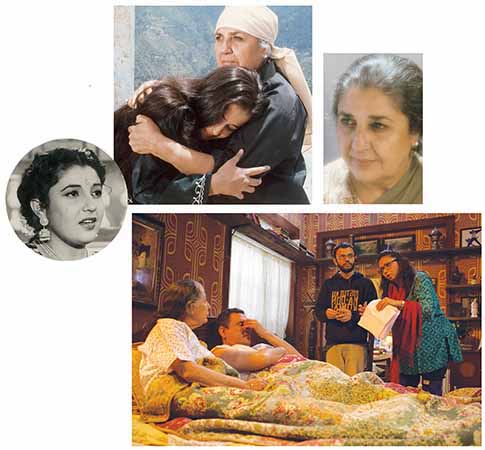
(Clockwise from above) Shammi’s varied roles as: a young starlet; a matron; a friend and confidante;
at a shoot with Boman Irani for Shirin Farhad Ki Toh Nikal Padi taking instructions from Bela Bhansali Sehgal
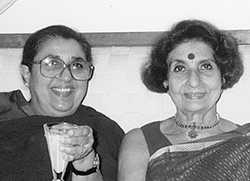
Nergish (left) with Mani Rabadi
"Prolific actress, years of contribution to the industry, dear family friend,” tweeted icon Amitabh Bachchan. Between her lead role in the 1951 film Malhar produced by singer Mukesh which crashed at the cash counter to her last film, Shirin Farhad in 2012, she played umpteen vamp and comedy roles, frequently portraying a nanny or naani (grandmother). "Perhaps it was Shammi Aunty’s joie de vivre that came in the way of her being taken seriously as an actor,” noted a write-up in The Hindu of March 7. "The actress imbued even casually written roles with a dash of energy,” noted a tribute in The Times of India of the same day.
She got her first break when she was cast in Sheikh Mukhtar’s Ustad Pedro. Over the next six decades the "tomboy” of tinsel town was seen in Sangdil with Dilip Kumar, Upkar, Purab Aur Paschim and Kranti with Manoj Kumar, Musafirkhana and Kaun Apna, Kaun Paraya with Johnny Walker, Half Ticket with Kishore Kumar and Pran, Dil Apna Aur Preet Parai with Meena Kumari and Raj Kumar… The Hindi film industry "has given me the satisfaction of doing the work I love,” she had acknowledged in an interview with Parsiana (see "A switch of screens,” February 2003).
Although Malhar was not successful, the Lata Mangeshkar-Mukesh duet Bade armaan se rakha hai balam teri kasam filmed on Shammi continues to be popular to this day. In yet another immortal song Ajeeb daastaan hai yeh she was able to make an impact with her expressive eyes although the camera was trained on her for barely three seconds of the song. She is also remembered for jiving heartily with comedian Johnny Walker to the track Thoda sa dil laga ke dekh in Musafirkhana.
Variously described as the prime cheerleader of Bollywood, an ageless confidante, a keeper of secrets, her other close friends from the industry included Jaya Bachchan, Waheeda Rehman, Helen, Saira Banu and Nanda. "Shammi Aunty’s friendliness was known to transcend generations,” confirmed The Hindu write-up.
At the age of 41 she married producer director Sultan Ahmed and the couple produced hit films like Heera and Ganga Ki Saugandh before they divorced seven years later. After the divorce, she adopted Ahmed’s brother’s son Iqbal, and in later life chose to reside next door to Iqbal’s family.
Among the teleserials where she made an impact was Dekh Bhai Dekh, Imtehaan, Kabhi Yeh Kabhi Woh. The production company Akruti, started with Parekh produced teleserials like Daal Mein Kala, Kora Kagaz, Baaje Payal. Shammi was "a founder of the Cine and TV Artists’ Association. She was a lovely, happy-go-lucky woman,” Parekh was quoted in The Hindu.
The basics of acting Shammi had learnt from director Tara Harish who also gave her practice in dialog delivery. When her sister Mani started acting in dramas produced by the Indian People’s Theatre Association, Nergish would observe the artistes at rehearsals and subsequently even play small roles.
Her father, Ervad Jehangir Rabadi, a priest at the H. B. Wadia Atash Behram had died of a burst appendix when she was only two years old compelling her mother Hirabai to cook in Parsi homes and supply food items for prayer ceremonies at agiaries. It was her maasi (maternal aunt) Dosabai Gyara who raised the two little girls. Her maasa Minocher Gyara who was the principal of the Jejeebhoy Dadabhoy Charity School where she did her primary schooling was the only one from the family who supported her when she signed with Omar Khayyam Films and encouraged her to take up a course in Hindi and give examinations, she had recounted for the Parsiana interview. Initially residing at Dhobitalao, the family had later shifted to Khetwadi and then to the Ratan Tata Colony in Tardeo.
To finance her secondary education at the Grant Road High School, she started working as a clerk at the age of 13 with Artytoys, a toy factory run by Sir Ratan Tata Trust opposite her residence. The Trust would send her fees directly to the School. After a couple of months Nergish worked as a clerk for J. L. Morrison and Sons. Mani too worked there as a stenographer prior to establishing a name for herself as a popular costume designer. Compared to the trying times they lived through, the youngsters today lead a fairly comfortable life, observed Nergish who was fond of traveling, reading bestsellers, books on philosophy, and listening to Indian and western classical music.
Wearing a sudreh-kusti only when visiting fire temples, the rebel had opined, "God is universal. One doesn’t become religious by following man-made rituals… I sincerely pray and hope that our younger generation puts its foot down and tells the older one to let go of traditions which do not work in today’s times.”
◆ ◆ ◆
From the archive