
Cover Story
Underexposed filmmaker
Despite being referred to as the father of the Indian talkie, film pioneer Khan Bahadur Ardeshir Irani remains a little known figure
"It is as if the Indian film industry put him on a pedestal and labeled him ‘father of the Indian talkie’…the clapping ends a minute later…followed by months, years and decades of silence,” noted researcher Dr Narendra Panjwani. He was speaking on "Rediscovering Ardeshir Irani — Indian Cinema’s Elusive Pioneer” at The K. R. Cama Oriental Institute (KRCOI) on April 6, 2018. Calling Irani (1886-1969), the maker of India’s first talking film Alam Ara (ornament of the world) in 1931 a "curious mystery,” the speaker said that not enough is known about this visionary. Irani continued to make movies till 1957. "The Indian film industry as we know it today, that makes films in 14 languages and employs 2.5 million people owes a lot to Alam Ara,” he said. "There is no entry for Irani on the website of the National Film Archive of India (https://www.nfai.gov.in/),” the lecturer said. ("No record found,” was the message received when Parsiana checked for "Ardeshir Irani” and "Alam Ara” on April 7).
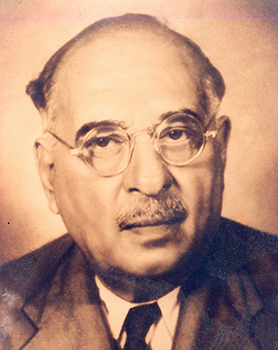
Ardeshir Irani
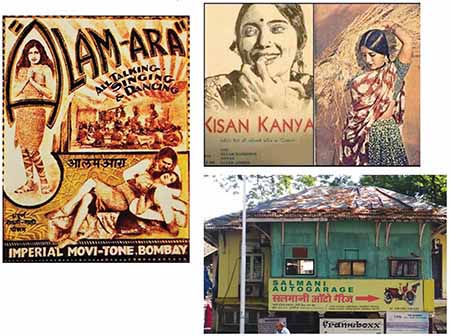
Clockwise from above: posters of Alam Ara, India’s first talkie movie;
Kisan Kanya, first color movie; green villa, former offices of the Imperial Film Company
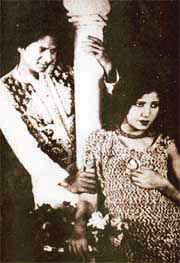
Master Vithal and Zubeida in Alam Ara Photo: Wikipedia
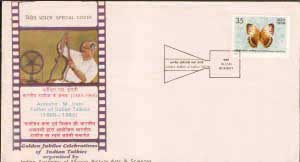
First day cover, 1981
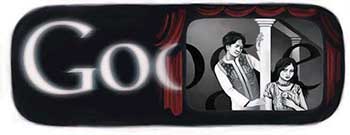
Google Doodle
"All talking, singing and dancing,” said the publicity material for Alam Ara, with no use of the word "film” or "cinema.” Advertisements for the March 14, 1931 release of the movie at Bombay’s Majestic Talkies only named the actors (Zubeida, Master Vithal, Prithviraj Kapoor … "and all star cast”) and listed the show timings and ticket prices for the "100% talkie picture.” There is no reference to Irani in the posters and advertisements of Alam Ara, Panjwani demonstrated in his presentation. A lot of what is written about Irani is not based on facts. "Various Internet sources state that he became ‘the India representative of (Hollywood’s) Universal Studios in 1905,’ but that cannot be accurate as Universal was founded only in 1912,” according to Panjwani. "Not much is known about his early life. How did a Poona-born lad find himself in Bombay at the J. J. School of Art at an early age?” he asked.
The speaker demonstrated, with video clips from Hollywood’s 1952 comedy Singing in the rain (portraying performers in the 1920s transitioning from silent films to talkies), the difficulties with sound synchronization, diction and placement of mikes that Irani would have had to contend with at his Imperial Studios.
The area where Imperial Studios stood is now generally known as Jyoti Studios, a rabbit warren of garages, iron welders and small businesses. A green, old-style building, now extended and built over, that once housed the offices of Irani’s company, stands at the foot of the Khan Bahadur Ardeshir Irani Bridge (previously Kennedy Bridge). A red brick, high roofed building that must have once been a studio are all that city history buffs say remain of the once thriving Imperial. "Irani kaun (who Irani)?” retorted a watchman at the premises when Parsiana asked him about the erstwhile movie man on April 8.
"Alam Ara had limited artistic value… it is not a work of art,” according to Panjwani. "A modern reviewer would give it three or three-and-a-half out of 10,” he said, narrating the story briefly: an aging king with two wives, a scheming queen, nomads, triumph of good over evil, and seven songs. Yet, a four-anna ticket sold for five or six rupees in the black market. "And they kept selling… it ran to houseful shows for several weeks.” Attempting to explain this, Panjwani said that the film was made in Hindustani, "it was their (audience’s) language… the actors sang and danced for them… it was a novelty.”
The movie "created a fever… the floodgates had opened… audiences in Lahore and Delhi were now within Irani’s reach.” Till then silent movies were largely based on Hindu mythological themes. "There were no gods in Alam Ara.” With the release of Irani’s movie, Arabian Nights-type fantasies became popular. Madan Theaters of Calcutta soon released Shirin Farhad, which also became a hit. Wadia Movietone went on to make several movies of this genre, said Panjwani, specifically naming Lal-e-Yaman, on the theme of humanism and social justice. The fantasy movies created an "Indian” cinema as different from "Hindu” cinema. "It may be awkward for established filmmakers to admit that these fantasy films became as popular as the Hindu mythologicals,” said Panjwani.
"We must remember that Irani was a recent migrant to India from Iran… Persian was his language,” said Panjwani. Internet Movie Database (IMDb) credits Irani with directing Dukhtar e Lur [Daughter of Lur (Lorestan province of Iran)] (see "First Persian talkie”) about how an abducted girl finds love in the wilds of Lorestan, but had to migrate with her lover to Bombay to escape the lawlessness there. The movie starred Abdolhussain Sepanta, who is also credited with the script. Known to be a "man of many tongues” (see "Ardeshir M. Irani: father of the Indian talkie,” Parsiana, March 1982, reprinted with permission from Fifty years of Indian Talkies published by the Indian Academy of Motion Pictures, Arts and Science, Bombay), Irani’s Imperial Studios made movies in Gujarati, Tamil, Urdu, Burmese, Malay and Pushtu among other languages.
"Action!”
Unraveling some of the cloud around Irani, Panjwani said that the filmmaker acquired his first movie hall (Alexandra) in 1914 from an Englishman who was going off to fight in World War I. "He learnt the basics of cinema by watching silent English movies at his movie hall which he rented out. Quoting from a published interview with Irani’s daughter Nergish Marazban, Panjwani narrated that she told her interviewer that winning a lottery of Rs 14,000 allowed him to set up a shop for musical instruments and also his Majestic Studios. "(He had) no inclination till then to venture into film production….now that he had the resources… he made his first movie Veer Abhimanyu,” said Panjwani. Noted writer, playwright and author Saddam Hassan Manto was engaged by Irani as a munshi (book keeper) and was credited with the script for Irani’s 1937 film Kisan Kanya, believed to be India’s first color film. "Maybe the others were not up to the mark,” surmised Panjwani.
Not a single print of Alam Ara remains. "It is as if he was robbed of his shadow,” says Panjwani of the filmmaker, who made his first film in 1922, and went to make 145 silent films before embarking on his talkie venture. IMDb credits Irani with only seven movies as director, four as producer, two as writer and one as cinematographer. "I don’t blame agencies like IMDb... No American film industry person is frankly bothered about aapro Ardeshir. He means nothing to them, he is culturally too far,” Panjwani’s wrote in an email to Parsiana, about the apparent discrepancy. "We Indians have such scant regard for the truth, especially historical truth... I am not saying I know the truth, I don’t. All I know are a few fragments of his life; the research on his life is in-process,” admits Panjwani.
Unraveling some of the cloud around Irani, Panjwani said that the filmmaker acquired his first movie hall (Alexandra) in 1914 from an Englishman who was going off to fight in World War I. "He learnt the basics of cinema by watching silent English movies at his movie hall which he rented out. Quoting from a published interview with Irani’s daughter Nergish Marazban, Panjwani narrated that she told her interviewer that winning a lottery of Rs 14,000 allowed him to set up a shop for musical instruments and also his Majestic Studios. "(He had) no inclination till then to venture into film production….now that he had the resources… he made his first movie Veer Abhimanyu,” said Panjwani. Noted writer, playwright and author Saddam Hassan Manto was engaged by Irani as a munshi (book keeper) and was credited with the script for Irani’s 1937 film Kisan Kanya, believed to be India’s first color film. "Maybe the others were not up to the mark,” surmised Panjwani.
Not a single print of Alam Ara remains. "It is as if he was robbed of his shadow,” says Panjwani of the filmmaker, who made his first film in 1922, and went to make 145 silent films before embarking on his talkie venture. IMDb credits Irani with only seven movies as director, four as producer, two as writer and one as cinematographer. "I don’t blame agencies like IMDb... No American film industry person is frankly bothered about aapro Ardeshir. He means nothing to them, he is culturally too far,” Panjwani’s wrote in an email to Parsiana, about the apparent discrepancy. "We Indians have such scant regard for the truth, especially historical truth... I am not saying I know the truth, I don’t. All I know are a few fragments of his life; the research on his life is in-process,” admits Panjwani.
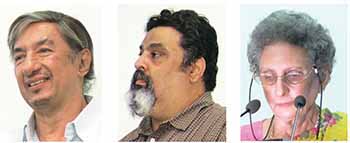
Above, from l: Dr Narendra Panjwani; Dr Kurush Dalal; Dr Nawaz Mody Photos: Farrokh Jijina
Why is the life of the man who spent "all his time in his studios” so under-documented? wondered Panjwani. "None of the films made by Irani have survived,” he said. Only two or three posters and stills remain. Irani finds no mention in either volume of H. D. Darukhanawala’s Parsi Lustre on Indian Soil. A special postal cover released by the postal department in December 1981 marks the golden jubilee of Irani’s talkie movie. In 2011, Google honored Irani with a Doodle (a temporary change in the logo on its home page) to mark the 80th year of the release of Alam Ara.
As Panjwani explained, "Had Irani not chosen a "unique mix of Urdu-ized Hindi as the language of his talking picture, Indian cinema as we have come to know it, may not have been born.”
The session at KRCOI was chaired by archeologist and food historian Dr Kurush Dalal who said that Panjwani’s "passion for the media hides his other accomplishments.” According to him, Panjwani, who has worked at The Times of India and The Independent, is interested in research in housing and security.
Dalal is soon to be inducted on the governing council of KRCOI. He says he has "fond memories of running around at the Institute” when accompanying his archeologist mother Dr Katy Dalal on her trips to the Institute. Joint honorary secretary of the Institute Dr Nawaz Mody had earlier welcomed the audience and proposed a vote of thanks.
"I chose the lyrics...”
A copy of an interview with Ardeshir Irani exists on "Sound cultures in Indian Cinema” the (on-line) media lab of Jadavpur University. Researcher Dr Narendra Panjwani made a reference to the interview, which Parsiana located on-line. Speaking to film historian the late B. D. Garga in 1949 and 1964, the visionary reveals snippets from the making of his path-breaking venture. Garga records that during the first interview, Rustom Bharucha, "a versatile lawyer who also managed (Irani’s) Imperial Studios” and who assisted Irani with recording the songs and dialogs of Alam Ara was also present. Irani admits to being inspired to make India’s first talking movie after watching Show Boat a "40% talkie” in 1929 at Excelsior Cinema. Irani revealed that Alam Ara was based on a popular stage play by "that doyen of Bombay dramatists Joseph David” who also adapted it for the screen. In the interview Irani laments about there being no soundproof studios in those days. "Microphones had to be hidden (in the studio) in incredible places to keep out of camera range,” he added. Finding the foreign sound technician too expensive ("he was charging Rs 100 per day”) Irani and Bharucha took it upon themselves to record the film. "I chose the lyrics and the tunes,” Irani told Garga. "We used only a harmonium and a tabla.”
"It was a very closely guarded secret” that Imperial Studios was making a talkie, Irani revealed, adding that the film was made at a cost of Rs 40,000 "thanks to the cooperation of the artists and technicians who shared my excitement at making the first Indian talkie.”
Gloating about the success of his talkie movie, Irani informed Garga that "almost all the songs were hits” especially "De de khuda ke naam pe, pyare (give in the name of God, dear one)” sung by W. M. Khan, who played a fakir in the movie.
Panjwani reveals that Irani was looking for a person with a "booming bass voice,” and zeroed in on Khan who was a pathan (security guard) in a building near Imperial and had walked in to view the shooting of Alam Ara.
A copy of an interview with Ardeshir Irani exists on "Sound cultures in Indian Cinema” the (on-line) media lab of Jadavpur University. Researcher Dr Narendra Panjwani made a reference to the interview, which Parsiana located on-line. Speaking to film historian the late B. D. Garga in 1949 and 1964, the visionary reveals snippets from the making of his path-breaking venture. Garga records that during the first interview, Rustom Bharucha, "a versatile lawyer who also managed (Irani’s) Imperial Studios” and who assisted Irani with recording the songs and dialogs of Alam Ara was also present. Irani admits to being inspired to make India’s first talking movie after watching Show Boat a "40% talkie” in 1929 at Excelsior Cinema. Irani revealed that Alam Ara was based on a popular stage play by "that doyen of Bombay dramatists Joseph David” who also adapted it for the screen. In the interview Irani laments about there being no soundproof studios in those days. "Microphones had to be hidden (in the studio) in incredible places to keep out of camera range,” he added. Finding the foreign sound technician too expensive ("he was charging Rs 100 per day”) Irani and Bharucha took it upon themselves to record the film. "I chose the lyrics and the tunes,” Irani told Garga. "We used only a harmonium and a tabla.”
"It was a very closely guarded secret” that Imperial Studios was making a talkie, Irani revealed, adding that the film was made at a cost of Rs 40,000 "thanks to the cooperation of the artists and technicians who shared my excitement at making the first Indian talkie.”
Gloating about the success of his talkie movie, Irani informed Garga that "almost all the songs were hits” especially "De de khuda ke naam pe, pyare (give in the name of God, dear one)” sung by W. M. Khan, who played a fakir in the movie.
Panjwani reveals that Irani was looking for a person with a "booming bass voice,” and zeroed in on Khan who was a pathan (security guard) in a building near Imperial and had walked in to view the shooting of Alam Ara.
First Persian talkie
In response to Parsiana’s queries, Ranjita Ganesan, a masters student at the School for Oriental and Asian Studies, who is researching Indo-Iranian collaborations in the early years of cinema, recalls how the first Persian talkie Dukhtar e Lur (poster pictured) saw the light of day thanks to Ardeshir Irani.
Abdolhossein Sepanta, who went on to act in the film, was a young poet and writer who had travelled to Bombay from Tehran in 1927 with a desire to learn more about the Zoroastrian history of Iran. "He was soon employed with one Dinshah Irani, writing and translating works for the Iran League. He later met and studied with scholar Bahramgore Tahmuras Anklesaria who motivated him to join cinema and introduced him to the prolific Ardeshir Irani,” notes Ganesan.
"Ardeshir’s Imperial Film Comapny had been in the course of producing Daku ki Ladki,” she informed Parsiana. Sepanta is quoted as having written in his memoirs that "Seeing the film, plus the friendship between my employer (Dinshah) and Ardeshir Irani gave me the perfect opportunity to interest Ardeshir in producing a film in Persian language. Within a short time he decided to do so.”Ardeshir, whom Sepanta described as an excellent film editor, offered technical advice to the young Iranian, including some books on script writing, directing, and editing. Together, the two convinced Roohangiz Saminejad, the wife of an Iranian staff driver at Imperial Films, to take on the lead role during a time when no Iranian women wished to appear on screen. Sepanta played the male lead himself.
"Dukhtar e Lur became the first Persian-language talkie feature. With Sepanta advising on matters of Iranian settings and ethnic nuances, the film was shot in Chembur by cinematographers Rostam Irani and A. D. Irani. Given the technical quality of the film and its Iranian theme, the release was a success in Iran as well as in Bombay” she said.
"It was made largely in praise of the then government of Reza Shah,” added the scholar. "Because its plot, which attempted to highlight advances made by Reza Shah, Dukhtar e Lur even had an alternate title Iran of yesterday and Iran of today,” indicated Ganesan.
In response to Parsiana’s queries, Ranjita Ganesan, a masters student at the School for Oriental and Asian Studies, who is researching Indo-Iranian collaborations in the early years of cinema, recalls how the first Persian talkie Dukhtar e Lur (poster pictured) saw the light of day thanks to Ardeshir Irani.
Abdolhossein Sepanta, who went on to act in the film, was a young poet and writer who had travelled to Bombay from Tehran in 1927 with a desire to learn more about the Zoroastrian history of Iran. "He was soon employed with one Dinshah Irani, writing and translating works for the Iran League. He later met and studied with scholar Bahramgore Tahmuras Anklesaria who motivated him to join cinema and introduced him to the prolific Ardeshir Irani,” notes Ganesan.
"Ardeshir’s Imperial Film Comapny had been in the course of producing Daku ki Ladki,” she informed Parsiana. Sepanta is quoted as having written in his memoirs that "Seeing the film, plus the friendship between my employer (Dinshah) and Ardeshir Irani gave me the perfect opportunity to interest Ardeshir in producing a film in Persian language. Within a short time he decided to do so.”Ardeshir, whom Sepanta described as an excellent film editor, offered technical advice to the young Iranian, including some books on script writing, directing, and editing. Together, the two convinced Roohangiz Saminejad, the wife of an Iranian staff driver at Imperial Films, to take on the lead role during a time when no Iranian women wished to appear on screen. Sepanta played the male lead himself.
"Dukhtar e Lur became the first Persian-language talkie feature. With Sepanta advising on matters of Iranian settings and ethnic nuances, the film was shot in Chembur by cinematographers Rostam Irani and A. D. Irani. Given the technical quality of the film and its Iranian theme, the release was a success in Iran as well as in Bombay” she said.
"It was made largely in praise of the then government of Reza Shah,” added the scholar. "Because its plot, which attempted to highlight advances made by Reza Shah, Dukhtar e Lur even had an alternate title Iran of yesterday and Iran of today,” indicated Ganesan.
◆ ◆ ◆
From the archive