
Comment
Women with drive
Permitting women to drive in Saudi Arabia is a welcome reform, but it has its challenges
Saudi Arabia’s decision to end its long-standing ban on women drivers by June 2018 is a small step for the kingdom but a giant leap for Saudi society.
King Salman bin Abdulaziz Al Saud’s decree made headlines the world over, sending supporters, critics, cynics and car dealers into overdrive. Although the consensus is that the royal decision — with the blessings of the senior clerics — is a long overdue move in the right direction, it is not going to be a smooth ride for Saudi women. In a male-dominated and patriarchal society, the paradigm shift — to permit women to be independent — will have to come from Saudi men.
King Salman bin Abdulaziz Al Saud’s decree made headlines the world over, sending supporters, critics, cynics and car dealers into overdrive. Although the consensus is that the royal decision — with the blessings of the senior clerics — is a long overdue move in the right direction, it is not going to be a smooth ride for Saudi women. In a male-dominated and patriarchal society, the paradigm shift — to permit women to be independent — will have to come from Saudi men.
The Saudi Arabian national emblem (Photo courtesy: Wikipedia)
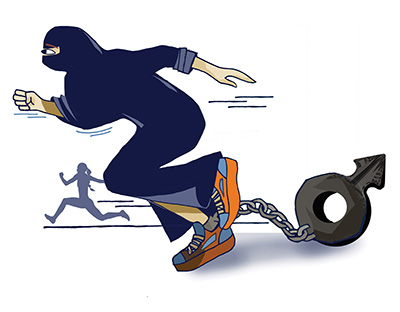
Illustration by Farzana Cooper
The kingdom’s notoriously slow and red tape-riddled bureaucracy will have its hands full in the run-up to June, as it gears up to tackle the logistical nightmare of millions of women applying for driver’s licenses. The government will have to hire thousands of women police officers to deal with women drivers and will also have to set up driving schools with qualified female instructors.
Having lived and worked in Saudi Arabia for 14 memorable years, I grew to love the country — warts and all. I moved to Dhahran, headquarters of the oil company Saudi Aramco, in October 2001, one month after 9/11, apprehensive and not knowing what to expect from a country that appeared to have a frighteningly long list of don’ts, where even simple pleasures were proscribed. Within the first few weeks, my fears vanished. The sprawling Saudi Aramco compound which houses the families of expatriate and Saudi employees is like a resort, with its own schools, restaurants, a movie theater, supermarkets, a golf course and stables for employees to house their Arabian horses. There is a strong sense of camaraderie among its residents, newcomers are warmly welcomed and women — Saudis and expats — are allowed to drive within the walls of the gated community. To go off camp, the company provides a fleet of "shopper’s buses” that ferry employees and their dependents to shopping malls and supermarkets in the nearby towns of Al-Khobar and Ad-Dammam in the mornings and evenings.
Within the Aramco compound and elsewhere, villas and bungalows are surrounded by high walls to prevent prying eyes peering at womenfolk. Most Saudi homes have a separate entrance for women, sitting rooms for men and women within the home are segregated, and entrances to ladies’ beauty parlours are as heavily gated and secured as bank vaults. There are separate waiting rooms for men and women in hospitals and other public places, and at weddings, the reception halls for men and women are set some distance apart: the women’s "enclosure” can only be accessed with a key card similar to the ones used in hotels. Once inside the ladies’ section, head scarves and ‘abayas’ are removed, revealing plunging necklines, strapless gowns and haute couture of the kind that graces the pages of Vogue. Taking photographs of this fashion parade and of the ladies letting their hair down is strictly prohibited.
My first job in Dhahran was teaching English as part of Saudi Aramco Schools’ adult education program. In every class, I was impressed by the ambition, determination and drive displayed by the girls and women. It is possible that they were more outspoken and comfortable with a female teacher than the male students, but they always seemed more motivated and forthright.
As happens with many expatriate women, I had a couple of run-ins with the dreaded mutawas or religious police, employees of the Committee for the Promotion of Virtue and the Prevention of Vice (CPVPV). These gentlemen patrol city streets on the lookout for anyone infringing the Saudi moral code (unrelated men and women cannot socialize) or dress protocol for women (full-length black abayas and head scarves covering the hair are mandatory), including expatriates. Gesticulating frantically, the mutawa asked me to cover my hair with my scarf. This happened only in the early years; I cannot recall any other contretemps with the religious police during the last 10 years of my stay. In 2016, the mission of the CPVPV was amended to "carrying out the duty of promoting virtue and preventing vice in a gentle and humane way.”
.jpg)
Manal al-Sharif, a women’s rights activist from Saudi Arabia who helped
start a right to drive campaign for women in 2011 Photo courtesy: Wikipedia
Over the years there were gradual but noticeable changes and signs of progress. Road signs which were previously mainly in Arabic began to be displayed in Arabic and English; vehicle license plates also changed from only Arabic to Arabic and English. In shopping malls, fewer Saudi women were wearing the niqab or full face covering. Their heavily made-up faces were uncovered, but their head scarves were always in place. It became common for groups of young girls and women — without their menfolk — to meet in the "family” section of coffee shops. There were also frequent sightings of single women, with only their laptops for company, dining in restaurants alone. This is something one takes for granted elsewhere in the world, but this was happening in Saudi Arabia!
More and more women were entering the workforce, and making rapid strides in their chosen fields. They were well educated, feisty and articulate. The department that I worked for was headed by a woman general manager, one of the first women to rise to that position in the company. In 2015, women were allowed to vote and to run for seats on the kingdom’s local councils. Saudi women were on the ascendant and there was no stopping them…
During my stay in the kingdom, we heard every now and again that the ban on women drivers was being lifted. A few years ago, it was rumored that the ban would end in a phased manner — only professional women, those who did not use makeup and those aged over 40 would be allowed to drive in the kingdom. We also heard with disbelief some of the arguments against women driving — it would lead to promiscuity and the collapse of the Saudi family. In December 2016, as the movement to lift the ban was gathering pace, an official report by Prof Kamal Subhi to the Shoura Council stated that lifting the ban would cause prostitution, pornography, homosexuality, divorce and the "end of virginity.”
Chauvinism will not be the only challenge facing women drivers hitting the streets of Saudi Arabia this June. The kingdom has an alarmingly high traffic accident rate, and drivers routinely disregard speed limits, use the hard shoulder as the fastest lane on the road and show very little courtesy to other motorists. The road accident statistics for the kingdom are grim. Citing data from the General Authority for Statistics and the Ministry of Municipal and Rural Affairs, a report in Arab News says: "Car accidents in 2016 killed 9,031 people…with an average of over 25 deaths a day and one death an hour.”
Refresher courses for drivers who are currently a menace on the streets, well-qualified driving instructors, education for new drivers and stricter driving tests need to be introduced immediately to make Saudi roads safer. Traffic rules also need to be enforced more strictly. Traffic policemen lolling in their cars and talking on their cell phones are a common sight at intersections at which motorists are breaking every rule in the book within a few yards of the police car. To its credit, the government has taken steps to curb speeding by installing speed traps and cameras on major thoroughfares but a lot of bad driving goes unpunished because of the offender’s wasta (clout). Gulf Traffic Week is an annual event throughout the region during which the mangled remains of cars and SUVs involved in fatal accidents are displayed at street corners in an attempt to shock motorists into driving carefully.
The decision to let women drive has sent more tremors through Saudi society than the shock tactics used during Traffic Week. One can only hope that good sense and practicality will prevail over chauvinism as the women drivers of Saudi Arabia start their engines.
Excerpted from an article originally published in Asian Conversations online magazine — http://www.asianconversations.com
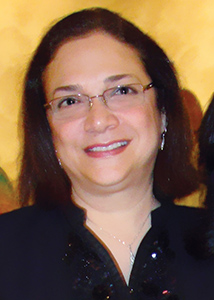 Delshad Karanjia’s journalistic career has spanned newspapers, radio and television. She has also taught English and worked as a writer/editor in Saudi Arabia. Now settled in Poona, she continues to edit books, write and teach.
◆ ◆ ◆
From the archive