
The outsiders
The term Parsipanu is often a euphuism for racism
"You knew what you were getting into.”
"A child inherits his father’s name and religion, not his mother’s.”
"Women with non-Parsi spouses will have their kids navjoted only to avail of housing and monetary benefits from our wealthy community trusts.”
"Our religion does not allow intermarriage or conversion.”
"Recognising the children of intermarried Parsi men was a mistake, and recognising those of women will be another one. Two wrongs don’t make a right.”
I am a Parsi woman married to the son of a Parsi mother and a Sindhi father. Had his father been a Parsi and his mother from another community, he would be considered Parsi.
We have a delightful four-year-old son, whose brown hair and light eyes are living proof of his part-Iranian heritage, but sadly, he is not recognized as Parsi as per the existing case law and our skewed customs.
My husband Rishi was brought up in a colony with Parsi friends and family. His second-class status, a consequence of not being on the right side of the fence, has resulted in his facing discrimination all his life.
"I actually did my best to keep him away from Parsis,” my mother-in-law often tells me. "I never wanted him to have to go through what he did at the hands of some narrow-minded people. Unfortunately, he had a lot in common with Parsi kids and inevitably ended up as just another colony kid himself.”
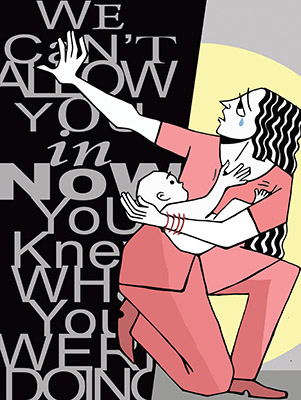
Illustration by Farzana Cooper
Rishi has never been allowed into a fire temple alongside his mother to offer prayers, nor has he been navjoted — he played sports year-round with his friends, but sat on the benches when community tournaments were played. Some well-intentioned mates sometimes let him play in weaker teams that were soon eliminated. Cricket and volleyball were his forte, but he was never allowed to play to the best of his abilities.
His surname — Kishnani — has usually been concealed on entry forms as though it were a dirty word. "We don’t want Guptas, Kumars and Shahanis in our baugs and colonies,” is a statement you often hear. It’s ironic when these declarations are made by Desais, Patels, Kapadias, Dalals, Khans, Nicholsons and Chowdhrys. Where have your surnames come from? I ask them. Iran? No response.
The Ripon Club has spent years dithering over whether Parsi women should be offered full-fledged Club membership, as opposed to the associate membership status they have so far been accorded. Those opposing their entry claim non-Parsi husbands of inter-married Parsi women will take over the institution and its administration. Curiously, all the non-Parsi women who have been frequenting Ripon all these years with their Parsi spouses are not perceived as a threat (because they cannot attend annual general meetings and cannot vote).
Even more ludicrous rules apply at the Dadar Parsee Gymkhana, of which I am a member: the children of male club members are of course accepted, but those of intermarried women can frequent the premises until the age of five. After that, they have to limit their visits to four times a month. So I’m supposed to explain to my son a year from now that he’ll have to bow out gracefully, leaving behind his friends and the playground that he so loves.
Traditionalist Parsis bar women from places of worship, from the funerals of parents, socially ostracize them, treat their children and spouses like outcasts and justify all of these dire moral transgressions in the name of religion and tradition.
The phrase used to justify their blatant racism is the preservation of ‘Parsipanu.’
"If we give these women what they want, it will be the end of our Parsipanu!” Mothers, daughters, sisters, wives — we are all reduced to a collective and contemptible "these women.”
Let me tell you about some of "these women.” Like my great-grand-aunt, who single-handedly hammered her son-in-law for domestic violence perpetrated against her long-suffering daughter. Or my grandmother, who was widowed at 39 and brought up three children and supported her aging parents alone. Or my own mother, the polestar of my life, who has been a pillar of strength ever since my father tragically lost his eyesight when I was only 15. I daresay that every one of "these women” had more strength in their individual capacity than all the Parsi males blustering with self-importance that I know.
If they believe that they are better than someone else due to biological differences, birth, or religion, they have no business being part of secular society.
I was born in a Zoroastrian family. Nobody has the right to take from me, or my child, what was not theirs to give in the first place. Parsi daughters are not inferior to sons.
"You knew what you were getting into.” Yes I did — a stable, happy marriage to a man who loves me and believes I am his equal in every possible way. That is why we have been together for nearly 18 years and counting.
"A child inherits his father’s name and religion, not his mother’s.” That isn’t your call to make, it’s his parents’. My child has inherited my religion, which also happens to be part of his father’s identity. Live with it.
"Women with non-Parsi spouses will have their kids navjoted only to avail of housing and monetary benefits from our wealthy community trusts.” My child’s faith is not to be determined by financial considerations; religion is not a commodity that you can refuse to sell me.
Also, stop talking about "our trusts” like you own them. My forefathers laid the foundation of the largest Zoroastrian residential enclave in the world, so don’t go talking like it’s your father’s money I’m after.
"Our religion does not allow intermarriage or conversion.” Yes, it does. Read our scriptures. There is a mountain of evidence to prove that this is a convenient deception. "The Zoroastrian religion not only permits but enjoins conversion,” stated the honorable Bombay High Court Justices Dinshaw Davar and Frank Beaman while outlining the legal definition of a Parsi a century ago.
My son is not a statistic. He is a well-behaved, kind-hearted child who makes his mother proud and prays to Dadaji just like every other young Parsi child his age. He whispers thanks to Ahura Mazda for his toys and his wonderful family, and dutifully touches his forehead to the feet of our venerable Prophet whenever he sees me do so. His innocence, like the innocence of all children, is a reflection of all that is pure and angelic in this world. What a shame indeed, that a community renowned for its generosity is struggling to accept him. To accept its own.
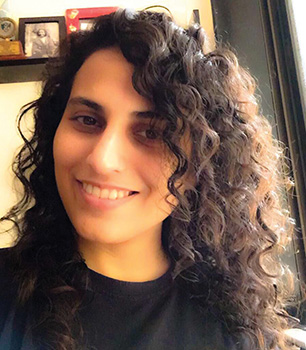 Sanaya Dalal was formerly a Features Editor with rediff.com. A Parsi married out of the community, she is currently lobbying for gender equality.
Change is coming in small doses. With the establishment of the New ARZ Dadgah in Poona acceptance will be far easier now. By the next generation all will be embraced.