
Events & Personalities
Explaining the faith
"I have always concerned myself with the community aspect of our lives as Parsis, not harboring much curiosity about religion at all,” states director Divya Cowasji, whose 15-minute documentary film Not just sugar in milk, made on behalf of the Ministry of Minority Affairs (MOMA) aims to explain the core of Zoroastrianism. The film was released at the Iranshah Udvada Utsav (IUU) in December 2017. Researching for this film was a learning experience for her, Cowasji told Parsiana in an email interview. "It was a revelation to learn how much of how we are as a people is because of what we have imbibed from our faith, whether we are aware of it or not.” The emphasis on ecological ethics "and its astounding relevance in the current day” is one that was particularly touching to the director.
Cowasji was selected by the ministry, "I think on the back of my earlier film Qissa-e Parsi (see "National award for Qissa,” Events and Personalities, Parsiana, June 7, 2015) and was then asked to make a presentation before MOMA officials and finally the minister of minority affairs Mukhtar Abbas Naqvi. I was informed of my selection shortly after.”
Cowasji was selected by the ministry, "I think on the back of my earlier film Qissa-e Parsi (see "National award for Qissa,” Events and Personalities, Parsiana, June 7, 2015) and was then asked to make a presentation before MOMA officials and finally the minister of minority affairs Mukhtar Abbas Naqvi. I was informed of my selection shortly after.”
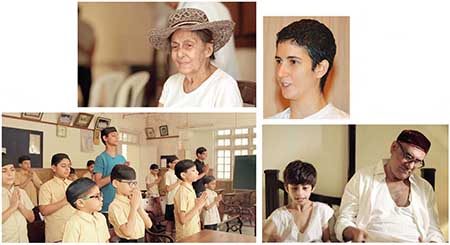
Clockwise from extreme right: Director Divya Cowasji; stills from her film Not just sugar in milk
The director states that research and scripting took upwards of a month-and-a-half, with the location study and shoot about a month. "We had decided to launch it at the IUU (see "Faith, fun and food,” Parsiana, January 7, 2018) so that was the deadline we had to work with.” The main challenge with the film "was the small amount of time I had to make it in, as well as the task of fitting a lot of information without making it feel rushed... dealing with actors and a crew of 20 people (when I’m used to just two) was quite a nerve wracking experience.”
Of actor Boman Irani, who plays the role of the grandfather narrating concepts of Zoroastrianism to his grandson played by Rustom Tirandaz, grandson of Bombay Parsi Punchayet trustee Armaity and her late husband Rustom, Cowasji states that working with the veteran actor "was such a dream... Irani was so gracious and easy to work with and really put me at ease...Working long hours with a child (Tirandaz) was also challenging but Rustom is such a gem... The chemistry between him and Boman was great.”
"How readily the community rallied around to help in whatever way that was required!” exults Cowasji. "People went above and beyond — whether it was opening their homes up to film in, or lending their services free of charge, or spending hours guiding me and taking me through their worlds.”
To have the film premiere in Udvada, "a place I love so much” was special for the director. She adds her reminiscences: "The first time I explored (Udvada) in earnest I was already an adult, on a cherished trip with my grandparents Minnie and Phiroze Illava, whose influence has been the primary reason for my sense of enquiry when it comes to our religion and community. That trip to Udvada was a time of firsts — the first time I had doodh na puff (frothy milk cups), boi (mullet fish), the delectable handmade mango ice cream they sell in the back of auto rickshaws that don’t really have anywhere to take people to; my first midnight prayers (in the Iranshah Atash Behram) that are ethereal to behold, a real sense of wonderment in who we are, excessive affection for this sleepy and crumbling town caught in time, and also the painful realization that I could not, in fact, speak Gujarati.” Cowasji’s parents Anahita and Zal reside in Mhow.
The director fills us in on her work after Qissa-e Parsi: "I spent a few months in New York as an Inlaks Scholar at the International Centre of Photography where I studied alternative techniques in photographic practices which I am currently trying to employ back home by starting my own darkroom and studio.” Stating that she is on "a bit of a hiatus” from making movies, Cowasji lets on that she has produced a short fiction film called Man of The House, directed by her brother Jall, "which was a great learning experience.”
Working within a governmental framework certainly has its ups and downs, states the filmmaker. "But in the end it’s a balancing act of give and take and working towards the best possible product that makes everyone happy,” she ends.
◆ ◆ ◆
From the archive