
Naoroji’s nerve
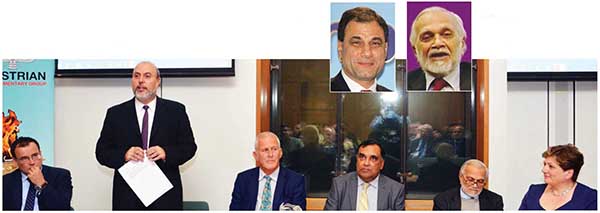
"Naoroji has been a hero of mine well before I joined Parliament. He was the first Indian parliamentarian in 1892,” reminded Bilimoria whose maiden speech as an Independent Crossbench Peer in the House of Lords was prefaced by the speech Naoroji first made in Parliament. To Bilimoria, the Grand Old Man of India "had an entrepreneurial spirit and I believe that entrepreneurs succeed because of guts. The guts to do it in the first place and the guts to carry on when others would give up. Naoroji carried on and persevered and succeeded and paved the way for us to be sitting here in this room right now 100 years after his death.” The fact that "Britain and India are now the fifth and sixth largest economies in the world, as great friends with a special relationship and a bright future together as two great nations and partners,” Bilimoria attributed to the seeds sowed by Naoroji.
Among the Indian parliamentarians currently in the British Parliament is Lord Bhikhu Parekh who also addressed the gathering that evening claiming "three bonds with Dadabhai.” They were born only a few miles from each other; Naoroji was a professor of Gujarati at the University College in London, a language that is Parekh’s mother tongue; Naoroji was dewan of the state of Baroda where Parekh was once vice chancellor of the Maharaja Sayajirao University.
In Parekh’s opinion, "Although not a great debater, Naoroji was skillful in marshalling arguments and presenting a strong case for his views.” Whilst critical of Britain for draining India’s wealth, he appreciated their values of fairness and justice. Naoroji was "one of the founding fathers of the liberal tradition in India, an alien and rather fragile implant, and did much to nourish it along with constitutionalism and Parliamentary democracy…Dadabhai’s legacy is considerable. The Congress party is one of them, secularism is another... He inspired both (Mahatma) Gandhi and (Mohammad Ali) Jinnah and saw India’s major communities with an impartial eye… He set a great example of rectitude and hard work.”
Providing Parsiana the highlights of the meet, ZTFE president Malcolm Deboo commented, "It was a full house! Even the Indian Parliament did not have a similar event.” The co-chairs for the event were Gordon Marsden MP, chairman of the History of Parliament Trust, and Gareth Thomas MP, co-chair of ZAPPG. Others who participated in the deliberations were Lord Nick Bourne, under secretary of State at the Department of Communities and Local Government, Emily Thornberry MP and shadow foreign secretary, Yashvardhan Kumar Sinha, High Commissioner of India, and Dr Vikram Visana, historian, University of Edinburgh.
Dr Kusoom Vadgama, co-chair of the Indo-British Heritage Trust and author of India in Britain (1852-1947) penned an article, "The Grand Old Man of India” for The House Magazine, September 15, 2017, extracts from which are printed with her permission:
Among Naoroji’s supporters were "His Royal Highness the Gaekwad of Baroda whose 20 carriages helped the voters to travel to the polling stations. After his victory, Naoroji wrote a letter of thanks to the electorate of Finsbury Central: ‘You have, in electing me generously and nobly, helped India to obtain a voice in the Imperial Parliament. I promised that, if elected, the interests of Clerkenwell will always receive my first and principal consideration. That promise shall be, by me, faithfully performed.’
"The news of Naoroji’s election victory was received with mixed feelings. It took India by storm with a school holiday and a public meeting in the Bombay Town Hall. A public meeting and a banquet was organized by Indians in England.
"In contrast, the greatest displeasure came from the Prime Minister, Lord Salisbury, who called Naoroji a ‘black man’ and doubted his competence. His racist remark did not go without a cautionary remark by Queen Victoria. For William Gladstone, the leader of the opposition, and Florence Nightingale, the victory was a ‘great satisfaction.’
"The Pall Mall Gazette called it an ‘epoch in our political evolution’ adding that, to Lord Salisbury, Naoroji’s election would ‘be somewhat of a mortification.’ For the panic stricken Bristol Times, it was an odd choice. The paper asked: ‘Is Mr Naoroji supposed to represent our Eastern Empire or Finsbury? If Mr Gladstone’s policy is carried out to its logical conclusions, we may wake up one morning to find that the English members are in minority in the Imperial Parliament and that we are legislated by our former dependencies.’
"The Bradford Observer reported that ‘the election has contributed some new members of distinction. The first and foremost is Lord Salisbury’s ‘black man,’ Mr Naoroji, whose skin, as a matter of fact, is as white as Lord Salisbury’s. He is the first Indian who has been elected to the House of Commons and his choice will give immense satisfaction through our Indian Empire.’
"In his maiden speech on August 9, 1892, Naoroji declared that his presence in the House of Commons was a unique event and hoped that ‘the connection between England and India may continue long with benefits to both the countries.’
"Naoroji refused knighthood twice as well as an honor from the Shah of Persia but humbly accepted the unofficial and affectionate title, ‘The Grand Old Man of India,’ bestowed upon him by the Indian National Congress. There is a Naoroji Road and there are two plaques in Finsbury to his memory. A portrait of his hangs at the entrance to the Visitors’ Gallery in Parliament.