
Cover Story
Political space
A trip to the British Parliament reviews past achievement and future needs
At the invitation of Gareth Thomas, Member of Parliament (MP) for Harrow West, a group of delegates attending the Eighth World Zoroastrian Congress in London visited the Mother of Parliaments as the august body is called. Small in comparison to the Lok Sabha in Delhi, the hallowed hall is packed with history, the larger than life statues of former prime ministers recalling the times of British glory when the flag of this small nation fluttered over half the world.
Eventually congregating in the appointed committee room, words of welcome and a brief genesis of Parliament were offered by Zoroastrian Trust Funds of Europe (ZTFE) trustee Noshir Avari in the absence of Thomas who, unfortunately for the Zarathushtis, had been called away for an important governmental meeting.
Avari mentioned how scrupulously the narrow strip of open floor in front of the Speaker’s chair in the House of Commons is honored according to Parliamentary tradition, as to step outside the lines limiting the governing party and the opposition amounts to "crossing the floor” in this house –– the only one in the world, according to Avari, which is rectangular in shape.
He traced events since the birth of the London association, coeval with the entry of Dadabhai Naoroji in Parliament as the first Asian MP on a Liberal ticket, and the efforts of the community through their British compatriots to help Manekji Limji Hataria alleviate the sufferings of Iranian Zoroastrians. These combined efforts had culminated in the withdrawal of the jazia tax which had decimated Iranian Zoroastrians economically, and thence, physically,
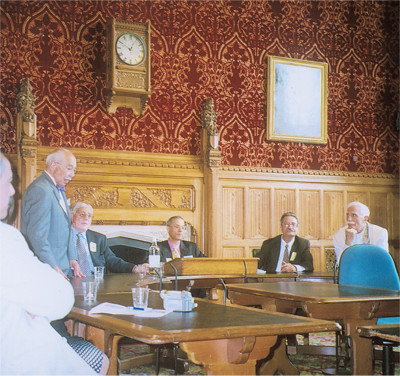
Above (from left) Mehr, Avari, Mistry, Dalal and Ervad Mehraban Firuzgary Photo: Arnavaz Mama
Referring to the vacuum in the history of the London community after the death of Muncherjee Bhownaggree, the second Zarathushti MP and the first Tory, Avari noted that a revival began only in the 1960s as new groups from East Africa, Aden, Iran and India saw a surge in the membership of the association. That was also the time when Dastur Sohrab Kutar established the Setayesh Gah, a dadgah fire which is lit as and when the occasion demands it.
Consistently plugging the need for unity, whether speaking formally or informally, Avari noted, "We Zoroastrians have to get back here (in Parliament). We have to rekindle the Zoroastrian spirit of good thoughts, good words, good deeds, contain the antagonism (within the community). Only then can we be power brokers.” He referred to ZTFE president Dorab Mistry’s attempts to bring the community to the notice of the authorities with timely letters and messages. "We need leaders who are articulate, professional. But first they have to be Zarathushtis.”
Professor emeritus of international relations at Boston University, Dr Farhang Mehr was circumspect in his comparison of the British Parliament and the Iranian Majlis as he was requested to do. He urged the gathering to "try to induce tolerance, ensure human rights and the protection of the environment,” in the spirit of Zarathushtra who was "the first person to speak of human rights,” referring to Cyrus the Great who put those concepts in practice, created the first charter of human rights, helped Jews rebuild their temple, as "the founder of federalism.” According to Mehr, Zarathushtis need greater recognition before they can be a force towards the elimination of discrimination everywhere in the world. "But for that we must be united. After all, all of us are members of one extended family!”
Himself a parliamentarian, Mobed Koroosh Niknam spoke of conditions in Iran. Life for the minorities functions around their religious roots, he said. A few months ago the minister of information had questioned why other countries were saying that Iran is not treating its minorities well. One response was that it was perhaps due to Muslims having problems in other parts of the world, he noted. The long and short of it was that the Islamic government has assigned 350 million tomans for the use of the minorities including Zarathushtis, he added.
Humbled "in these hallowed premises,” Bombay Parsi Punchayet (BPP) chairman and president of the Federation of Parsi Zoroastrian Anjumans of India Minoo Shroff referred to the high quality of debate and extent of tolerance for conflicting opinion in the British Parliament: "The Prime Minister may be heckled but political sense prevails.” Referring to the much larger Indian parliament, Shroff spoke of the need for at least two reserved seats for Parsis in its upper house, the Rajya Sabha. "We had refused reservations and said we can stand on our own feet. Now, other communities feel we need to be given reservation for all that has been done by the community. We must find political space.”
Surprising the delegates with the comment, "We have tried to model ourselves on the Jews,” Mistry noted that a community of 278,000 Jews in the UK has successfully sent in 51 as members of Parliament. "And they control half the City of London (London’s business district)!” interjected Avari.
Concluding the session, Congress vice chair Rusi Dalal explained how the committee rooms, like the one where the Zarathushtis then rested, comprise the "corridor of power.”
These committees comprise members of all parties, he noted. While the hereditary peerage has been abolished, the House of Lords now consists of peers appointed for life and though there are quite a few among them from the greater Indian community, there are so far no Zoroastrians among them. He depicted the ZTFE as having become a more outward looking body and participating in academic, religious, interfaith and social events with other communities since the centenary celebration of Naoroji’s advent into the House of Commons held about a decade ago.
Speaking of their respective political affinities, Mistry bantered, "Noshir (Avari) is a conservative, Rusi (Dalal) is a Liberal Democrat and therefore unlikely to ever be here, and I am with the winning side!”
◆ ◆ ◆
From the archive